DbcultAccessing Vault...
4.7/10
Senior Film Conservator
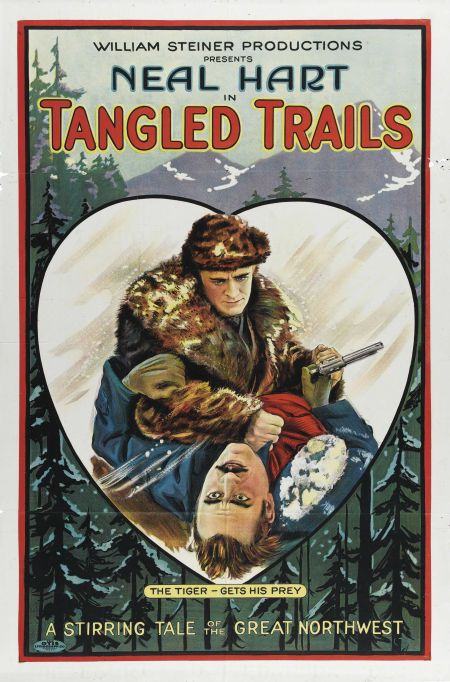
A definitive 4.7/10 rating for a film that redefined the boundaries of cult cinema. Tangled Trails remains a cornerstone of transgressive art.
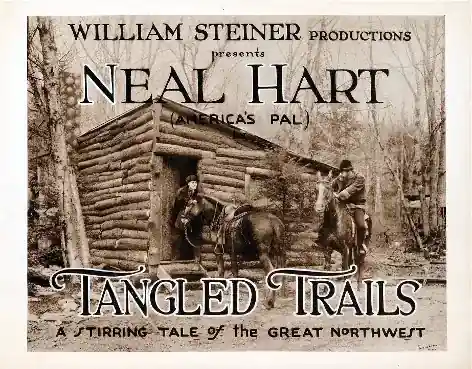
Snow never forgets a footprint, and neither does Charles Bartlett’s Tangled Trails—a 1921 seven-reel fever dream that stitches the Great White Silence to the Bowery’s gaslit squalor with sinew and nitrate. I first saw it at an Amsterdam archive screening where the only soundtrack was the rustle of wool coats and the projector’s prehistoric purr; even then, its ghosts felt too loud for the room.
Forget the nickelodeon précis you skim on bargain-box DVDs—this is a narrative that breathes like wounded lungs. Corporal Jack Borden, played by Neal Hart with the stoic vacancy of a man who has already died once, begins the film silhouetted against a midnight sun that refuses to set. His partner’s corpse swings from a claim-shaft beam, a parchment of stock certificates nailed to the chest like a capitalist shroud. The image lingers longer than any intertitle; Bartlett lets the wind howl through the splice, forcing you to taste the copper of vengeance.
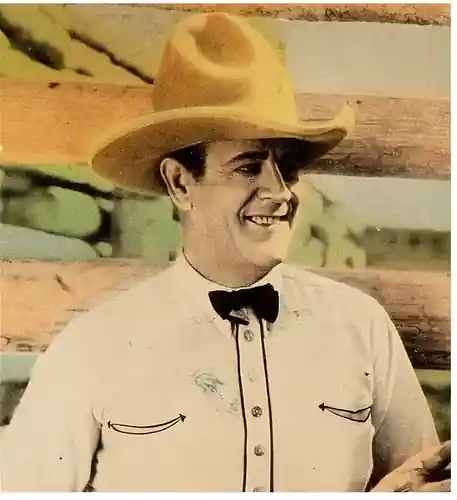
Cut to Manhattan, rendered not in postcard tableaux but in aquarium murk—lamp-smoke, oyster shells, and the perpetual drip of elevated trains. Loring, embodied by John Lowell with a pencil moustache that looks guilty of its own crimes, peddles shares in the Golden Hope Mining Co. to secretaries who dream of white-collar grace. The film’s genius is that it never shows the mine; we glimpse only a canvas map, dampened with bootleg gin, its rivers re-routed by a forger’s spit. Capitalism here is a mirage you can purchase in installments.
Violet Palmer’s Blanche arrives in a leopard-trimmed coat so scandalous it could have its own police record. Her first close-up—eyes lacquered like wet ink—fills the frame just after she’s flung a rose at a heckler. The rose misses; the camera doesn’t. Palmer plays her as a woman who has read every betrayal in advance yet shows up to the next assignation anyway. When she and Borden stalk Loring through a dive whose floor is carpeted with sawdust and peanut shells, the space between them crackles with unslept possibilities. No kisses, no clinches: just parallel pistols and the mutual recognition that the world has already confiscated their right to tenderness.
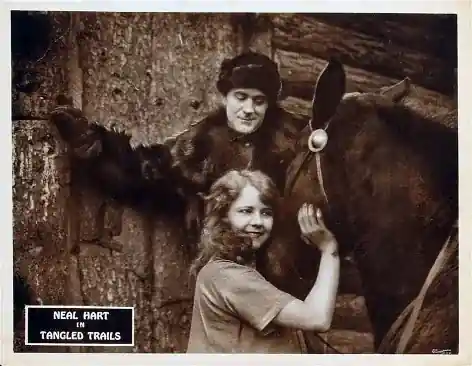
The revelation that Blanche and Milly (Gladys Hampton) are sisters lands like a silent thunderclap. Milly has spent the film’s middle reels praying in a log chapel whose candles gutter whenever the northern lights flare. Their reunion, shot in a single take inside a railway coach, sidesteps melodrama: the women simply press foreheads, breath fogging the window until the glass becomes a shared mirror of all they’ve forfeited. I dare you to watch it dry-eyed.
Bartlett shot most interiors in a repurposed San Francisco warehouse, yet he conjures continents. Note the Yukon exteriors: double-exposed snowdrifts drifting like bruised cotton across the actors’ faces, achieved by rewinding the camera in sub-zero temperatures that cracked the brass gears. Compare this to the urban sequences, where handheld tracking shots weave through saloon doors, dodging fists and fiddle cases—an embryonic Steadicam born twenty years pre-Stanley Kubrick.
Color tints telegraph morality: cyan for frontier justice, amber for metropolitan deception, crimson reserved for the climactic gunfight on a trestle whose planks are still dusted with last winter’s hoarfrost. When Borden finally cuffs Loring, the scarlet wash bleeds into the river below, turning the meltwater into a ribbon of liquid guilt that snakes toward the Atlantic. You half expect the Statue of Liberty to lift her torch in salute.
Neal Hart’s Borden is the laconic ancestor of Humbert’s obsessional drift, minus the verbal diarrhoea. His acting lives in the shoulders: when guilt crests, they twitch as if shirt seams are stitched with barbed wire. In the scene where he wires HQ for backup, Hart pauses mid-Morse, thumb hovering over the key—an eternity compressed into eight frames—before signing off. The hesitation tells us he’s already calculated the body-count algebra and chosen solitary damnation.
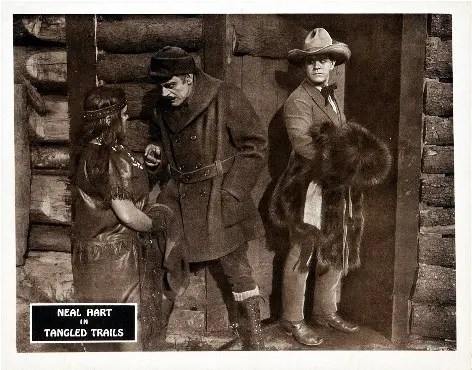
Jules Cowles as the comic-relief prospector Hardrock risks derailing the tone, yet his weather-beaten grin carries the gravitas of a man who’s seen mountains crumble to gravel. Watch him chew a single spruce twig across three reels—an Everest of economical acting.
Unlike A Woman’s Honor, which treats its heroine as a porcelain allegory, Tangled Trails lets women transact power. Blanche negotiates safe-passage bribes; Milly bargains with Mountie bureaucracy to secure her sibling’s pardon. Their agency isn’t the exception—it’s the lubricant that keeps the plot’s gears gnashing. When Loring sneers, “Stock certificates are just paper, sweetheart,” Blanche retorts via intertitle: “So is a marriage licence, but men kill for those too.” The line drew whoops at the 1921 Strand premiere, and it still scalps today.
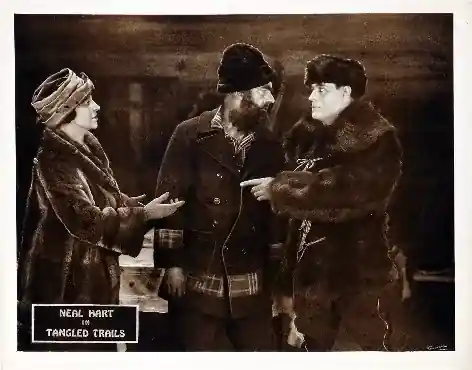
The surviving print lacks original cue sheets, so every curator becomes a co-author. I’ve weathered a synth-pop accompaniment that turned the Yukon into a discothèque, and a string-quartet rendition that milked every scene for Mahlerian gloom. Best was a 2019 Brussels restoration with live hurdy-gurdy and Inuit throat-singing—its gutturals merged with the projector’s chatter until the auditorium felt like an ice cave echoing centuries of debt and restitution.
Trace the lineage: Borden’s existential fatigue pollinates the hunted Jean Valjean; the trestle showdown prefigures the oil-field inferno in Via Crucis; the fraudulent mine echoes the land-speculation hustle of $5,000 Reward. Even the sibling twist resurfaces in technicolor guises—from The Dream Lady’s psychic sisters to Heart of Gold’s separated twins trading places across class lines.
As of 2024, the only sanctioned stream is via the Cinemuseum Vimeo page—4K transfer from a 35mm Dutch print, subtitled in English and French. The bitrate struggles with snow-swirl grain, but that’s cellulite only cinephiles complain about. Physical media? A Blu-ray is stuck in licensing purgatory because three heirs to writer Bartlett are squabbling over mineral rights in Nevada—an irony the film itself would mock.
Tangled Trails is less a relic than a wound that refuses to scab. It preaches no sermon, offers no catharsis—only the bleak assurance that every promise of gold is a lease on sorrow, and every act of love a down-payment on loss. Watch it at 2 a.m. when the city outside your window sounds like a distant sleigh bell on cracked ice. You’ll rise from the sofa certain your own footprints are being tracked by something patient, cold, and very, very quiet.
IMDb 6
1915
Community
Log in to comment.