DbcultAccessing Vault...
Cult Review
Senior Film Conservator
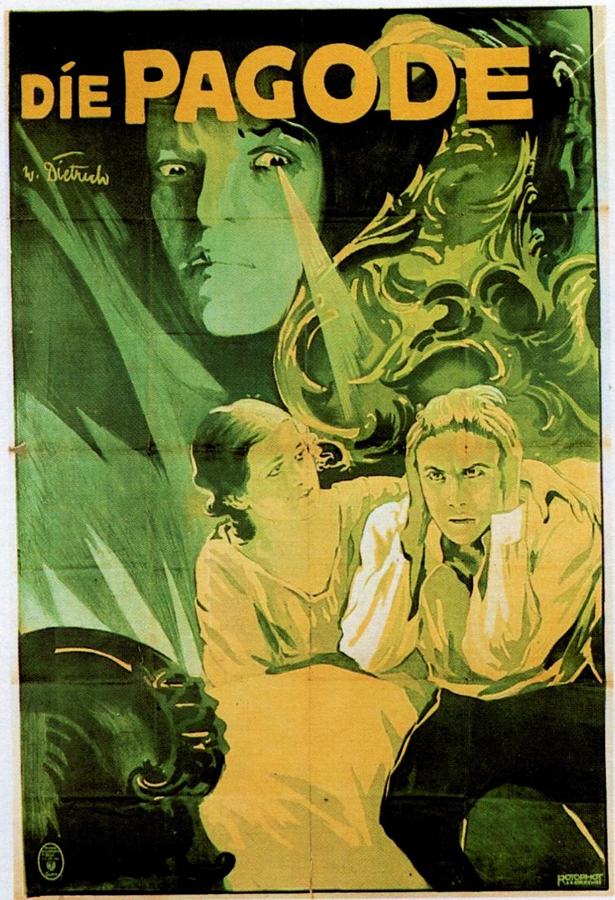
Stepping back into the hallowed, hushed halls of silent cinema, one occasionally unearths a forgotten gem, a film whose echoes resonate with surprising clarity across the chasm of a century. "Die Pagode" (1920) is precisely such a discovery, a cinematic tapestry woven with threads of exoticism, psychological tension, and a profound, albeit fictional, exploration of cultural collision. This German production, starring a triumvirate of the era's most compelling actors – Werner Krauss, Ernst Reicher, and Lupu Pick – stands as a testament to the evocative power of the moving image even before the advent of synchronized sound. It's a film that eschews simplistic narratives, instead plunging into the murky waters of human desire, spiritual reverence, and the indelible scars left by unchecked ambition.
The narrative unfurls with the arrival of Professor Albert Richter, an ethnographer whose academic pursuits quickly become entangled with a far more primal, almost spiritual, quest. Richter, portrayed with a nuanced blend of intellectual zeal and burgeoning fanaticism, is drawn to the mythical 'Dragon's Eye,' a sapphire of immense spiritual significance, rumored to be enshrined within the sacred Pagoda of Whispering Shadows in the fictional kingdom of Eldoria. His initial scientific curiosity, a seemingly benign desire to document and understand, soon curdles into an all-consuming obsession, mirroring the broader colonial appetites of the era. The film brilliantly uses Richter's personal journey to allegorize the Western world's often rapacious gaze upon the 'exotic' East, where cultural treasures were viewed less as sacred artifacts and more as objects of acquisition and study, ripe for the plucking. The pagoda itself becomes a character, an imposing edifice of ancient wisdom and impenetrable mystery, its very architecture a silent sentinel guarding secrets centuries old.
Werner Krauss, a titan of German Expressionist cinema, delivers a performance as the High Priest that is nothing short of mesmerizing. His portrayal is a masterclass in silent acting, conveying immense authority, ancient wisdom, and a simmering, righteous fury through subtle gestures, piercing stares, and a physical presence that dominates every frame he inhabits. Krauss's High Priest is not merely an antagonist but a guardian, a symbol of Eldoria's soul, fighting a desperate, losing battle against the encroaching tide of modernity and foreign intrusion. His eyes, often narrowed to slits, betray a deep sorrow for his people's inevitable fate, yet also a steely resolve to protect what remains sacred. The conflict between Richter's intellectual arrogance and the High Priest's spiritual conviction forms the very core of the film's dramatic tension, a clash of worldviews rendered with profound emotional weight. One cannot help but draw parallels to Krauss's other iconic roles, where he so often embodied figures of immense, often grotesque, power or tortured psyche, though here, his power is rooted in spiritual purity rather than malevolent intent, making his performance uniquely poignant.
Adding another layer to this intricate narrative is Ernst Reicher's Herr Kuno Berger, the astute German detective. Reicher, famous for his Das lebende Rätsel and other detective serials, brings a grounded, rational counterpoint to the film's more mystical and obsessive elements. Berger's arrival, prompted by the unexplained disappearances of European prospectors, injects a procedural element into the fantastical setting. His methodical investigation, a stark contrast to Richter's more impulsive pursuit, gradually uncovers the darker undercurrents of Eldoria's engagement with the West. Reicher's performance is characterized by a quiet intensity, his keen observational skills conveyed through a sharp gaze and deliberate movements, making him an anchor of logic in a world teetering on the brink of spiritual chaos. He represents the pragmatic, often cynical, face of Western power, less interested in spiritual artifacts than in the safety of his compatriots and the maintenance of order, however fragile.
Lupu Pick, another distinguished figure of early German cinema, portrays Master Li, the enigmatic local merchant. Pick's performance is a study in ambiguity. Master Li is a man caught between worlds, his loyalties constantly in flux. He navigates the treacherous waters between Eldorian traditions and the burgeoning opportunities (and dangers) presented by the European presence, his motivations shrouded in a veil of polite inscrutability. Is he a collaborator, a survivor, or a secret protector of his people? Pick imbues Li with a quiet dignity and a cunning intelligence, his subtle expressions hinting at depths of character and strategic maneuvering that are never fully revealed, keeping the audience perpetually guessing. This complex portrayal adds significant moral grey areas to the film, preventing it from devolving into a simplistic good-versus-evil dichotomy. The interactions between Li, Richter, and Berger are particularly rich, highlighting the misunderstandings and manipulations that characterize cross-cultural encounters.
Visually, "Die Pagode" is a triumph of early cinematic artistry. The set designs, particularly that of the pagoda itself, are breathtaking in their intricate detail and atmospheric grandeur. The use of light and shadow, a hallmark of German Expressionism, is employed with masterful precision, creating an oppressive sense of mystery and foreboding. Shadows stretch long and distorted, mirroring the moral ambiguity of the characters and the looming threat to Eldoria's spiritual heart. The camera work, though constrained by the technology of the era, is remarkably dynamic, often employing evocative close-ups to capture the raw emotions flickering across the actors' faces. The contrast between the sun-drenched, bustling marketplace and the gloom-shrouded, claustrophobic interiors of the pagoda effectively underscores the film's central themes of external intrusion versus internal sanctity. The visual language speaks volumes, conveying terror, reverence, and despair without a single spoken word.
The film's pacing is deliberate, building tension slowly but inexorably, allowing the audience to become fully immersed in Eldoria's exotic yet dangerous world. Each revelation, each step deeper into the pagoda's secrets, feels earned and impactful. The narrative, while seemingly straightforward in its quest for an artifact, is imbued with layers of allegorical meaning. It critiques the destructive nature of unchecked curiosity and the arrogance of cultural imposition, themes that remain acutely relevant even today. The film doesn't shy away from the tragic consequences of such encounters, culminating in a climactic confrontation within the pagoda's hallowed inner sanctum. This sequence is a masterclass in silent film dramatics, a furious ballet of desperation and defiance, where personal fates become inextricably linked with the destiny of an entire culture. The raw emotion conveyed by Krauss and Richter in this final act is palpable, leaving a lasting impression.
Comparing "Die Pagode" to other films of its era, one finds it stands apart in its unique blend of adventure, mystery, and profound cultural commentary. While films like Jeffries-Johnson World's Championship Boxing Contest offered glimpses into specific cultural events, and The Crisis delved into historical drama, "Die Pagode" ventures into more ethereal, spiritual territory. Its exploration of fate and the inexorable march of destiny finds a thematic kinship with a film like Destiny: or, the Soul of a Woman, though "Die Pagode" grounds its mysticism in a more tangible, socio-political context. The exotic setting might superficially connect it to films like Zigeuneren Raphael, but "Die Pagode" delves far deeper than mere spectacle, using its locale as a crucible for complex ethical dilemmas rather than simply a backdrop for romance or adventure. It's less about the 'otherness' for its own sake and more about the impact of the 'self' upon the 'other'.
The film's depiction of Eldorian culture, while filtered through a Western lens, attempts to imbue it with a sense of dignity and spiritual depth, rather than merely portraying it as primitive or savage. The High Priest's resistance is presented not as fanaticism but as a desperate struggle to preserve a way of life, a spiritual heritage under siege. This nuanced approach elevates "Die Pagode" beyond a simple adventure tale, transforming it into a poignant commentary on cultural preservation versus colonial ambition. The 'Dragon's Eye' is not just a jewel; it is the very soul of Eldoria, and its fate symbolizes the fate of indigenous cultures worldwide when confronted by external forces driven by greed and a lack of understanding. The film asks profound questions about who has the right to define and control cultural heritage, and at what cost. The silence of the film only amplifies these questions, forcing the audience to project their own understanding and empathy onto the screen.
The performances are a cornerstone of its enduring appeal. Krauss’s ability to convey profound emotion without dialogue is legendary, and here he is at his most potent, a force of nature channeling the ancient spirit of Eldoria. Reicher’s measured rationality provides a crucial foil, preventing the film from becoming overly melodramatic, while Pick’s subtle duplicity adds a vital layer of human complexity and moral ambiguity. Their collective artistry transforms what could have been a simplistic tale into a rich, multi-faceted drama. The interplay of their acting styles, from Krauss's grand theatricality to Reicher's understated realism, creates a dynamic tension that keeps the audience riveted. Each actor, in their own way, contributes to the film's overarching message about the fragility of peace and the destructive power of misunderstanding.
Ultimately, "Die Pagode" is a film that demands to be seen, not merely as a historical artifact, but as a vibrant piece of cinematic art that speaks to timeless themes. Its visual splendor, coupled with the compelling performances of its lead actors, creates an experience that is both intellectually stimulating and emotionally resonant. It is a powerful reminder of the silent era's capacity for profound storytelling and its often-overlooked ability to engage with complex socio-political issues. The film’s conclusion, while impactful, leaves a lingering sense of melancholy, a tacit acknowledgment that some wounds, once inflicted, can never truly heal. The final shots of the pagoda, scarred yet still standing, are emblematic of a culture's resilience even in the face of overwhelming adversity. This is not merely a film about a quest for a jewel; it is a meditation on the soul of a people and the enduring struggle for self-preservation in a world eager to consume and conquer.
In an age where cultural appropriation and the ethics of artifact collection are still hotly debated, "Die Pagode" serves as a remarkably prescient cinematic text. It foresees the long-term consequences of colonial attitudes and the often-irreversible damage inflicted upon indigenous spiritualities. The film's lasting power lies in its ability to transcend its immediate narrative, becoming a broader allegory for the clash of civilizations, a poignant lament for lost worlds, and a stark warning about the perils of unchecked human ambition. Its artistry lies not just in its visual composition or its compelling performances, but in its capacity to provoke thought and foster empathy across cultural divides. For those willing to delve into the rich tapestry of early German cinema, "Die Pagode" offers an unforgettable journey into the heart of darkness and the enduring light of resistance.
IMDb —
1921
Community
Log in to comment.