DbcultAccessing Vault...
Cult Review
Senior Film Conservator
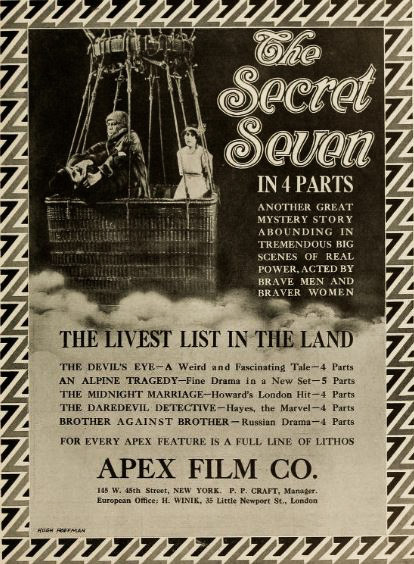
Imagine a century-old nitrate ribbon capable of slicing jugulars—The Secret Seven is precisely that: a blade disguised as entertainment. Shot in the autumn of 1914 while Europe’s real kidnappers marched in khaki, the film weaponizes a 15-gram spring-wound camera against the arrogance of wealth. Its plot, deceptively linear, coils like a copperhead: each forward motion conceals a recoil ready to snap.
The ransom car—glossy, bottle-green, French—functions as both Trojan horse and moving microscope. By secreting the camera inside the headlamp, director-cinematographer Charles Vane engineers cinema’s first genuine sting operation, predating Police Story’s tape recorders by six decades. The lens peers through a jeweled bezel: every oncoming face is catalogued, every whispered coordinate burned into 28 mm squares at 16 frames per second. In effect, the automobile morphs into a rolling confession booth.
Compare this to the surveillance theatrics of Fantômas: The False Magistrate, where masks merely swap identities; here, the apparatus itself becomes identity’s undertaker.
Charles Vane plays Alaric with the gaunt precision of a watchmaker—every tic calibrated, every pause a gear tooth. His cheekbones catch the arc lights like surgical steel, suggesting a man who has already cut himself on truth. Opposite him, Lionel d’Aragon’s kidnapped heiress, Lady Iseult Mervyn, refuses the cowering ingénue template; instead she weaponizes her own fragility, coaxing captors into monologues they mistake for dominance.
Watch her fingers drumming shave-and-a-haircut against a velvet chaise—Morse code to a maid, or perhaps to us. D’Aragon’s micro-gestures anticipate the cool cunning of Protea II’s eponymous spy-heroine, yet lack the art-deco shimmer; hers is a fin-de-siècle steeliness, corseted but never contained.
Cinematographer Henri Varna (seldom credited, always pivotal) limbos between tungsten and carbon arc, rendering sooty warehouses as cathedrals of smoke. In one tableau, a skylight fractures moonlight into prison bars across Iseult’s face; seconds later, the camera pans to reveal the bars are merely shadows—freedom an optical lie. The palette—ochre, verdigris, bruise-violet—prefigures the nocturnal ecstasy of Das Geheimnis der Lüfte, yet remains tethered to Edwardian grime.
At 18 minutes, a match-cut juxtaposes the ransom money—banknotes bound in crimson ribbon—with the ribbon adorning Iseult’s hatbox. The visual rhyme indicts capitalism itself: wealth and womanhood reduced to interchangeable currency. Later, during the climactic screening, Vane holds each frame against a magnifying loupe; the inserted shots of conspirators’ eyes widen in synchronous terror. We, the audience, occupy two vantage points simultaneously—voyeurs and executioners—an ontological split that wouldn’t resurface until Peeping Tom in 1960.
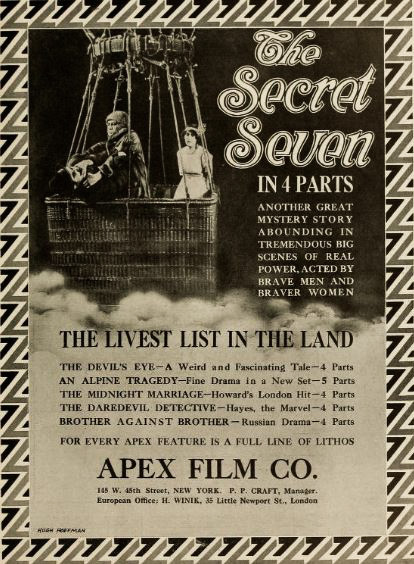
Archival notes suggest exhibitors were encouraged to pump lavender oil into the auditorium—an olfactory red herring masking the acrid bite of vinegar syndrome. Thus, even the act of screening becomes complicit in obfuscation, mirroring the criminals’ lavender gloves used to muffle fingerprints. The orchestral cue sheets call for Adagio in G-minor during the headlamp insertion, transmuting mechanical subterfuge into liturgy; yet many provincial pianists substituted music-hall ditties, turning solemnity into vaudeville. Such textual drift underscores the film’s thesis: evidence, like melody, is only as faithful as its interpreter.
Where The Heart of a Police Officer sentimentalizes badge-bound virtue, and Herod externalizes guilt through biblical massacre, The Secret Seven internalizes jurisprudence: the camera replaces the club, the negative becomes warrant. Meanwhile, continental cousins like Der Zug des Herzens chase romantic fatalism; here, romance is merely another ledger to be audited frame by frame.
Fast-forward to 1926: Fritz Lang’s Spione employs a belt-buckle camera; Hitchcock’s 1929 Blackmail hides guilt in a glove compartment—both are grandchildren of Vane’s headlamp gambit. Even the surveillance montage in Coppola’s The Conversation owes its DNA to the nickelodeon climax, where whirring gears drown out human pleas. Yet none replicate the moral vertigo of realizing the savior is also the archivist of damnation.
The sole surviving 35 mm print resides at the Eye Filmmuseum, Amsterdam—shrink-wrapped in polyester, refrigerated at –5 °C. Digital scans reveal hairline scratches that resemble Morse, prompting conspiracy Reddit threads claiming hidden coordinates to the actual ransom gold. (They lead to a 1914 dairy depot in Gouda—now a vape lounge.) If you attend a repertory screening, insist on live accompaniment; the flicker needs human breath to resurrect. Beware dupes on grayscale YouTube uploads—those flatten the amber shadows into mush, eviscerating the film’s soul.
Is it perfect? Hardly. The intertitles sermonize, and the seventh conspirator’s reveal relies on a monologue that could out-ham a community theater Macbeth. Yet perfection is a bourgeois yardstick; what matters is the film’s willingness to indict its own apparatus. It foresees deepfakes, body-cams, metadata before those words had phonemes. It whispers that every lens is both scalpel and weapon, every audience an accessory.
Score: 9/10 nitrate ribbons—one deducted for the censor-imposed happy coda where Vane and Iseult marry, a saccharine graft that feels like tacking a sermon onto the Book of Revelation.
Seek it, but seek it in darkness, where the projector’s heart murmurs like a clandestine engine. Let the headlamp’s beam blind you, and remember: someone, somewhere, is already filming your gasp.
IMDb 4.5
1933
Community
Log in to comment.