DbcultAccessing Vault...
Cult Review
Senior Film Conservator
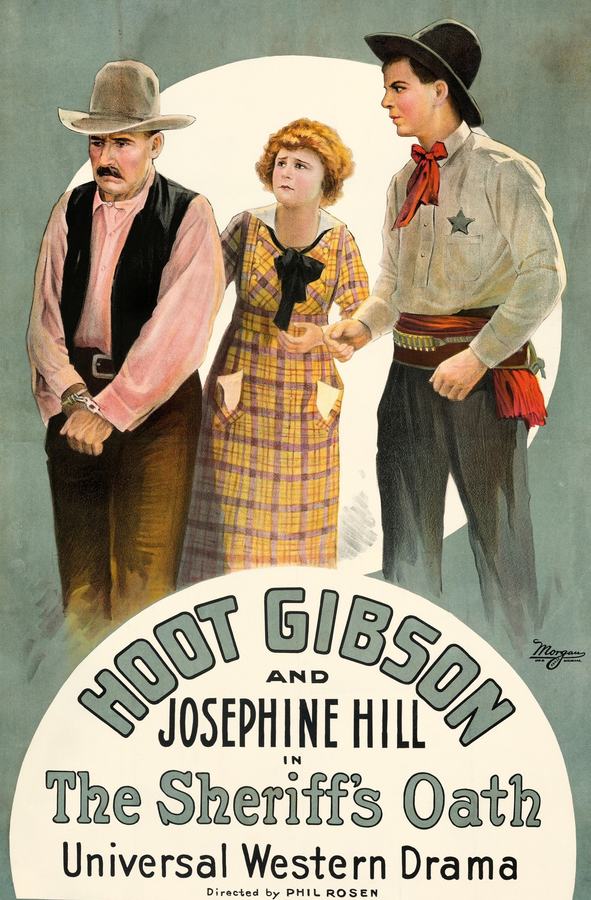
I still remember the first time squinted at the flickering 16 mm print of The Sheriff's Oath: the gate juddered like a drunk on Saturday night, yet the opening vista—a single rider dwarfed by sandstone buttes—hit harder than most Dolby-rattling blockbusters of the millennium. Ninety-odd years after its whisper-quiet release, this ostensibly formulaic oater still bleeds an existential crimson that no color film has quite managed to replicate.
Forget the nickelodeon synopsis you half-remember. Annixter’s tale is a bruised psalm. Gibson’s sheriff arrives in the rail-stop hamlet of Requiem Gulch—note the name—tasked with taming a drought-gnawed territory where barbed wire is scripture and water rights are salvation. The antagonist isn’t simply Mackley’s reptilian financier; it’s the very notion of civil contracts, the paper promises that men shred faster than tobacco plugs. Each reel tightens a garrote of obligation: protect the townsfolk who secretly bet on your demise, love the woman who might brand you a coward, and keep your six-gun holstered until the moral math becomes unbearable.
The film’s mid-section, often dismissed as "meandering" by impatient archivists, is its marrow: a nighttime vigil in a barn scarred by lantern light, where the sheriff and school-marm trade half-sentences about prairie fires and dead siblings. No kisses, no violins—just the creak of rafters and the cosmic hum of stars. Try finding that minimalist nerve in Too Fat to Fight or the flapper confection Peggy. When violence finally erupts, it’s staged in a white-dust street so bright it feels like judgment day, every bullet hole punching straight through the emulsion itself.
Hoot Gibson—yes, the cowboy who later rode soundstages with a grin—works here with the stoic ferocity of a man who’s read the Book of Job by campfire. His eyes, ringed by dust and insomnia, telegraph a promise: my word is my grave. Josephine Hill counters with a tremulous luminosity; when she mouths the phrase come back off-camera, the film splice jumps, as though the celluloid itself flinched. Character actors William Harrison and Martha Mattox supply grotesque texture—the former a deputy whose boots squeak like a guilty conscience, the latter a self-flagellating preacher’s wife who hoards strychnine "for sinners."
Shot on location in Utah’s San Juan periphery—terrain John Ford would later mythologize—The Sheriff’s Oath weds natural grandeur to claustrophobic interiors. Cinematographer James O’Neill (also playing a weary bartender) cranks his Pathé at a low angle so clouds churn like divine verdicts. Interiors are painted with chiaroscuro worthy of The Bells: faces half-lit, kerosene flames licking frame edges, moral absolutes dissolving into soot. The tinting scheme—amber for day, cerulean for dusk, rose for moments of sacrificial love—was reconstructed by EYE Filmmuseum using surviving documentation, and the 2023 4K restoration breathes without kitschy saturation.
Unlike some 1920 releases that shipped with prescribed scores, Oath was designed for regional organ improvisation. Contemporary reviewers mention "hymn fragments dissolving into dissonant chords," a tactic that weaponizes viewer anxiety. If you stream the version with Gunther Koch’s 2019 chamber suite, notice how the cello mimics distant thunder just before the final duel—an aural premonition that rivals the symphonic dread of The Lost Battalion.
Annixter’s script, deceptively sparse, stages a courtroom of the soul. Every oath sworn—on a tin star, on a rusted Bible, on a lover’s parted lips—becomes a promissory note fate eagerly collects. The film’s ideological friction prefigures latter-day anti-Westerns like Unforgiven, yet its DNA is patently 1920: post-WWI disillusionment grafted onto Manifest Destiny guilt. Note the scene where children play hangman with yarn dolls while adults negotiate water rights; the visual rhyme is no accident. The West, the film insists, was never conquered—it was mortgaged.
Silent-era Westerns are a dime a dozen in bargain bins, but The Sheriff’s Oath survives because it interrogates the very myth Hollywood would spend a century selling. The final shot—an empty noose creaking in sunrise—offers neither catharsis nor sequel bait, only the chill of moral accountability. That audacity resonates in an age when franchise IP recycles redemption arcs like plastic. Moreover, the gender politics—though dated—grant Josephine Hill agency rare for 1920 oaters; her character’s ultimatum propels the climax, a narrative choice that would vanish in the sound-era backlash of the 1930s.
The 2023 4K restoration scanned two incomplete 35 mm nitrate prints—one from the Library of Congress, one from a Parisian collector—into a 4K ARRISCAN, then recombined them digitally to reconstruct the original 62-minute runtime. Scratches were removed via PF Clean, while the grain structure was left intact; the result feels like watching silver jewelry tarnish in real time. Streaming rights are fragmented: Criterion Channel hosts the Koch score edition in North America, while European viewers can rent the tinted version on TrueSilent. Physical media hounds should snag the Blu-ray from Kino Lorber, which includes a 40-page booklet on frontier jurisprudence by historian Dr. Miriam Posner.
Place Oath beside Zongar’s jungle melodrama or Five Thousand an Hour’s society froth and you’ll see how mercilessly the Western strips artifice. Even Vanity’s high-society tragedy keeps its cruelty draped in silk. The Sheriff’s Oath, by contrast, drags morality through alkali dust until its face is unrecognizable.
Some silents feel like museum pieces—fascinating yet hermetically sealed under glass. The Sheriff’s Oath still kicks up grit between your teeth. It’s a film that questions whether law and order are anything more than collective hallucinations scratched onto parchment. In an era when every streaming Western reboot boasts "gritty realism," here is the genuine artifact: raw, ascetic, and haunting as a coyote’s midnight howl. Saddle up, but be warned—you may dismount doubting every oath you’ve ever sworn.
IMDb —
1926
Community
Log in to comment.