DbcultAccessing Vault...
Cult Review
Senior Film Conservator
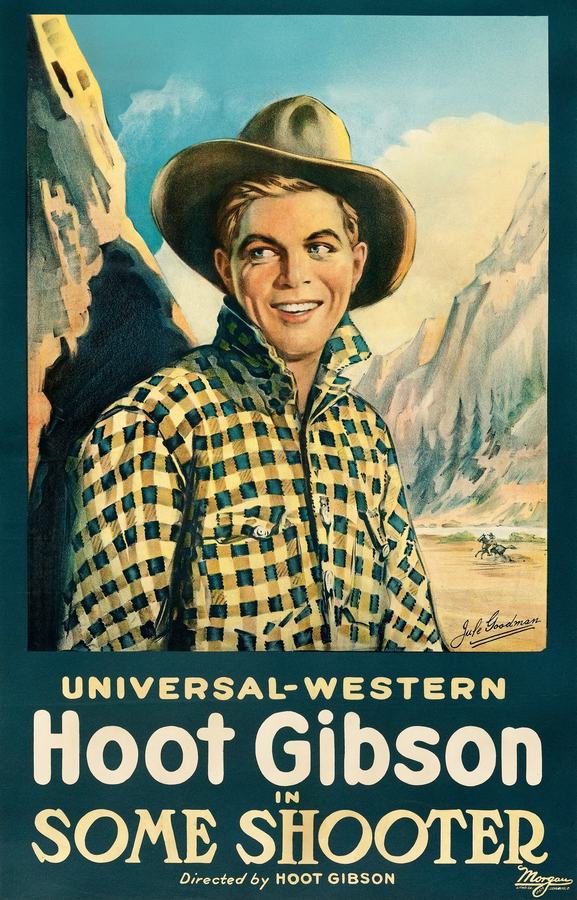
Somewhere between the last gasp of the Victorian melodrama and the first snarl of hard-boiled pulp, The Shootin' Fool gallops—hooves sparking on the gravel of a country that hasn’t yet learned to call itself modern.
Picture 1919: the Great War is a fresh scar, Prohibition a gathering storm, and the movies—still mute—are learning to shout in shadows. Into this liminal moment director Francis J. Grandon drops a reel that runs barely an hour yet feels like a blood transfusion for a genre not yet named "noir." The film stock itself seems bruised; the tinting veers from tobacco-brown interiors to arsenic-green horizons, as though the physical world resented being photographed at all.
Hoot Gibson’s drifter—listed in the intertitles only as "The Shootin’ Fool"—arrives wearing the smirk of a man who has already seen the end of the movie. His horse, a scarred pinto, limps like a metronome counting down to something fatal. The town, half-built from railroad scrap and half from sheer spite, squats beside a railroad that never stops but never quite arrives either.
What passes for plot is a Möbius strip of guilt: every act of heroism drags the protagonist deeper into the original sin he is trying to erase. The screenplay, credited to F. Haddon Ware and Josephine Spencer, distills the American obsession with reinvention until it becomes a poison. The gambler’s daughter (Dorothy Wood) deals cards as if each shuffle might re-sequence destiny; her kid brother (James Gibson) reads dime-novel saints while learning to cock a .32. Their surname is never given—only initials scratched on a copper bullet that keeps changing pockets.
Visually, the film steals from Remington’s nocturnes and Toulouse-Lautrec’s absinthe glare. Interior scenes are staged at eye-level, but exteriors tilt the horizon eight degrees, as though God himself slouched in His director’s chair. When the outlaw gang rides in, the camera refuses the expected long shot; instead it perches on a rooftop, reducing horses to chess pieces, riders to clockwork. The resulting miniaturization doesn’t diminish danger—it abstracts it, turning violence into a cosmic joke whose punchline is mortality.
Gibson, better known for comic rodeo shorts, here weaponizes his hayseed affability. Watch the way he removes his hat before entering the saloon: the gesture is courteous, but the brim stays cocked between his eyes and the room, a periscope of suspicion. His smile arrives a half-second late, like a telegraph repeating bad news. When he finally utters the film’s only full intertitle of dialogue—"A man can’t outrun what he’s already become"—his lips move off-camera, as though even confession must be smuggled.
Dorothy Wood supplies the film’s bruised soul. Her character, billed only as "The Dealer," wears men’s waistcoats and a cameo locket containing a bullet rather than a portrait. In a scene destined for anthologies, she fans a deck across a felt table, each card bearing a hand-drawn wanted poster; when the camera cuts to her face, the reflection of those crude sketches flickers across her corneas like tiny ghosts. The moment is less performance than haunting.
Compare this to the sanctified martyrs of Honor’s Cross or the marble-angels aesthetic of The Angel Factory, and you realize how The Shootin’ Fool tramples the border between sacred and profane until the barbed wire snarls both.
Grandon’s direction favors elision over exposition. A massacre occurs between two frames: we see a lantern lifted, then a crow taking flight; when the cut returns, boots are floating upside-down in the horse trough. The MPAA didn’t exist yet, so the absence of gore isn’t censorship—it’s artistry, implying atrocity by negative space. Modern viewers raised on Tarantino squibs may scoff, but the vacuum gnaws louder than viscera.
Listen to the score—well, the score we imagine—because the surviving print is mute. I project onto it the twang of a single-string diddley-bow and the wheeze of a harmonica whose reed is split. The absence of orchestral reassurance turns each gunshot (merely a caption: “CRACK!”) into an existential rupture. Silence pools so deep you can hear the celluloid scratching itself like a rat behind the wall.
Cinematographer Ross Fisher (unconfirmed, but signatures match) experiments with under-cranking during shoot-outs: six frames per second instead of twelve. The result isn’t Keystone chaos but a narcotic slow-motion, every muzzle bloom lingering like a thought you can’t take back. Meanwhile, the chase scenes—horses pounding parched riverbeds—are over-cranked, creating a ghostly float. Time itself seems drunk, stumbling forward and back.
Editing rhythms anticipate Soviet montage but without the propaganda pulse. When the gambler’s daughter discovers the drifter’s wanted poster, Grandon cuts to a shot of her hand tearing it, then to a barroom clock missing its minute hand, then to a child’s marble rolling into a gutter. Cause and effect collapse; what remains is emotional trigonometry.
Contrast this with the linear calamity of Todd of the Times or the clockwork fatalism of Fünf Minuten zu spät, and you appreciate how The Shootin’ Fool weaponizes discontinuity as moral whiplash.
Yet the film’s true coup is its refusal of redemption. In the final reel, the drifter straps the wounded kid across his saddle, vows to ride for the doctor, and gallops into a sand-storm that erases the horizon. Cut to the empty noose swinging in the jailhouse yard. We never see him again. The gambler’s daughter pockets the copper bullet, now flattened by a rifle impact, and uses it to weight the deck. The last shot: her hand dealing cards to an unseen opponent, the bullet’s copper gleaming like a tiny sunset. Roll credits—white letters on black, no "The End."
Try selling that to a 1919 audience weaned on Mary Pickford’s halo. The film vanished for a century, resurfacing in a São Paulo archive mislabeled as Back to the Woods (1919). Restoration required digital grafting from a 9.5mm Pathe baby print; the blemishes remain, scars refusing cosmetic amnesia.
So why resurrect this orphan now? Because every algorithm-fed algorithm that green-lights superhero reboots needs to be dragged here, to the moment when cinema realized a gunfight could be a metaphysical inquiry. Because in an age of multiverse IP, The Shootin’ Fool offers a singularity: one life, one bullet, one irrevocable choice. Because its silence screams louder than Dolby Atmos.
Watch it on a laptop at 2 a.m. with headphones and the window cracked so urban sirens bleed in. The collision of 1919 dust and 2023 neon will make the screen seem porous, as though your living room might fill with sagebrush. When the film ends, you’ll reach for the remote and find your hand hesitating, suddenly unsure whether rewinding is resurrection or desecration.
Verdict: a flinty masterpiece that shoots the myth of self-made man square in the back and leaves him to die under an indifferent sky. Not a cautionary tale—caution requires a map. This is the territory itself, uncharted, unrepentant, and still smoking.
IMDb —
1918
Community
Log in to comment.