DbcultAccessing Vault...
Cult Review
Senior Film Conservator
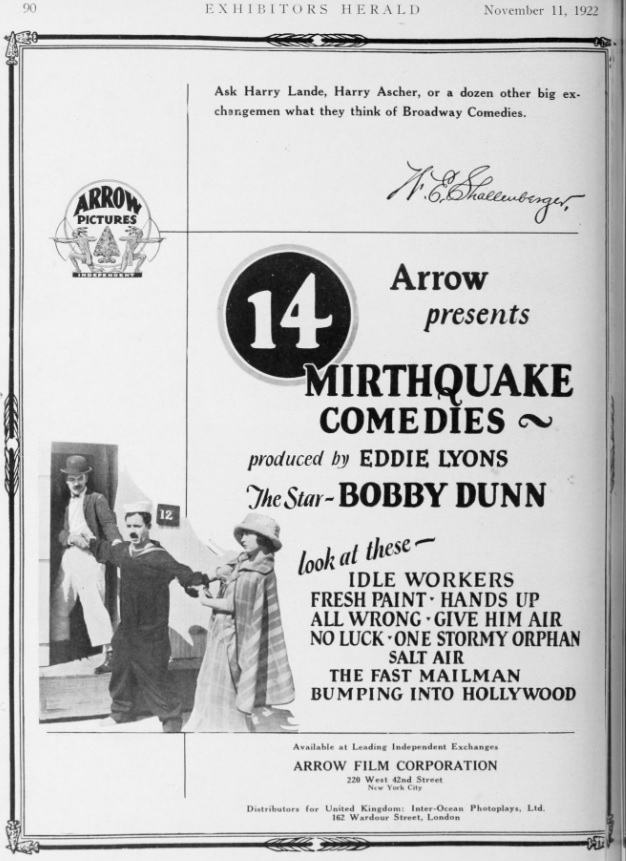
In the pantheon of silent-era slapstick, certain figures occupy the celestial heights—Chaplin, Keaton, Lloyd—while others, equally adept at the physical geometry of humor, linger in the fertile shadows of cinematic history. Bobby Dunn is one such figure, a performer whose rubber-limbed agility and expressive vulnerability find a perfect crucible in the Glen Lambert-penned Poor But Honest. This film is not merely a sequence of gags; it is a frantic, breathless exploration of the 'little man' archetype struggling against the rigid, often nonsensical structures of early 20th-century urban life. Unlike the more polished narratives of Sentimental Tommy, which sought a certain literary prestige, Poor But Honest revels in the visceral, the immediate, and the profoundly ridiculous.
The narrative ignition point is an act of unvarnished chivalry. Bobby, observing a damsel in distress within the churning currents of a watery grave, plunges in with a disregard for personal safety that borders on the existential. This rescue, however, does not yield the immediate social dividends one might expect. Instead, it serves as a catalyst for a fracas with the constabulary. Here, Lambert’s script deftly subverts the heroic trope. In a world reminiscent of the social frictions seen in The Grouch, Bobby’s altruism is misinterpreted as public disorder. The police, portrayed here as a monolithic and somewhat obtuse force of nature, become the primary antagonists, transforming a moment of grace into a protracted pursuit.
This initial conflict establishes the film's rhythmic pulse. The movement from the fluid, unpredictable environment of the river to the rigid, paved world of the city creates a visual dissonance that Dunn exploits through his physicality. His movements are a counterpoint to the stiff, rhythmic marching of the officers. It is a dance of evasion that predates the more complex social commentaries found in The Hun Within, yet it carries an equal weight of individualistic defiance.
Perhaps the most technically accomplished segment of the film occurs within the confines of a tailor’s shop. In an attempt to rectify their disheveled appearances—a necessity for maintaining the 'honesty' alluded to in the title—both Bobby and his pursuers converge upon this atelier. What follows is a masterclass in spatial comedy. The tailor shop becomes a labyrinth of fabric, measuring tapes, and mistaken identities. The mix-up of clothing is not merely a low-brow gag; it is an ontological crisis. In the 1920s, the suit was the man. By swapping garments, Bobby and the officers temporarily swap social roles, a theme explored with more gravity in His Official Fiancée, but here played for maximum kinetic energy.
The choreography in this scene is precise, almost mathematical. Dunn’s ability to navigate the narrow aisles while simultaneously evading detection and attempting to dress himself is a testament to his background in the L-KO and Keystone traditions. The humor is derived from the frustration of the mundane—the snagged sleeve, the mismatched button, the sudden appearance of a hand where a pocket should be. It is a reminder that in the world of Poor But Honest, the material world is just as much an enemy as the legal one.
As the chase intensifies, the film takes a detour into a darker, more atmospheric milieu: the tramp hotel. This setting provides a stark contrast to the bright, chaotic energy of the tailor shop. Here, the film flirts with elements that would later define the noir aesthetic. The shadows are longer, the faces more weathered, and the stakes feel suddenly, jarringly real. Bobby finds himself entangled with two hold-up men, a development that elevates the film beyond simple slapstick into the realm of the adventure-comedy, akin to the tonal shifts in Bullets and Brown Eyes.
The interaction with the criminals highlights Bobby’s inherent goodness—his 'honesty.' Even when surrounded by the desperate and the nefarious, he maintains a sort of holy-fool innocence. His escape from the hold-up men is not achieved through brute strength, but through a combination of serendipity and a desperate, fluttering ingenuity. This segment serves to ground the film, reminding the audience that Bobby’s poverty is not a whimsical aesthetic choice but a precarious condition that places him in constant proximity to danger. It echoes the social stakes of The Woman Pays, albeit through a much more comedic lens.
Just as Bobby manages to 'give them the slip,' the cycle of pursuit begins anew. The police, ever-present and ever-persistent, reappear to reclaim their role as his primary tormentors. This cyclical structure is essential to the film's philosophy. It suggests a Sisyphean struggle where the protagonist is never truly free, only momentarily unburdened. The mix-ups with the 'uniformed enemies' become increasingly absurd, pushing the boundaries of physical possibility. We see echoes of this relentless pacing in The Aero Nut, where the machinery of the world seems designed to frustrate human ambition.
Dunn’s performance in these final sequences reaches a fever pitch. His face, often a mask of bewildered determination, conveys a deep-seated exhaustion that resonates with anyone who has ever felt overwhelmed by systemic forces. Yet, he never loses his comedic timing. Even in the throes of a chase, he finds moments for small, character-driven flourishes—a quick adjustment of a hat, a momentary pause to observe a passing curiosity—that humanize him in a way that many of his contemporaries failed to do. He is more grounded than the character in Nimrod Ambrose, possessing a vulnerability that makes his eventual triumph feel earned rather than inevitable.
Despite the relentless pressure of the law and the underworld, the film concludes on a note of poignant romanticism. The final fade-out, showing Bobby arm in arm with the girl he rescued, is a powerful assertion of the human spirit. It suggests that while the structures of society—the police, the economy, the urban labyrinth—may be hostile, the individual can still find sanctuary in human connection. This ending is less about the resolution of his legal troubles and more about the victory of his heart. It is a sentiment mirrored in A Woman's Way, where personal loyalty outweighs social standing.
The girl, though primarily a catalyst for the action, represents the 'prize' for Bobby’s honesty. Her heart is won not through wealth or status, but through his unwavering, if clumsy, commitment to doing the right thing. In a cinematic landscape that often focused on grand historical narratives like Cuauhtémoc or moralistic dramas like Hygiene der Ehe, Poor But Honest stands as a vibrant, populist testament to the 'little man.' It acknowledges the reality of poverty while celebrating the possibility of integrity.
Reviewing Poor But Honest through a modern lens requires an appreciation for the constraints of its time. The film does not possess the technological polish of The Cowboy and the Lady, nor the psychological depth of The Man Who Forgot. However, what it lacks in budget, it more than makes up for in sheer, unadulterated energy. Glen Lambert’s writing provides a solid framework for Dunn’s improvisational genius, creating a work that feels as much like a live performance as a recorded one. It is a vital piece of the Bobby Dunn filmography, sitting comfortably alongside his other works like Bobby Comes Marching Home.
Ultimately, the film is a celebration of the 'honest' struggle. It doesn't promise that the world will stop chasing you, or that your clothes will ever fit quite right. It simply suggests that if you keep moving, keep dodging, and keep your heart open, you might just find someone to walk arm-in-arm with at the end of the day. For a silent comedy from the early 20th century, that is a remarkably profound, and enduringly human, message. It is a work of kinetic poetry that reminds us why we fell in love with the moving image in the first place: its ability to capture the chaotic, beautiful, and often hilarious essence of being alive.
"A masterclass in the geometry of the gag, Poor But Honest proves that heart and hilarity are the ultimate survival tools in a world designed to keep the little man down."
In the grand tapestry of film history, where we often focus on the epic and the avant-garde like La María, it is essential to return to these foundational comedies. They are the bedrock of visual storytelling, teaching us the language of movement, the rhythm of timing, and the enduring power of the underdog. Poor But Honest is not just a relic; it is a living, breathing example of the joy of cinema.
IMDb —
1927
Community
Log in to comment.