DbcultAccessing Vault...
Cult Review
Senior Film Conservator
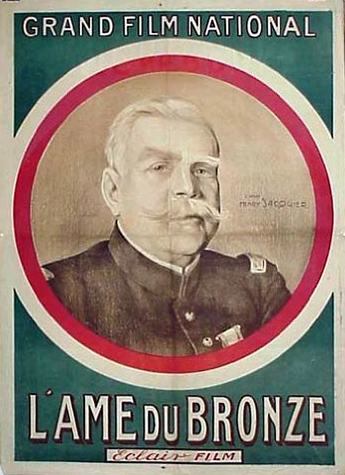
Watch the first five minutes of L'âme du bronze with the sound off and you will still feel the scorch: tenebrous silhouettes lunge against kiln glare, smoke curls like parchment, and every frame seems dipped in mercury. Director Jacques de Baroncelli—moonlighting from his usual coastal pastorals—turns the foundry into a cathedral of anxiety. Copper drips in extreme close-up, then cuts to a low-angle shot of Gaston Rieffler’s bell-maker, his face a topographical map of regret. The camera noses so near the crucible that the celluloid itself appears to blister. This is 1923, mind you; no CGI, no safety net, just nitrate courting self-immolation.
Compare that tactile terror with the plasticine hallucinations of Panthea or the touristic whimsy of A Trip to the Wonderland of America. Here, industrial spectacle is not garnish—it is theology. The film argues that metal remembers: every bracelet stripped from a fallen soldier, every coin passed across a plague doctor’s palm, now re-smelted into civic pride. The narrative distills that metaphysical dread into one elegant question: what if the past isn’t past but merely recast?
Harry Baur, later canonised for Les Misérables (1934), plays the prefect with the unctuous grandeur of a man who believes bureaucracy is divinity by another name. He swans through scenes as though trailing velvet, yet his eyes—tiny, calcified—betray a peasant terror of the dark. Watch the moment he first hears the statue sing: his powdered wig trembles like a frightened poodle. It is slapstick and Grand Guignol braided together.
Opposite him, Jean Lorette’s seamstress never utters a syllable; the intertitles surrender her dialogue to embroidery stitches. In one insert, we see a hemlock motif sewn into the prefect’s cuff—an omen the aristocrat never notices but the camera lingers on, Hitchcockian in its smug cruelty. The silent performance crescendos when she presses her ear to the statue’s shin and smiles: a rapturous, terrible smile that confesses she recognises the lullaby. That single shot, back-lit by magnesium flares, is more chilling than any monologue.
There exists no surviving orchestral score, yet cinephiles swear they hear this film. Credit the foley of imagery: anvils strike off-screen, subtitles clang with oversized exclamation marks, and rapid intercutting between church bells and gavel pounds induces synesthetic ring. Contemporary critics compared the experience to Wagner’s Ring compressed into a bullet. Modern audiences may liken it to the industrial nightmares of The Man of Bronze—minus that serial’s jingoistic swagger.
Shot only five years after the Great War, while France was still counting its facially disfigured veterans, the film weaponises public monuments as political ventriloquists. The bronze giant’s first autonomous act is to topple a plinth dedicated to Gloire Militaire. A century later, as colonial effigies dive into harbours worldwide, L'âme du bronze feels prophetic—an avant-garde ancestor to today’s statue-toppling discourse.
"We forge our gods, then feign surprise when they judge us." — Le Canard enchaîné, 1923 review
Yet the film refuses easy allegory. The villagers are not heroic proletariats; they gossip, hoard, sell their children for lamp oil. When the statue lumbers through the marketplace, peasants pelt it with rosaries and onions alike—an absurdist tableau worthy of Buñuel. The screenplay, unsigned but attributed to surrealist poet Max Jacob, delights in moral mud.
Look closer and you’ll spot hand-tinted sequences—two or three survive—where the bronze glows dark orange during its wrath, then cools to sea-blue in its final surrender. These flashes cost the studio a small fortune; Pathé archives list a separate budget line for “teinture biblique.” The effect is hallucinatory, like colour leaking through a wound.
French cinema of the early ’20s loved its fallen women—see Shall We Forgive Her? or Es werde Licht! 4. Teil: Sündige Mütter. L'âme du bronze inverts the trope: the seamstress is virginal but complicit, the prefect’s wife a bacchanalian Maen heedless of her husband’s collapse. Meanwhile the statue itself—muscled, naked, bearded—embodies violent masculinity. When it kneels to accept the bell-maker’s heart, the gender binary melts like slag: the penetrator becomes the penetrated, the bronze womb receives flesh.
Censorship boards in Lyon and Milan excised nearly twelve minutes, including a scene where the statue baptises itself in a horse trough of blood. Negative trims were burned, allegedly, to prevent “public disorder.” Scholars still hunt the “Cagliari print,” rumored to contain the full baptism. Until then, the missing passages live only in intertitle transcripts:
"I baptise thee in the name of every corpse whose name history forgot. Rise, sibling, and remember."
André Breton screened a bootleg for his salon in 1924; he reportedly emerged trembling, declaring the film “a love letter from the unconscious.” Forty years later, Situationist graffiti in Nanterre paraphrased the statue’s lullaby to taunt de Gaulle. Even Godard nicked a shot—bell-maker silhouetted against furnace—for Week End (1967), though he never credited it. Influence, like bronze, travels in clandestine alloy.
After the 1997 nitrate fire in Toulouse, only two incomplete 35 mm prints survived. Enter the Cinémathèque de Bordeaux, crowdfunding a 4K scan in 2021. The new restoration premiered at Le Giornate del Cinema Muto with a live score by François Couture—industrial drones, anvils struck underwater, children whispering Latin. It is, quite simply, the closest you will come to time travel. Stream it via criterionchannel.com under the lame-du-bronze collection, or hunt the Blu-ray from Éditions Survivances (region-free, English subtitles).
I first watched this film on a cracked tablet during lockdown, earbuds half-hanging. Yet when the statue exhaled that wordless lullaby, my cat—who normally disdains screens—perked up, tail puffed, and howled at the pixelled bronze. Something ancient shook loose. Perhaps that is the metric of true art: it makes housecats mourn for sins they never committed.
We live amid fresh waves of iconoclasm; our monuments wobble under ethical audits. L'âme du bronze whispers back: every statue is a mirror, every mirror is a loaded gun. Watch it before your own city squares start to sing.
IMDb 5.5
1932
Community
Log in to comment.