DbcultAccessing Vault...
Cult Review
Senior Film Conservator

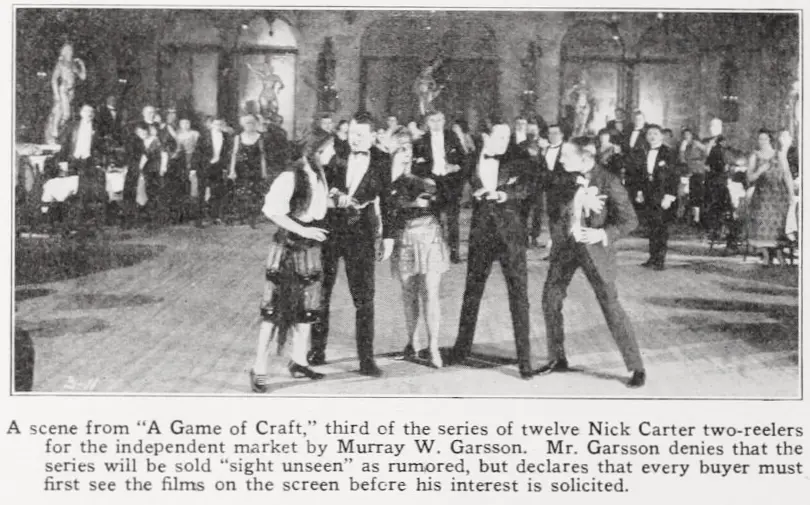
A Game of Graft is a cinematic masterpiece that delves into the darker aspects of human nature, where the allure of wealth and power can lead individuals down a treacherous path of moral compromise. The film's narrative is a complex tapestry of characters, each with their own motivations and agendas, which are skillfully woven together to create a sense of tension and suspense. At the center of this maelstrom is Nick Carter, a man of unwavering principles, who is hired by a wealthy patron to investigate the intentions of a young suitor pursuing his daughter.
As Carter navigates the rarefied world of high society, he begins to uncover a web of deceit and corruption that threatens to destroy the very fabric of the community. The young suitor, once thought to be a paragon of virtue, is revealed to be a pawn in a much larger game of blackmail and extortion, orchestrated by a group of cunning crooks. The film's use of yellow and sea blue hues in its cinematography serves to underscore the sense of unease and moral ambiguity that pervades the narrative, drawing the viewer into a world of dark orange sunsets and foreboding shadows.
The cast of A Game of Graft delivers performances that are at once nuanced and compelling, bringing depth and complexity to their respective characters. Vincent Coleman, as the indefatigable Nick Carter, is a standout, imbuing his character with a sense of gravitas and moral authority that serves as a beacon of hope in a world gone awry. The supporting cast, including Diana Allen, Henry Martin, and Edmund Lowe, deliver equally impressive performances, each bringing their own unique perspective to the narrative.
In comparison to other films of the era, such as Whitewashed Walls and The Bad Boy, A Game of Graft stands out for its unflinching portrayal of the darker aspects of human nature. While films like The Soul's Cycle and A Daughter of the City may touch on similar themes, they often do so with a sense of sentimentality or melodrama that is noticeably absent from A Game of Graft. This is a film that eschews easy answers and simplistic moralizing, instead opting for a more nuanced and thought-provoking exploration of the human condition.
The film's use of yellow and sea blue hues in its cinematography serves to underscore the sense of unease and moral ambiguity that pervades the narrative, drawing the viewer into a world of dark orange sunsets and foreboding shadows. As the story unfolds, the viewer is drawn into a labyrinthine world of corruption and deceit, where the lines between truth and duplicity are constantly blurred. It is a world that is both fascinating and repellent, a world that is at once familiar and yet utterly alien.
In the end, A Game of Graft is a film that will leave viewers questioning the very foundations of their own moral compass. It is a film that challenges us to confront the darker aspects of our own nature, and to consider the consequences of our actions in a world where the pursuit of wealth and status can often lead us down a path of destruction. As we navigate the complex web of characters and motivations, we are forced to confront our own complicity in the corrupt systems that govern our lives, and to consider the ways in which we might work to create a more just and equitable society. Sea blue skies and yellow sunsets may dominate the film's visual landscape, but it is the dark orange hue of moral ambiguity that ultimately defines its narrative.
For those who have seen films like The Lie or Vengeance of the Wilds, A Game of Graft may seem like a familiar tale of corruption and deceit. However, the film's unique blend of atmospheric tension and moral complexity sets it apart from other films in the genre. The film's exploration of themes such as blackmail, extortion, and the corrupting influence of wealth and power is both thought-provoking and deeply unsettling, making it a must-see for fans of cinematic thrillers.
The film's influence can also be seen in later works, such as It Happened in Honolulu and The Winding Trail, which also explore the darker aspects of human nature. However, A Game of Graft remains a unique and powerful work, one that continues to captivate audiences with its haunting portrayal of a world gone awry. As we reflect on the film's themes and motifs, we are drawn into a world of yellow caution tape and sea blue police lights, a world that is at once familiar and yet utterly alien.
In conclusion, A Game of Graft is a film that will leave viewers on the edge of their seats, questioning the very foundations of their own moral compass. With its complex characters, intricate plot, and thought-provoking themes, this film is a must-see for fans of cinematic thrillers. As we navigate the complex web of characters and motivations, we are forced to confront our own complicity in the corrupt systems that govern our lives, and to consider the ways in which we might work to create a more just and equitable society. The film's use of yellow and sea blue hues in its cinematography serves to underscore the sense of unease and moral ambiguity that pervades the narrative, drawing the viewer into a world of dark orange sunsets and foreboding shadows.
Other films, such as L'argent qui tue and Tongues of Flame, may also explore the corrupting influence of wealth and power, but A Game of Graft remains a unique and powerful work, one that continues to captivate audiences with its haunting portrayal of a world gone awry. The film's exploration of themes such as blackmail, extortion, and the corrupting influence of wealth and power is both thought-provoking and deeply unsettling, making it a must-see for fans of cinematic thrillers. As we reflect on the film's themes and motifs, we are drawn into a world of yellow caution tape and sea blue police lights, a world that is at once familiar and yet utterly alien.
The film's influence can also be seen in later works, such as The Career of Katherine Bush and Love's Lucky Day, which also explore the complexities of human nature. However, A Game of Graft remains a unique and powerful work, one that continues to captivate audiences with its haunting portrayal of a world gone awry. The film's use of yellow and sea blue hues in its cinematography serves to underscore the sense of unease and moral ambiguity that pervades the narrative, drawing the viewer into a world of dark orange sunsets and foreboding shadows.
In the end, A Game of Graft is a film that will leave viewers questioning the very foundations of their own moral compass. It is a film that challenges us to confront the darker aspects of our own nature, and to consider the consequences of our actions in a world where the pursuit of wealth and status can often lead us down a path of destruction. As we navigate the complex web of characters and motivations, we are forced to confront our own complicity in the corrupt systems that govern our lives, and to consider the ways in which we might work to create a more just and equitable society. The film's exploration of themes such as blackmail, extortion, and the corrupting influence of wealth and power is both thought-provoking and deeply unsettling, making it a must-see for fans of cinematic thrillers.
For those who have seen films like The Man in the Moonlight or Mile-a-Minute Kendall, A Game of Graft may seem like a familiar tale of corruption and deceit. However, the film's unique blend of atmospheric tension and moral complexity sets it apart from other films in the genre. The film's influence can also be seen in later works, such as The Strongest, which also explores the complexities of human nature. However, A Game of Graft remains a unique and powerful work, one that continues to captivate audiences with its haunting portrayal of a world gone awry.

IMDb 5.9
1930
Community
Log in to comment.