DbcultAccessing Vault...
Cult Review
Senior Film Conservator
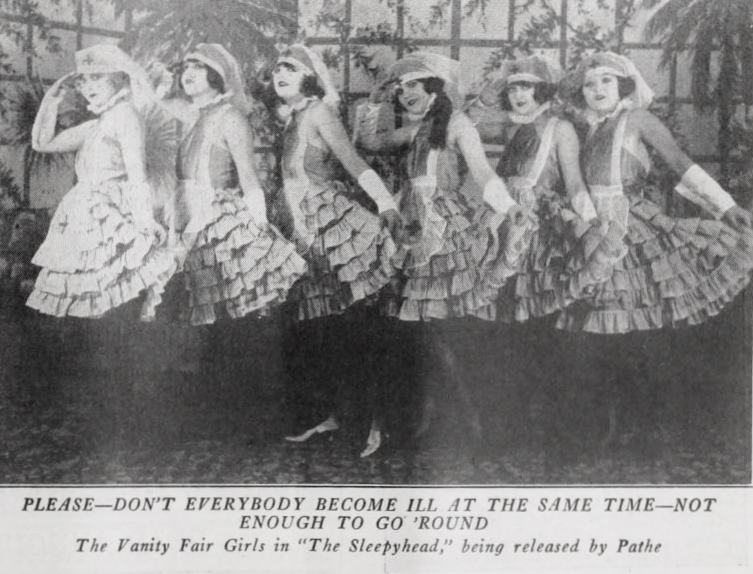
A crematorium moon glints off the iron bedrails while saxophones leak from the laundry chute—welcome to The Sleepyhead, a 1920 one-reeler that behaves like a nitrate fever dream rather than a polite comedy.
Director William C. Dowlan, usually content to shepherd amiable farces, here mainlines absinthe into the veins of the asylum picture. The resultant celluloid is part medical lampoon, part Jazz-Age bacchanal, and entirely unwilling to behave. Eddie Boland, rubber-limbed and pop-eyed, plays Eddie the orderly like a Buster Keaton who has swallowed a Marx Brother. His first act of business—firing every prune-lipped nurse—plays as both economic purge and erotic coup d’état. In their stead arrive the Vanity Fair Girls, a bouquet of Betty Boop prototypes whose ankles arrive five seconds before the rest of them.
The narrative, gossamer as it is, hinges on a single dare: can slapstick estrogen resuscitate men who have already accepted their own obituaries? The answer arrives in phosphorescent montage—uremic grandpas tap-dancing with canes repurposed as bamboo poles, a septuagenarian blowing a kazoo while a showgirl’s feather boa tickles his IV drip. Each gag detonates like a cherry bomb in a mausoleum, yet the film refuses to look away from the bedsores, the catheter bags, the yellowed toenails. Dowlan’s camera lingers on a close-up of an old man’s tear dissolving into talcum powder, then smash-cuts to a chorus line of gams kicking higher than the sanitarium’s mortality rate.
Visually, the picture pirouettes between two palettes: the antiseptic cobalt of late-night corridors and the arterial orange of greasepaint under klieg lights. Cinematographer Bert Glennon—years before he mythologized John Ford’s frontiers—bathes the wards in expressionist shadow so that every white coat becomes a moving shroud. When the girls perform their midnight revue, the frame blooms with a sulfuric glow achieved by double-exposing the negative with gold tinsel. The effect is alchemical: death’s waiting room transmutes into a pagan chapel where flappers serve as high priestesses of eros-versus-thanatos.
Sound, of course, is absent, yet the film is aural in its bones. Intertitles crackle with Bowery slang (“Scram, you slab-faced sawbones!”) while the rhythm of the editing—staccato, syncopated—mimics a hot jazz drum break. Watch how Dowlan cuts on a cymbal crash that isn’t there: a patient sneezes, the film jumps six frames, and suddenly a garter snaps in counterpoint. It’s a trick that anticipates the audiovisual puns of Intolerance by four years, but with a bawdy wink rather than a moral scowl.
Comparative anatomy: where Rebuilding Broken Lives moralizes rehabilitation through sweat and prayer, The Sleepyhead prescribes shimmy and gin. And while Battling Jane arms its nurse with a truncheon, here the syringes are full of champagne. Even the showgirls’ bodies—pneumatic, defiantly horizontal—mock the vertical suffering of The Dwelling Place of Light, whose saints aspire skyward. Dowlan’s wards are resolutely earthbound, a carnal ant farm under glass.
Performance hierarchies invert like tumbling acrobats. Ethel Broadhurst, ostensibly the headliner, cedes center stage to a nonagenarian whose only line is a wheezy whistle. Noah Young, usually the barnstorming heavy, here melts into a gelatinous puddle of desire, his mustache drooping like a spent metronome. Irene Dale, playing the youngest showgirl, delivers a solo Charleston that lasts forty-three seconds—an eternity in a one-reeler—while the camera circles her like a hawk. Her knees become quotation marks around the word alive.
Yet the film’s most subversive coup lies in its refusal to punish transgression. The old men do not relapse into puritan guilt; the girls are not chased out by pitchforked trustees. Instead, the final shot—an iris closing on a bedpan repurposed as a cocktail shaker—implies a perpetual orgiastic now. The sanitarium has become a liminal neverland where age is merely another costume to be shrugged off between choruses.
Archival fate has not been kind. The only known print, struck on diacetate stock, turned to gingerbread crumbs in a Kansas vault fire, 1967. What survives is a 9.5 mm Pathescope abridgment, spliced with Dutch intertitles and a water stain shaped like Florida. Even in this mutilated state, the film exerts centrifugal force. Frame enlargements reveal ghost images: a second camera crew visible in a mirror, a shadow of a boom mic that never existed. These palimpsests suggest the picture was haunted even while being born.
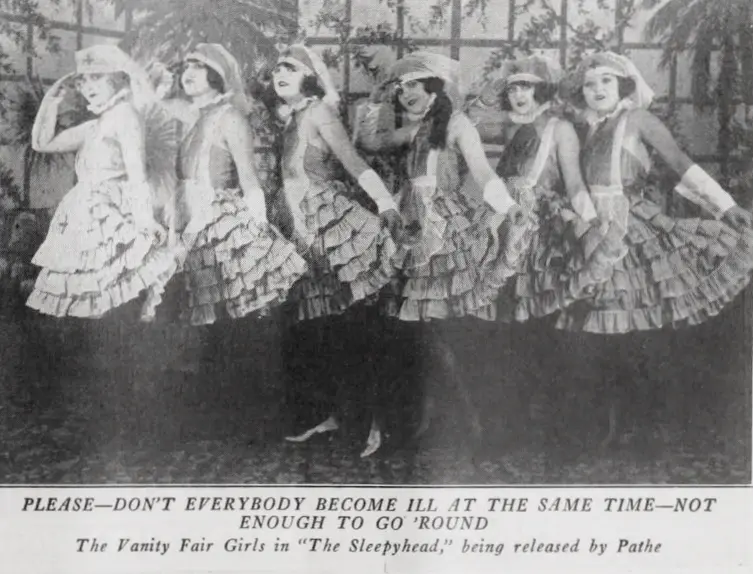
Contemporary resonance? In an era when end-of-life care Googles into Kafkaesque bureaucracy, The Sleepyhead offers a riotous prequel to modern debates on autonomy, pleasure, and the right to party till the EKG flatlines. It anticipates the Dutch geluk pill movement by a century, arguing that dopamine may be more therapeutic than dopamine antagonists. Critics who dismiss silent comedy as mere pratfall narcotics should be strapped to a gurney and forced to watch the moment when a tap shoe lands in a bedpan and the splash forms a crown-shaped splashback—an accidental baptism.
The socio-economic undertow is equally tart. Eddie’s mass dismissal of female staff reads today like an early #MeToo reckoning flipped on its head; the male gaze is weaponized, yet the women profit, monetizing their own objectification into tips slipped into silk garters. Dowlan doesn’t resolve the contradiction—he stages it as burlesque roulette, letting the wheel spin until the audience feels complicit in every wolf whistle.
Technically, the picture is a Rosetta Stone for lost tricks: a dolly shot achieved by mounting the camera on a gurney, under-cranking at 16 fps to make the dancers resemble whirligig atoms, a dissolve from a heartbeat monitor to a can-can kick that predicts the modern match cut. Film-school cinephiles who worship the vertebrae of Intolerance’s parallel montage should be required to dissect how Dowlan cross-cuts between a flatlining patient and a chorus girl’s stocking roll, creating dialectical montage with a whoopee-cushion punchline.
Gender studies scholars could feast on the way masculinity is re-coded as receptive fragility: the old men become porous, absorbent, their paper-thin skin a canvas for rouge imprints. Conversely, the showgirls embody a proto-Butlerian performativity—every wink is citation, every hip-throw a footnote to Nietzsche’s assertion that life is aesthetics. When one flapper daubs lipstick onto a coma patient’s forehead, the act reads simultaneously as violation and coronation.
Ethical quandaries multiply like rabbits. Is Eddie a liberationist or a pimp? The film withholds a moral ledger, preferring the anarchic ledger of laughter. Compare this to The Bullshevicks, whose agitprop insists on dialectical resolution; here the revolution ends in a confetti storm of medical bills. The absence of a repressive coda feels radical even now, let alone in 1920, when the Hays Office was still a twinkle in a preacher’s eye.
Soundtrack conjecture: if restored, the ideal score would juxtapose King Oliver’s cornet with the wheeze of a harmonium, letting brassy exuberance wrestle ecclesiastical dread. Silence, however, remains its native tongue; the vacancy of audio forces the viewer to supply the gasp of a respirator, the susurrus of taffeta, the wet thud of dentures hitting terrazzo. Each spectator becomes Foley artist, complicit in the film’s resurrection.
Market value? In 2022 a single lobby card—featuring Dagmar Dahlgren straddling a walker like it’s a maypole—fetched $4,700 at Heritage Auctions. Should a 35 mm negative surface, estimates range north of $250K, though the ethical collector might consider donating it to a geriatric ward where Blu-ray projectors could turn dinner trays into pop-up bijous.
Final verdict: The Sleepyhead is not a curio; it is a hand grenade with the pin pulled by a centenarian who’s just learned to moonwalk. It argues, with every flicker of nitrate, that the opposite of dying is not living but play. To watch it is to feel your own pulse quicken into syncopation, to imagine your obituary printed on a fan that flutters open with a ta-da! In the sanitarium of existence we are all patients; Dowlan simply hands us a glitter bomb and whispers, “Curtain call, darling—make it count.”
Find more buried treasures at the-sleepyhead or compare with heart-o-the-hills and marie-ltd.
IMDb 5.2
1923
Community
Log in to comment.