DbcultAccessing Vault...
Cult Review
Senior Film Conservator
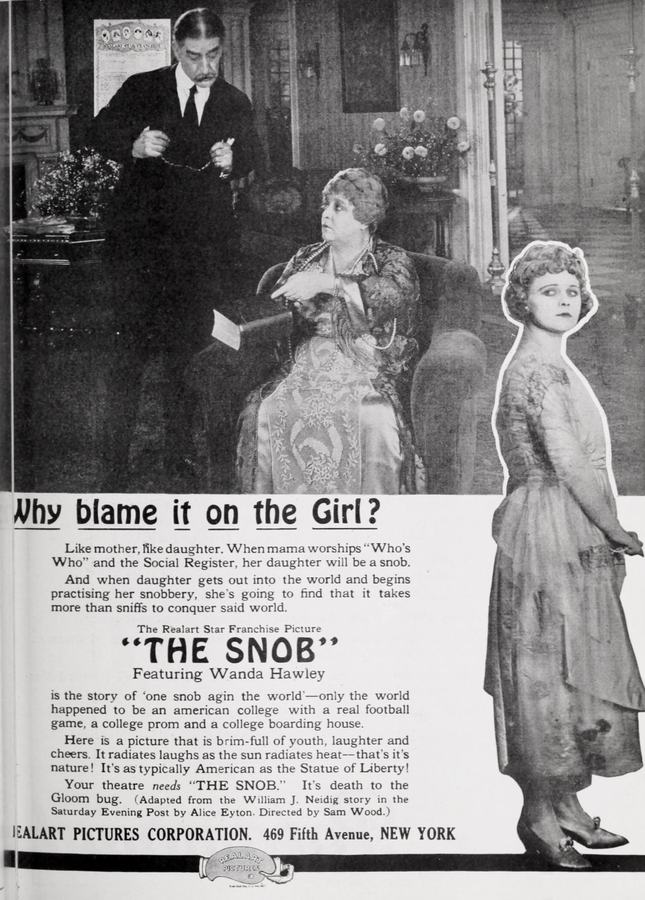
In the annals of silent cinema, where societal mores and individual transformations often served as compelling narrative fodder, "The Snob" (1924) emerges as a surprisingly incisive and enduring commentary on the pitfalls of social ambition and the redemptive power of humility. Directed with a keen eye for character nuance, this cinematic artifact, though nearly a century old, resonates with a timeless quality, dissecting the superficiality of inherited wealth versus the intrinsic value of character and honest endeavor. The film meticulously charts the journey of Kathryn Haynes, a young woman ensnared by the ostentatious aspirations of her newly minted millionaire parents, whose trajectory from haughty disdain to profound self-awareness forms the pulsating heart of its narrative.
Kathryn, portrayed with a compelling blend of initial arrogance and eventual vulnerability by Wanda Hawley, is not merely a character; she is a meticulously crafted symbol of the nouveau riche phenomenon that characterized the Roaring Twenties. Her father, Jimmie Haynes, having parlayed his humble origins as a sheepherder into an oil empire, embodies the era's boundless opportunities, yet his social climbing manifests in his daughter as an almost pathological sense of superiority. This parental ambition, rather than fostering grounded self-worth, instead cultivates in Kathryn a brittle pride, a defense mechanism against perceived social slights and an overt expression of her family's desperate yearning for acceptance within established high society. The film subtly critiques this transactional view of social standing, where lineage and perceived status are valued above genuine character or contribution. One might draw a thematic parallel to films like The Coast of Opportunity, if it similarly explores the illusions and disillusions tied to aspiring to a higher social echelon, often finding that the 'opportunity' itself is a mirage without an underlying foundation of integrity.
The screenplay, penned by William J. Neidig and Alice Eyton, avoids painting Kathryn as a one-dimensional villain. Instead, it carefully constructs her initial character as a product of her environment, making her eventual transformation all the more impactful. Her return from college, an institution often seen as a crucible for social refinement, paradoxically hardens her prejudices, setting the stage for the dramatic confrontations that propel the narrative forward. The film masterfully uses her interactions, particularly the pivotal encounter with Bill Putnam, to highlight the chasm between her inherited snobbery and the authentic dignity of honest work.
The introduction of Bill Putnam, a football hero portrayed with understated strength by W.E. Lawrence, serves as the initial tremor in Kathryn's carefully constructed world of privilege. Bill represents the antithesis of everything Kathryn has been taught to value: he is self-made, unpretentious, and earns his way through college. The fateful college dance becomes the crucible where Kathryn's snobbery is laid bare. Her act of striking his name from her dance card upon discovering his employment as a waiter is a moment of exquisite, almost painful, arrogance, a visceral manifestation of her ingrained class prejudice. It is a scene that, even without spoken dialogue, communicates volumes about the prevailing social stratification and the arbitrary lines drawn between individuals based on their economic status.
The brilliance of the screenplay shines through in the response to Kathryn's egregious behavior. Instead of direct confrontation, Bill's wealthy friends orchestrate a subtle yet devastating lesson. By feigning their own employment as waiters, they expose the sheer hypocrisy of Kathryn's disdain, forcing her to confront the arbitrary nature of her judgments. This collective act of solidarity, a gentle but firm rebuke, shatters her illusions and catalyzes a profound internal crisis. It's a testament to the film's nuanced approach that the lesson is delivered not through scorn, but through a mirroring of her own prejudice, leading her to a deeper realization of her erroneous beliefs. This form of social education, where one's own actions are reflected back, can be seen in other character-driven narratives, perhaps echoing the moral dilemmas found in films like The Question, if that film also delves into personal ethics and the consequences of moral choices in a social setting.
Kathryn's immediate reaction to the humiliation is rage, a natural defense mechanism against the shattering of her carefully constructed worldview. Yet, this rage soon gives way to introspection. The film beautifully portrays this internal struggle, showcasing her withdrawal from society and her subsequent observations of the world around her. She begins to see work and service not as marks of inferiority, but as commendable virtues, integral to the fabric of society. This epiphany is not sudden but a gradual dawning, a testament to the film's psychological realism. Her decision to atone for her previous scorn by working as a waitress herself is a powerful act of self-redemption. It is not merely a symbolic gesture but a genuine immersion into the very world she once dismissed, forcing her to confront her prejudices head-on and experience the dignity of labor firsthand.
This period of self-imposed penance is crucial for her character arc. It's here that Wanda Hawley truly shines, conveying Kathryn's vulnerability, her struggles, and her burgeoning empathy through subtle gestures and expressions. The narrative cleverly brings Bill's friends back into the picture, observing her transformation and reporting it to Bill. This narrative device ensures that her change is not merely internal but also externally validated, demonstrating a genuine shift in character. The film champions the idea that true worth is earned through experience and self-awareness, rather than conferred by birthright or sudden wealth. This theme of personal growth through challenging circumstances is a recurring motif in cinema, arguably resonating with the journey of characters in films like The Girl at Home, if that story also features a protagonist who finds true self-worth outside of conventional expectations or material possessions.

The performances in "The Snob" are particularly noteworthy for their ability to convey complex emotions without the aid of spoken dialogue. Wanda Hawley's portrayal of Kathryn is a masterclass in silent acting, her facial expressions and body language meticulously charting the character's journey from imperious disdain to humble enlightenment. Her initial haughtiness is palpable, her every gesture exuding a sense of entitled superiority. As the film progresses, her transformation is equally convincing, marked by a softening of her demeanor, a newfound empathy in her eyes, and a quiet determination in her actions. W.E. Lawrence, as Bill Putnam, provides a grounded and earnest counterpoint. His performance is one of quiet strength and integrity, making his character an anchoring presence amidst the social machinations. The chemistry between Hawley and Lawrence, while subtle, effectively conveys the evolving respect and affection that forms the basis of their eventual union.
The direction, while not overtly flashy, is effective in its storytelling. The camera work, typical of the era, focuses on clear compositions and character reactions, allowing the narrative to unfold naturally. Intertitles are used judiciously, providing necessary exposition without overwhelming the visual storytelling. The pacing is deliberate, allowing the audience to fully absorb Kathryn's internal struggle and subsequent growth. The sets and costumes, while reflecting the period's aesthetics, also subtly underscore the class distinctions at play. The opulence of the Haynes's mansion stands in stark contrast to the more modest settings, visually reinforcing the film's central themes. The director ensures that even the supporting cast, such as Josephine Crowell as Kathryn's mother and Richard Wayne, contribute meaningfully to the film's overall fabric, each embodying aspects of the social landscape of the time.
Released in 1924, "The Snob" is a fascinating cinematic time capsule, offering insights into the socio-economic landscape of the Jazz Age. The rise of new money, exemplified by Jimmie Haynes's oil fortune, challenged traditional social hierarchies, leading to a period of both aspiration and anxiety. The film deftly captures this tension, portraying the awkward dance between old wealth and new, and the often-humorous, sometimes painful, attempts of the newly rich to assimilate. It critiques the superficiality of status symbols and the folly of judging individuals based on their occupation or financial standing. The film's message of valuing genuine character over ostentatious display was particularly relevant in an era defined by rapid economic change and shifting social norms. It served as a gentle reminder that true aristocracy lies not in inherited titles or bank accounts, but in integrity, empathy, and the dignity of one's actions. This thematic thread, focusing on the true nature of character versus external appearances, echoes in various forms across cinematic history, much like films such as Souls in Pawn, if that narrative similarly explores moral debts and the intrinsic value of an individual beyond their social standing.
The film's exploration of work ethic is also deeply rooted in the American ethos. Bill Putnam, the self-reliant football hero, embodies the ideal of working one's way through life, a virtue highly prized in American society. Kathryn's journey from scorning such labor to embracing it herself underscores a fundamental belief in the transformative power of honest toil. It's a didactic element, certainly, but one delivered with narrative grace, avoiding heavy-handed sermonizing. The film suggests that true social mobility is not just about accumulating wealth, but about cultivating a moral compass that values all forms of contribution.
While perhaps not as widely remembered as some of its more epic silent contemporaries, "The Snob" retains its relevance through its universal themes. The struggle between appearance and reality, the desire for acceptance, and the journey of self-discovery are perennial human concerns. In an age where social media often amplifies superficiality and curated personas, the film's message about genuine character and the dignity of service feels remarkably contemporary. It reminds us that true worth is not found in the accolades of others or the contents of one's bank account, but in the integrity of one's actions and the humility of one's spirit. The film's resolution, with Bill being placed in charge of Mr. Haynes's oil interests, is a satisfying culmination of this theme, affirming that merit and character ultimately triumph over inherited status.
The film serves as an excellent example of how silent cinema, often underestimated, could deliver complex moral narratives with subtlety and emotional depth. Its reliance on visual storytelling and the expressive power of its actors means that its message transcends the spoken word, making it accessible even to modern audiences accustomed to talkies. It's a valuable piece of cinematic history, not just for its entertainment value, but for its enduring social commentary. It's a narrative that, much like the enduring appeal of a well-crafted character study, could be compared to the timeless nature of stories found in La verità nuda (The Naked Truth), if that film similarly strips away societal facades to reveal the authentic self.
Ultimately, "The Snob" is more than just a period piece; it is a resonant exploration of human nature, flawed judgment, and the capacity for growth. Kathryn Haynes's journey from a figure of entitled arrogance to one of empathetic understanding is a compelling character arc that anchors the film's enduring appeal. It's a narrative that, without resorting to grand pronouncements, quietly asserts the dignity of all labor and the profound emptiness of status sought for its own sake. The film stands as a quiet triumph of early Hollywood, a testament to the power of storytelling to illuminate universal truths about class, character, and the perpetual human quest for genuine connection and self-worth. Its themes remain as pertinent today as they were in the roaring twenties, offering a gentle yet firm reminder that true nobility resides within, not in the trappings of external wealth or social standing.
For those who appreciate the nuanced character studies of silent film and the rich social tapestries they often weave, "The Snob" offers a rewarding viewing experience. It invites contemplation on personal values and societal expectations, proving that a film from nearly a century ago can still hold a mirror to contemporary aspirations and follies, sparking reflection on what truly defines a person of substance. It's a compelling argument for seeking authenticity over superficiality, a message delivered with elegance and a touch of timeless charm.
IMDb —
1916
Community
Log in to comment.