DbcultAccessing Vault...
Cult Review
Senior Film Conservator
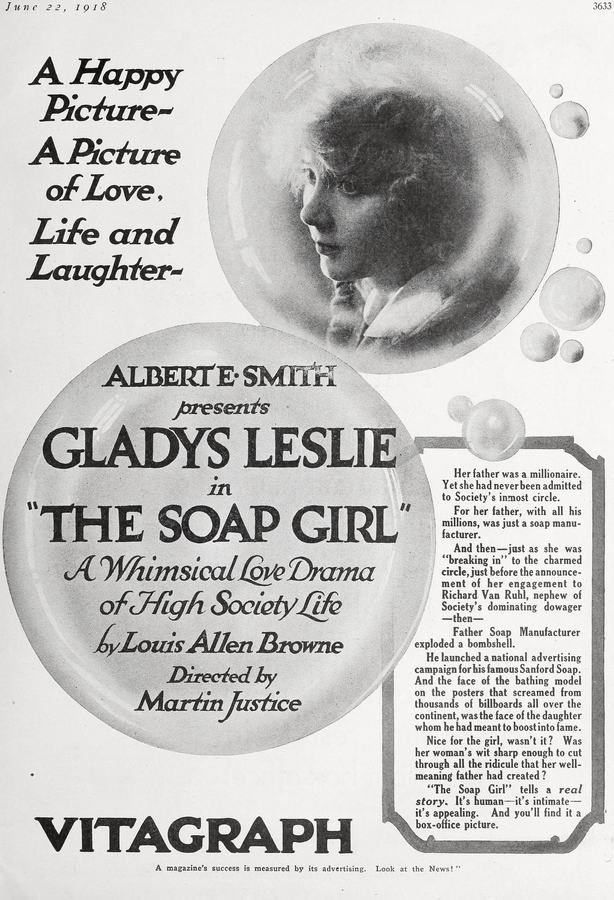
There are films you watch; then there are films that scrub you raw, leaving a film of lather in your brain long after the projector clicks off. The Soap Girl is the latter—a celluloid cake of soap slipped under the seat of 1927 audiences, exploding into suds of social satire so slippery the Hays Office must have contemplated a mop.
Director Martin Justice—a name too perfect for this morality lather—opens on a montage of conveyor belts: bars of Sanford’s “White Rose” soap glide like debutantes, each stamped with a promise of purity. The factory whistles mimic society orchestras; the editing rhymes assembly-line cogs with ballroom chandeliers. In ten seconds flat, Justice tells you that cleanliness is not next to godliness—it is next to market share.
Enter Marjorie, played by Gladys Leslie with the porcelain fragility of a china doll who has read The Second Sex in secret. Leslie’s performance is a masterclass in micro-rebellion: the way her gloved finger traces a soap bubble as if plotting detonation, the fractional lift of her chin when Richard first kisses her hand—every gesture calibrated to expose the rigidity beneath the rococo froth.
The infamous bathtub spread—shot in sinuous soft-focus, steam curling like gossip—was scandalous enough to make Peggy look like a convent handbook. Newspapers ran editorials titled “Is the Sanford Girl Scrubbing Away Decency?” Meanwhile, Variety quipped that viewers would need “a double-brush of prudery” to erase the image. Yet Justice frames the sequence with clinical detachment: the camera peers down from the rafters, turning Marjorie into a specimen, a commodity, a living logo. You are complicit in the gaze, and that complicity stings like bathwater in a paper cut.
Color palettes in late-silent cinema rarely get their due, but here the tinting tells the story. The early reels bathe in amber—the hue of wealth, candlelight, and soap-box gold. Once Marjorie is spurned, the film stock plunges into molten copper during distillery scenes, as if the narrative itself is aging in oak casks. The first time we see Mrs. Van Ruhl’s portrait on a whiskey label, the image is hand-tinted a lurid sea-foam green—a subliminal bruise on blue-blood lineage.
The montage of bottles rolling off the line—each label bearing the matriarch’s sneer—plays like a Triumph of the Will newsreel re-edited by a gin-soaked Dorothy Parker. It’s advertising devouring its own parents, a proto-Mad Men move that predicts viral meme culture by ninety years.
Under the froth lies a scalding critique of American caste. Mrs. Van Ruhl (a deliciously icy Julia Swayne Gordon) doesn’t object to Marjorie’s money—she objects to its smell, the whiff of trade, of factories, of work. The film slyly reminds us that the Van Ruhl fortune was built on colonial rum, a truth Marjorie weaponizes with bibliographic glee. In one intertitle, she cites a 1679 ledger: “One hogshead rum, traded to the Lenape for 40 beaver pelts.” The line arrives with the crisp snap of a well-folded broadsheet, and you can almost hear the ghost of P.T. Barnum cackling in the wings.
Sanford, meanwhile, is no cuddly patriarch. Frank Norcross plays him with the carnivorous cheer of a barker who could sell absolution in a bottle labeled “Sin-Be-Gone.” Watch the way he calculates the cost of a daughter’s broken heart against the column inches of free publicity—his pupils dilate like cash registers. When he finally blesses the marriage, it’s not redemption; it’s hostile takeover.
Richard Van Ruhl (Edmund Burns) could have been a bland stock suitor, but Burns gives him the nervous energy of a man who knows he’s the weakest piece on the board. His courtship scenes unfold like proxy battles: a picnic becomes a skirmish over ancestral land deeds; a waltz is scored to the clatter of ticker tape. When he finally defies his mother, the film withholds applause. Instead, Justice cuts to a shattered whiskey bottle on cobblestones—its label of Mrs. Van Ruhl dissolving in the rain—a visual sneer that romance itself is just another merger.
Screenwriter Lewis Allen Browne deserves a toast for intertitles that crackle like flash powder. My favorite: “Mother Van Ruhl’s blood ran cold—then remembered it was blue.” Another, after Marjorie’s distillery purchase: “She bought the barrels, the bottling plant, and the hangover.” These aren’t just gags; they’re manifestos on the economics of shame, each one a tweet before Twitter, a TikTok before vertigo.
Stack it beside Anything Once and you see how both films weaponize publicity, yet The Soap Girl is nastier, less forgiving. Sadie Goes to Heaven offers redemption through divine intervention; here redemption is bottled at 90 proof. Pair it with Sister Against Sister and notice how both exploit sororal rifts, but The Soap Girl makes the feud capitalist, not cathartic.
Curiously, the film also rhymes with The Hazards of Helen in its serial-like escalation—each reel a new cliffhanger of etiquette—but where Helen races trains, Marjorie weaponizes them, sending freight cars of liquor straight into the drawing rooms of the elite.
Costume designer unnamed in surviving records—let’s call her the Chanel of celluloid—dresses Marjorie in organza so sheer it seems carved from soap film. When the character pivots to tycoon, she dons a velvet riding jacket the color of bourbon, its lapels sharp as contract clauses. Notice how the jacket reappears in the final reconciliation scene, now accessorized with a single white rose—a visual ceasefire, soap and spirits entwined.
Equally striking is the ephemera that survives: a lobby card tinted with arsenic greens, a glass slide for projectionists bearing the warning “Women may faint—provide smelling salts.” One can only imagine the 1927 audience, wavering between gasp and guffaw, their own moral compasses spinning like a bar of soap on a wet basin.
Watch the film with modern ears and you’ll swear you hear champagne corks, the hiss of carbonation, the slap of silk on marble. That’s the phantom soundtrack of class anxiety, and it crescendos in the penultimate scene: a long shot of Marjorie alone in the distillery warehouse, shafts of moonlight slicing through skylights like accounting ledgers. The silence is so absolute you can almost hear soap scum forming. It’s a moment of eerie prescience—an heiress in a cathedral of capital, listening for the echo of her own footsteps and hearing only inventory.
In an age where personal brands are minted on bathtub selfies and influence is measured in soap-bubble metrics, The Soap Girl feels less like a period curio than a user manual for digital shaming. Swap the bathtub spread for an ill-advised Instagram post, the whiskey label for a meme, and you have the same cautionary fable: reputation is a commodity, but its market is run by trolls.
Yet the film refuses nihilism. Its final image—Richard and Marjorie exiting a church under a confetti of rice and rose petals—might seem like capitulation to rom-com convention. Look closer: the rice falls like ticker tape, the petals like subpoenas. The couple descend the steps not into happily-ever-after but into the flashing bulbs of a press corps Sanford has summoned. Love wins, perhaps, only because it photographs well.
Verdict: Seek out this forgotten satire wherever archivists stash their 35mm treasures—be it a warehouse in Pordenone or a pop-up in Brooklyn. Watch it with a glass of rye in one hand, a bar of artisanal goat-milk soap in the other. Let the lather dry on your skin as the credits roll. You will feel both scrubbed and soiled, a sensation as rare in modern cinema as nitrate that doesn’t combust. And when the lights come up, check your own reflection—because somewhere between the bathtub and the billboard, we are all the soap girl, waiting for the next scandal to rinse us clean.
IMDb —
1927
Community
Log in to comment.