DbcultAccessing Vault...
7.2/10
Senior Film Conservator
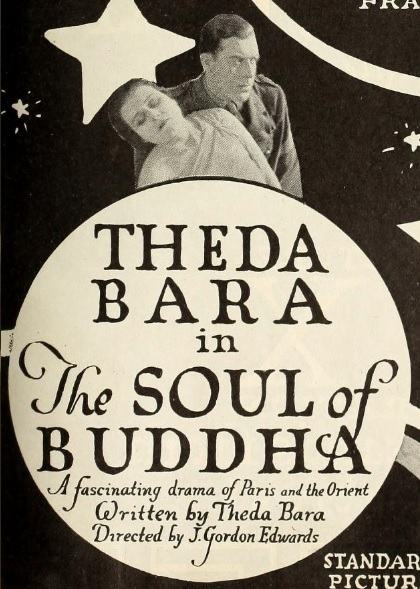
A definitive 7.2/10 rating for a film that redefined the boundaries of cult cinema. The Soul of Buddha remains a cornerstone of transgressive art.
Temple incense still clings to the celluloid, even a century after The Soul of Buddha vanished into nitrate bonfires. Few have seen it, yet its perfume—sandalwood laced with gun oil—lingers in cinephile whispers. Picture this: a half-caste bayadère, anklets once shackled to nirvana, pirouettes off the mandapa and onto the Opéra stage where gaslights applaud sacrilege. Florence Martin’s Bavahari is every exile’s double: brown enough to titillate, white enough to pity, doomed enough to sell tickets.
The narrative, stitched by Theda Bara & Adrian Johnson, refuses the missionary comfort of redemption. Instead it offers karmic noir: every good deed is a credit note forged in hell. Bavahari’s renunciation isn’t spiritual liberation; it’s a bounced cheque to the cosmos. The High Priest—Henry Warwick in kohl so thick it could plug bullet wounds—watches her apostasy with the quiver of a spurned god. His vow of vengeance is filmed in chiaroscuro: torchlight carves hieroglyphs on his collarbones, the shadow of a cobra hood blooming behind him like a cursed halo.
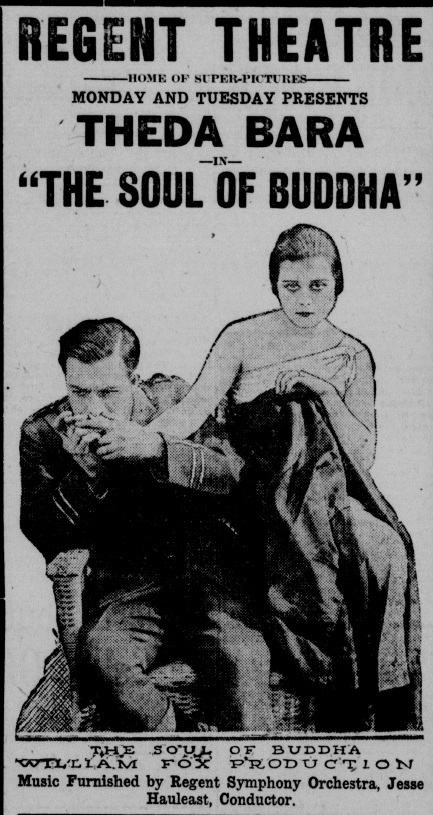
Cut to Paris, 1917: the city is a fever dream of wartime scarcity and champagne burlesque. Bavahari’s debut at the Folies Bergère is staged like an exorcism. The camera—probably hand-cranked by a drunk anarchist—tilts up her glistening calves, past the sari repurposed into a panther’s pelt, until it halts at her face: a death-mask of kohl and defiance. The audience, a mélange of colonial officers and demimondaines, misreads her mudra for seduction. They don’t sense the High Priest crouched inside the papier-mâché Buddha parked backstage, eyes gleaming like garnets soaked in butter.
Her marriage to Captain Meredith—Tony Merlo playing Anglo fragility with a moustache borrowed from Kipling—functions as a colonial transaction: he gets the harem fantasy, she gets a passport. But the screenplay scalds that fantasy. In a cramped Montparnette garret, Bavahari’s bharatanatyam footwork rattles the floorboards; Meredith can only counter with clumsy waltz steps. The marriage suffocates on the disparity of rhythms. When she leaves, he shoots himself in the footlights’ glare, crimson pooling over her abandoned ghungroos. Critics of the era mislabeled it melodrama; today it scans as an anti-imperial suicide note.
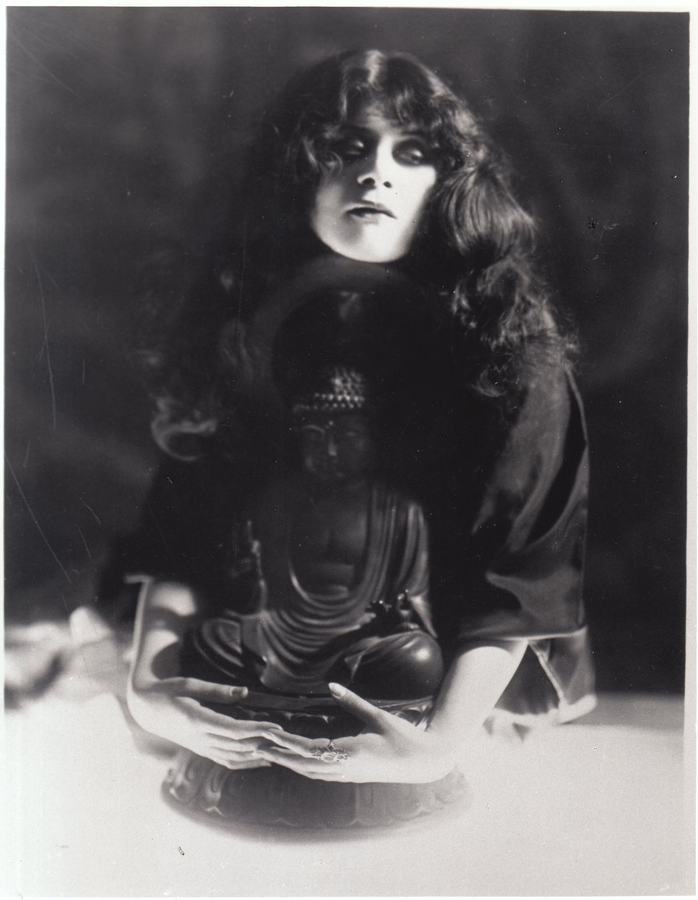
Enter the Sign of Death: a lotus sigil slashed in vermilion across her dressing-room mirror. The film’s tinting veers into feverish magenta here, as though the print itself is hemorrhaging. The High Priest’s disguise—a life-size lacquered Buddha with detachable arms—ranks among early cinema’s most sinister images. Inside the hollow idol, Warwick’s breathing is heard via intertitle: “The wheel turns; the dancer must fall.” The line, flashed over a close-up of the Buddha’s unblinking gaze, merges the erotic and the eschatological.
The finale is a danse macabre. Bavahari, costumed as Apsara Urvashi in gold foil, twirls center stage while the Buddha glides—an automaton apparently propelled by backstage pulleys. Music, supplied by a live orchestra in 1918, was reportedly Debussy’s "Danse sacrée" slashed with tabla beats. Mid-pirouette, the idol’s hand lifts: a stiletto flashes. The assassination is framed in long shot so the audience—both diegetic and real—becomes complicit. Blood spatters the footlights; the camera irises in on her lifeless eyes, ref lecting the gilded corpse of the god who murdered her. Curtains.
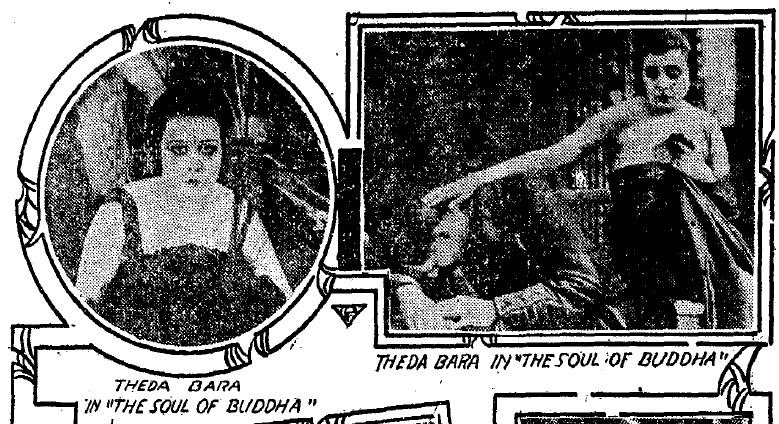
Lost films often accrue exaggerated genius, yet surviving production stills and the 1918 Moving Picture World synopsis corroborate a singular ambition: to weaponize orientalist iconography against itself. Compare it to The Climbers where social ascent is punished by poverty, or An Innocent Magdalene that forgives the fallen woman; Buddha offers no such absolution. Bavahari’s sin isn’t leaving the temple; it’s believing she could leave. The High Priest is less villain than cosmic debt-collector, ensuring the ledger of karma balances with theatrical spectacle.
Visually, director Victor Kennard pilfered from both Calcutta’s Kalighat scrolls and Beardsley’s erotic grotesques. One publicity still shows Theda Bara—who also co-wrote—sprawled across a lotus, wearing nothing but a strategically-placed serpent bracelet. The image scandalized Boston censors, who blue-penciled “blasphemous concupiscence.” Yet Bara’s intent was subversive: by conflating goddess and vamp, she exposed the western male’s simultaneous lust for and terror of the colonized female body. The film’s erotic charge lies not in nudity but in iconoclasm: every time Bavahari dances, she unthreads the sutras that bind her.
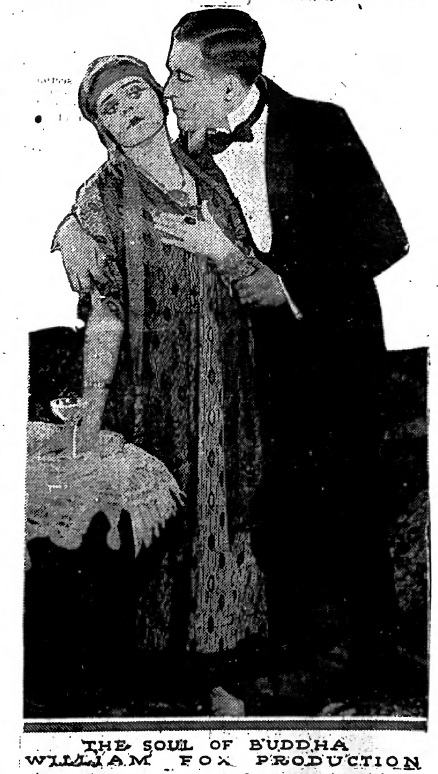
Performances oscillate between mute-era semaphore and uncanny modernity. Florence Martin, a Broadway chorine hired for her ankle articulation, layers her dance with micro-gestures: a tremor in the ring finger when she receives the Buddha’s death-mark, the fractional delay before she smiles at her husband—enough to betray love fossilized into obligation. Henry Warwick counterbalances with operatic stillness; inside the idol he moves only his eyes, yet the camera’s prolonged close-up magnifies the pulsing vein on his forehead into a metronome of doom.
The screenplay, attributed to “Lori Bara” (a pseudonymous mash-up of Theda and her publicist), is peppered with intertitles that read like Upanishads rewritten by a pulp hack: “Desire is the knife; the wheel, its handle.” Such purple flourishes risk risibility, yet in the context of 1918—when American audiences were discovering both Buddhism and Barnum—they land like Zen koans wrapped in nickelodeon leaflets. The film’s brevity (five reels, roughly 58 minutes) compresses epic themes into haiku violence; there is no narrative fat, only sinew.
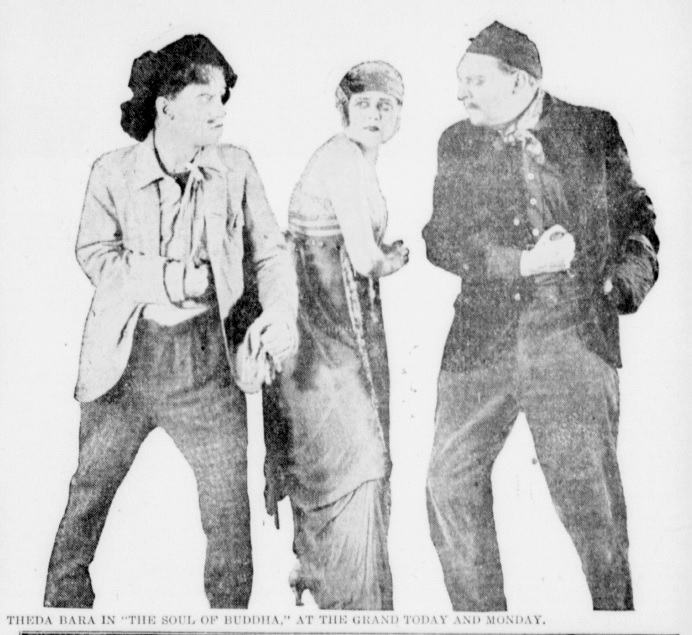
Technically, Buddha pushed the envelope. Cinematographer Jack Ridgeway experimented with day-for-night tinting, bathing Parisian rooftops in cobalt so Bavahari’s crimson costume flares like a wound. The on-stage killing required a retractable blade, a blood squib of carmine gelatin, and a jump-cut so the actress could swap with a dummy—an effect that reportedly caused fainting spells in Cincinnati. Compare this ingenuity to the staid tableaux of Wolfe; or, the Conquest of Quebec; Fox’s artisans were already flirting with the grammar of montage that would flower in Eisenstein’s temples.
Contemporary critics, alas, were befuddled. Variety dismissed it as “oriental hokum,” while a New York preacher condemned the “pagan glorification of female narcissus” (sic). The film’s financial fate mirrored its heroine: spectacular debut, swift demise. Prints vanished—some say recalled by Hindu societies offended at the Buddha-as-killer imagery, others claim nitrate fire devoured them in a Fort Lee vault. All that lingers are fragments: a mirror shard smeared with vermilion, a lobby card of Theda Bara mid-twirl, and the echo of an audience gasp as the god stabbed the dancer.
Yet its thematic ripples surface in later cinema. Powell & Pressburger’s Black Narcissus borrows the erotic-repressed priest trope; Powell confessed in a ’64 Cahiers interview to having seen “a 1918 fox trot of doom starring a vamp and an idol.” More directly, the death-on-stage motif resurfaces in The Red Shoes, though ballet replaces bharatanatyam and guilt replaces karma. Even Hitchcock’s Vertigo owes a debt: both films punish heroines for attempting to rewrite male-scripted narratives, both stage murders inside sacred spaces (a bell tower, a Buddha).
For modern viewers, The Soul of Buddha operates as a cautionary fable about cultural ventriloquism. Bavahari’s body—exotic canvas for occidental fantasies—ends up a corpse. The High Priest, avatar of patriarchal orthodoxy, is himself consumed by the idol he hollows out. Meanwhile the audience, both 1918 and 2024, pays admission to watch the other bleed. Perhaps that is the film’s most radical sutra: voyeurism is the only transcendence capitalism allows.
Restoration hopes flicker. A 2019 rumor claimed a 9.5 mm print surfaced in a Buenos Aires basement, sandwiched between Fatal Orgullo trailers. Funding stalled when Indian heritage groups protested re-animating “blasphemous” imagery. Yet if any silent relic deserves resurrection, it is this danse macabre where divinity and desire share the same blade. Until then, we prowl the archives like High Priests in the wings, waiting for the lotus sigil to bloom again across a door that isn’t there.
Watch it—should the reels ever resurface—with the lights low and your guilt lit like a footlight. Remember: every dance is a prayer to something, every ticket a vow. And karma, that meticulous projectionist, always collects her cut.
IMDb —
1926
Community
Log in to comment.