DbcultAccessing Vault...
Cult Review
Senior Film Conservator
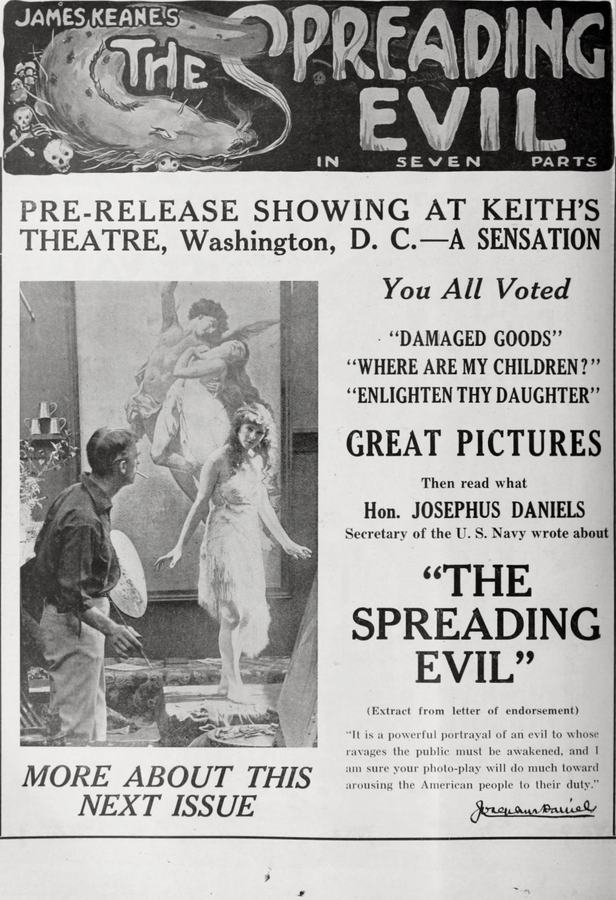
In the dim glow of a pre-code silent film, *The Spreading Evil* emerges as a stark allegory of human frailty and systemic avarice. Directed by James Keane with the precision of a surgeon dissecting a decaying organism, the film lingers in the memory like a haunting melody. It is not merely a story of syphilis and its cure, but a scathing indictment of a world where profit eclipses humanity. The narrative unfolds with the gravity of a requiem, each frame a brushstroke of moral decay.
At its core, *The Spreading Evil* is less about the biological contagion of syphilis and more about the moral plague of unchecked capitalism. Emil Hartsell, the Berlin chemist whose discovery could save countless souls, becomes a tragic figure of hubris. His descent from altruism to avarice mirrors the film’s themes of betrayal. The decision to sell the cure to Adolph Keller—a New York profiteer—transforms Hartsell into a symbol of the very corruption he sought to eradicate. This act of treachery is not driven by malice but by the seductive allure of wealth, a choice that resonates with the modern viewer’s disillusionment with corporate greed.
Lennon Morrett’s arc is the film’s emotional nucleus. As an artist’s model who contracts syphilis from the lecherous M. Saccard, she embodies the intersection of beauty and vulnerability. Her inability to afford the cure thrusts her into a world where dignity is bartered for survival. The film’s portrayal of her moral collapse—sleeping with multiple men not out of wantonness but as a desperate protest against a society that has abandoned her—is both harrowing and provocative. When she infects Karl Hartsell, the son of her tormentor, the act becomes a cathartic explosion of blame and despair, a testament to the cyclical nature of suffering.
Karl Hartsell’s journey from obedient son to tragic hero is rendered with poignant subtlety. His engagement to Keller’s daughter, Alice, is a transactional arrangement cloaked in romance, a microcosm of the film’s critique of capitalist marriage. When his bachelor fling with Lennon results in infection, the irony is inescapable. Karl’s subsequent death by walking into the sea to join his drowned father is a visual metaphor for the futility of legacy in a world driven by greed. His demise is not a climax but a resolution, a final act of resignation to a fate he could not control.
Dr. John Carey, the blood specialist, serves as the film’s moral compass. His relentless pursuit of the cure’s distribution to the poor is met with indifference, even hostility, from Hartsell. Carey’s character is a quiet force of conscience, his dialogue sparse but weighted with the urgency of a man racing against time. His plea to Hartsell in Holland, where the scientist coldly dismisses America’s plight, underscores the film’s central tragedy: the inability of individuals to effect change within an indifferent system.
Keane’s direction is a masterclass in silent film technique. The use of shadow and light to depict moral ambiguity is particularly striking. Hartsell’s submarine, a symbol of his isolation and arrogance, is a visual motif that parallels the oceanic depths of his conscience. The final scene, where Karl walks into the waves, is framed with the same desaturated tones as the opening, creating a cyclical narrative that suggests no escape from the film’s bleak reality. The absence of dialogue allows the audience to project their own interpretations, a hallmark of the silent era’s psychological depth.
*The Spreading Evil* occupies a unique space in the silent film canon, its themes resonating with contemporaries like *Trilby* (href="/movies/trilby") and *The Gilded Spider* (href="/movies/the-gilded-spider"). Like *Trilby*, it explores the destructive power of obsession, albeit through the lens of medical ethics rather than spiritualism. Its critique of capitalism shares DNA with *Gold and the Woman* (href="/movies/gold-and-the-woman"), where wealth and morality are at odds. Yet, *The Spreading Evil* distinguishes itself through its unflinching focus on disease as a metaphor for societal rot, a theme also present in *99* (href="/movies/99") but rendered with greater emotional gravity here.
The cast, particularly Carolyn Wagner as Lennon and William Hackett as Karl, delivers performances that are understated yet deeply affecting. Wagner’s portrayal of Lennon’s anguish is a masterclass in physical acting—her eyes, often wide with unspoken fear, convey volumes in the absence of voice. Hackett’s Karl exudes restraint, his stoicism cracking only in moments of vulnerability, as when he learns of his father’s death. These performances, devoid of melodrama, anchor the film’s tragic realism.
Though *The Spreading Evil* may not enjoy the same acclaim as *Avatar* (href="/movies/avatar") or *Tom Sawyer* (href="/movies/tom-sawyer"), its relevance endures. In an age where healthcare disparities and corporate greed remain contentious issues, the film’s message is as urgent as ever. Its exploration of ethical compromise in the face of profit mirrors modern debates on pharmaceutical pricing and medical access. For scholars of silent cinema, it is a vital piece of the puzzle, a reminder that the era’s filmmakers were as prescient as they were artistic.
*The Spreading Evil* is more than a relic of the silent film era; it is a mirror held up to contemporary society. Its examination of greed, moral decay, and the human cost of neglect is as piercing today as it was in its time. The film’s legacy lies not in its resolution—there is none—but in its unflinching portrayal of a world where progress is possible only through the ruins of human suffering. For those seeking a film that transcends its medium to offer timeless insight, *The Spreading Evil* is a journey worth taking.
IMDb —
1926
Community
Log in to comment.