DbcultAccessing Vault...
Cult Review
Senior Film Conservator
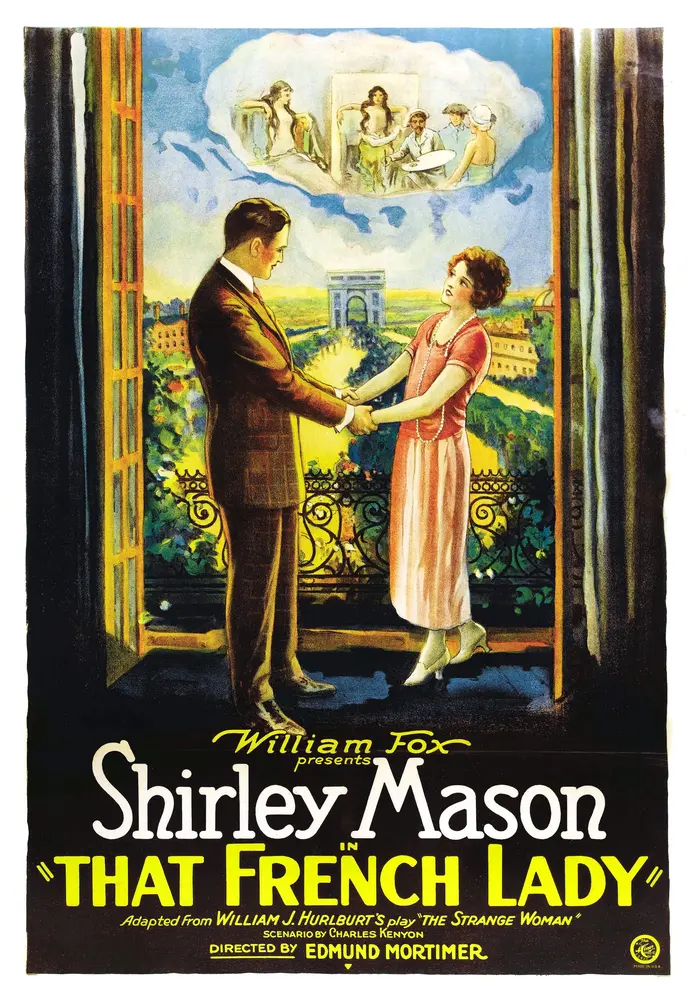
Cinema in the mid-1920s was often caught between the burgeoning avant-garde movements of Europe and the burgeoning moral conservatism of the American heartland. That French Lady (1924) serves as a fascinating, if occasionally melodramatic, bridge between these two disparate worlds. While many films of the era sought to simplify the 'fallen woman' trope, writers Charles Kenyon and William Hurlbut craft a narrative that is surprisingly sophisticated in its ideological confrontations. The film doesn't merely present a clash of personalities; it presents a clash of existential frameworks.
John Hemingway, portrayed with a grounded, perhaps slightly naive sincerity by Harold Goodwin, is a man defined by structure. As an architecture student in Paris, his life is governed by blueprints and historical precedents. This makes his sudden infatuation with Inez de Pierrefond all the more compelling. Inez, played by the luminous Shirley Mason, is the antithesis of a blueprint. She is a creature of fluid intellect and radical conviction. Unlike the protagonists in Diane of the Follies, who often find themselves victims of their own urbanity, Inez is a weaponized intellectual. She doesn't just live outside the law; she writes the manifesto for its obsolescence.
The Parisian sequences are captured with a soft-focus romanticism that contrasts sharply with the stark, high-contrast lighting utilized later in the film. Here, the 'marriage free of state and church laws' seems like a poetic necessity rather than a social rebellion. It is only when the setting shifts to the monochromatic rigidity of Iowa that the true weight of her philosophy is felt. The transition is jarring, intended to mirror the psychological shock Inez feels as she moves from the salons of the Left Bank to the porches of the Midwest.
Upon their arrival in Iowa, the film shifts gears from a romantic drama into a biting social satire. The villagers are not merely characters; they are archetypes of a suffocating moralism. Nora Cecil and Kate Lester deliver performances that are chilling in their domesticity, embodying the kind of 'virtuous' cruelty that defines small-town dynamics. This environment is reminiscent of the stifling religious atmospheres found in The Little Minister, yet where that film finds a path through faith, That French Lady finds a path through confrontation.
The scorn directed at Inez is visceral. She is 'the other' in its purest form—educated, foreign, and unapologetically autonomous. The film brilliantly utilizes the visual language of the silent era to convey this isolation. Frequently, Inez is framed alone in large, empty spaces, or conversely, claustrophobically surrounded by the dark, looming figures of the town elders. The cinematography emphasizes her vulnerability without ever stripping her of her dignity. She remains the smartest person in any room, a fact that only deepens the resentment of those around her.
The narrative pivot occurs when Inez realizes that the moral superiority of her detractors is a facade. This is a common trope in stories of this nature—the outsider revealing the rot at the core of the community—but Kenyon and Hurlbut handle it with a specific kind of surgical precision. Inez’s threat to reveal their secrets is not an act of malice, but an act of self-defense. It is a demand for a 'truce of silence' in a world that refuses to grant her the 'peace of honesty.'
Comparing this to Salvation Nell, we see a different approach to social redemption. While Nell seeks a spiritual cleansing, Inez demands a social reckoning. She forces the villagers to look into a mirror, and the reflection is hideous. The cast, including Theodore von Eltz and Lucy Beaumont, play these moments of realization with a frantic, desperate energy that underscores the fragility of their social standing. Their 'morality' is revealed to be nothing more than a lack of public exposure.
Technically, the film is a testament to the sophistication of 1924 production values. The set design for the Hemingway home in Iowa is a masterpiece of oppressive Victorian aesthetic—heavy drapes, cluttered mantels, and dark wood that seem to swallow the light. This stands in stark contrast to the airy, light-filled spaces of the Paris apartment seen early on. The costumes, too, tell a story. Inez’s Parisian fashions are flowing and transgressive, while the Iowa residents are buttoned up in stiff collars and restrictive bodices, looking much like the characters in Ashes of Vengeance but without the historical justification.
The intertitles are surprisingly sparse, allowing the physical performances to carry the emotional weight. Shirley Mason, in particular, uses her eyes to convey a complex internal monologue. In one scene, where she is being interrogated by the local matrons, her expression shifts from amusement to pity to iron-willed defiance without a single word being spoken. It is a performance that rivals the best of the era, far surpassing the more straightforward work seen in films like New York Luck or Her Tender Feet.
The resolution of the film, where Inez’s 'faith in marriage is restored,' is often criticized as a concession to the censors of the time. However, a closer reading suggests something more nuanced. Inez doesn't necessarily come to believe in the *laws* of marriage, but rather in the *possibility* of a partnership that survives the scrutiny of a hostile world. Her choice to marry John is an act of agency, not submission. She has defeated the town on her own terms, and her subsequent acceptance of the institution is a gesture of grace rather than a defeat of her principles.
This thematic complexity is what elevates That French Lady above the standard silent melodrama. It shares a certain DNA with the gritty realism of The Mutiny of the Elsinore, where characters are forced to find their own moral compass in the absence of a just society. Whether one views the ending as a cop-out or a clever subversion, there is no denying the power of the journey that precedes it.
In the broader context of 1920s cinema, That French Lady remains a poignant reminder of the medium's ability to tackle difficult social questions. It avoids the whimsicality of An Eskimotion Picture or the rural simplicity of Bawbs O' Blue Ridge, opting instead for a mature, if stylized, examination of the human condition. It is a film that demands to be seen not just as a relic of the past, but as a precursor to the modern social drama.
For those interested in the evolution of feminist themes in film, Shirley Mason’s Inez is a seminal figure. She is the intellectual ancestor of the modern anti-heroine—flawed, brilliant, and utterly refuse to be defined by anyone but herself. While films like Outlawed or So sind die Männer dealt with rebellion in more overt ways, That French Lady finds its power in the quiet moments of domestic warfare. It is a essential viewing for any serious student of silent cinema, offering a window into a time when the silver screen was just beginning to find its voice in the global conversation about morality and freedom.
Even when compared to international works like Um eines Weibes Ehre or Prinzessin Tatjanah, this film holds its own through its sharp American focus. It is a story about the cost of honesty in a world that prefers the comfort of a lie, a theme that remains as relevant today as it was in 1924. If you have the chance to see a restored print, do not miss the opportunity to witness The Knocking on the Door of history that this film represents.
IMDb —
1920
Community
Log in to comment.