DbcultAccessing Vault...
Cult Review
Senior Film Conservator
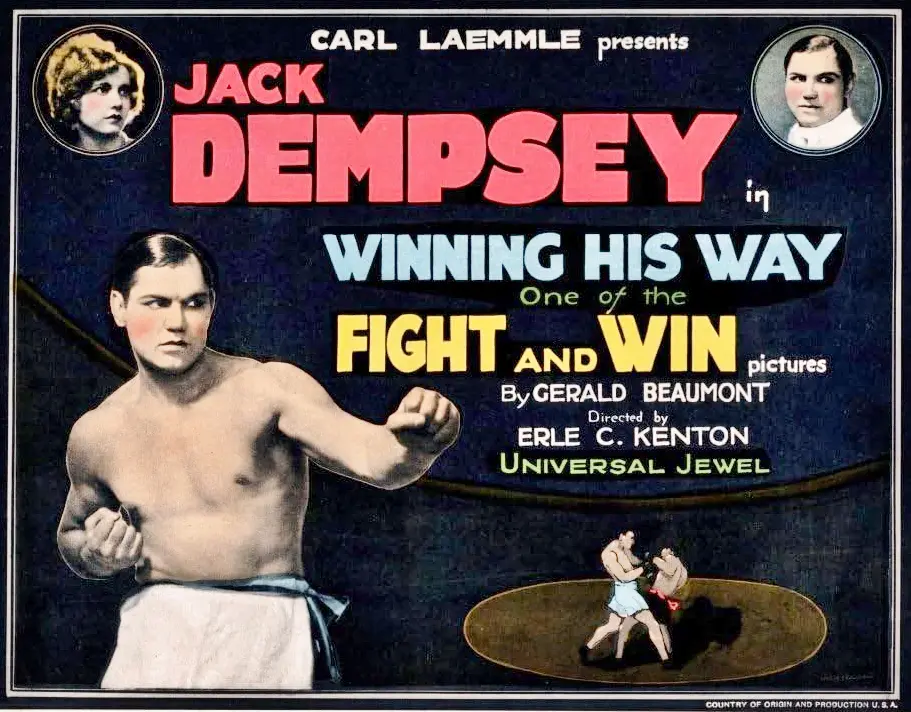
In the pantheon of early 20th-century cinema, few figures cast as long a shadow as Jack Dempsey. Yet, in Winning His Way, we see a departure from the raw aggression of the 'Manassa Mauler' persona. Instead, the film presents us with Jack O’Day, a character whose strength is tempered by a profound, almost Victorian sense of duty. The film opens not in the ring, but in the oppressive atmosphere of a steel mill, a setting that mirrors the heavy, rhythmic toil of the era’s working class. Unlike the exoticism found in Drifting, this film anchors its stakes in the immediate, soot-covered reality of the American laborer.
The central conflict is not merely physical; it is an ideological battle between a mother’s pacifist entreaties and the mercenary necessity of the boxing world. This dynamic provides a layer of emotional complexity often missing from contemporary action fare. O'Day is a man caught between two worlds: the silent, industrial grind where he is just another cog in the machine, and the roaring, electric atmosphere of the arena where he is a god of the squared circle. His decision to return to fighting is not born of ego, but of a desperate, altruistic need to save his mother’s health, a trope that resonates with the sentimental depth of Two Kinds of Love.
The visual language of Winning His Way is strikingly modern for 1924. Director Charles Reisner utilizes the steel mill not just as a backdrop, but as a metaphor for the protagonist's internal pressure. The play of shadows against the molten metal and the massive machinery creates a chiaroscuro effect that rivals the expressionist tendencies of European cinema like Maulwürfe. There is a weight to the frames here; you can almost smell the ozone and the sweat. This isn't the sanitized version of labor seen in some silent comedies; it is a visceral, tactile environment that justifies O'Day's desire to escape, even if that escape means returning to the violence of the ring.
When the narrative shifts toward the training camp, the cinematography opens up, moving from the claustrophobia of the mill to the expansive, albeit treacherous, landscapes of the American countryside. The contrast is stark and effective. It highlights the 'country' as a place of healing—a destination for O'Day's mother—while the city and the mill represent the slow decay of the human spirit. This thematic use of location is a hallmark of high-quality silent drama, reminiscent of the atmospheric shifts in Shattered.
One cannot discuss this film without dissecting the pivotal railroad trestle sequence. In an era where stunt work was often a matter of life and death, the rescue of the manager’s child is a masterclass in suspense. It serves a dual purpose: it provides the requisite thrill for the audience, but more importantly, it functions as the narrative’s moral fulcrum. The manager, played with a nuanced blend of cynicism and eventual vulnerability by Edgar Kennedy, is initially presented as a predatory figure. He views O'Day as a commodity to be exploited, even going so far as to plot a frame-up to ensure a specific betting outcome.
However, the moment O'Day risks his life on the tracks, the film shifts from a story of exploitation to one of redemption. The manager’s transformation is not sudden or unearned; it is a visceral reaction to an act of pure heroism. This subversion of the 'crooked manager' trope adds a level of sophistication to the plot that many boxing films of the time lacked. It moves the film away from the binary morality of The Fakers and into a more nuanced exploration of human character and the capacity for change.
Jack Dempsey’s presence on screen is magnetic. While he was not a classically trained actor, his physicality brings an authenticity to the role that no stage performer could replicate. His movements are economical, precise, and imbued with the quiet confidence of a man who knows exactly what he is capable of. In the ring, the choreography is surprisingly grounded. Unlike the exaggerated haymakers of later Hollywood boxing films, the exchanges here feel heavy and consequential. There is a sense of real danger in the way the cameras are positioned—often at low angles that make the fighters appear like titans clashing in an ancient arena.
The supporting cast provides the necessary emotional scaffolding. Esther Ralston offers a performance of quiet strength, avoiding the damsel-in-distress cliches that plagued many films like A Yankee Princess. George Ovey and Frank Coghlan Jr. round out a world that feels lived-in and populated by people with genuine stakes in O'Day's success. The chemistry between Dempsey and the child actor during the rescue scene is particularly touching, grounding the high-octane drama in a relatable, human moment.
Beyond its merits as a drama, Winning His Way serves as a fascinating sociological document. It captures a moment in American history when the transition from a rural, agrarian society to an urban, industrial one was causing significant cultural friction. The mother’s antipathy toward boxing is not just a personal quirk; it represents a fading Victorian sensibility that viewed such displays of 'brutishness' as a regression. O'Day’s struggle to reconcile his talent with his mother’s values is reflective of a generation trying to find its footing in a rapidly changing world.
Furthermore, the film touches upon the precariousness of the working class. The fact that a man of O'Day's physical prowess is forced to return to a dangerous profession just to afford medical care for his parent is a biting critique of the period’s lack of social safety nets. This thematic weight elevates the film above mere entertainment, aligning it with more socially conscious works like The Unbeliever or the gritty realism of Dangerous Paths. It asks the audience to consider the cost of 'winning' in a system that seems rigged against the honest man.
The pacing of the film is remarkably tight. Gerald Beaumont’s writing avoids the meandering subplots that often bloated silent features. Every scene serves the central narrative arc, building tension toward the final bout. The editing during the fight sequences is particularly noteworthy, utilizing quick cuts and close-ups to convey the disorientation and exhaustion of the pugilists. This rhythmic editing creates a pulse for the film, a heartbeat that mirrors the tension of the crowd within the story.
The use of intertitles is also judicious. Rather than over-explaining the action, they are used to punctuate emotional beats or provide necessary context, allowing the visual storytelling to take center stage. This confidence in the image is what separates a good silent film from a great one. It shares a certain visual literacy with Queen of the Sea, though it trades that film's fantasy for a grounded, muscular realism. The final sequence, where O'Day must overcome both his opponent and his own inner doubts, is a cathartic explosion of kinetic energy that satisfies on every level.
In the final analysis, Winning His Way is more than just a 'boxing movie.' It is a story about the weight of expectations, the price of devotion, and the possibility of moral realignment. It stands as a testament to Jack Dempsey’s underrated screen presence and Charles Reisner’s ability to weave social commentary into a popular genre. While it may not have the operatic scale of 'Nfama! or the historical sweep of Don Juan Manuel, it possesses a rugged, honest charm that is uniquely its own.
For modern viewers, the film offers a window into a bygone era of cinema where the hero’s journey was often mapped out in sweat and steel. It avoids the cynicism of later noir-inflected boxing dramas, opting instead for a narrative of hope and hard-won victory. Whether you are a fan of sports history, silent-era technical achievement, or simply a well-told story of human resilience, this film remains an essential piece of the cinematic puzzle. It reminds us that sometimes, the hardest fight isn't the one in the ring, but the one we wage to stay true to ourselves and those we love. Even when compared to the raw intensity of Venganza de bestia or the melodrama of A senki fia, O'Day's journey feels remarkably personal and enduringly relevant.
Final Thought: As the credits roll, one is left with the indelible image of Dempsey—not as a champion of the world, but as a son who found a way to bridge the gap between his violent gift and his gentle heart. It is a win, in every sense of the word.
IMDb —
1917
Community
Log in to comment.