DbcultAccessing Vault...
Cult Review
Senior Film Conservator
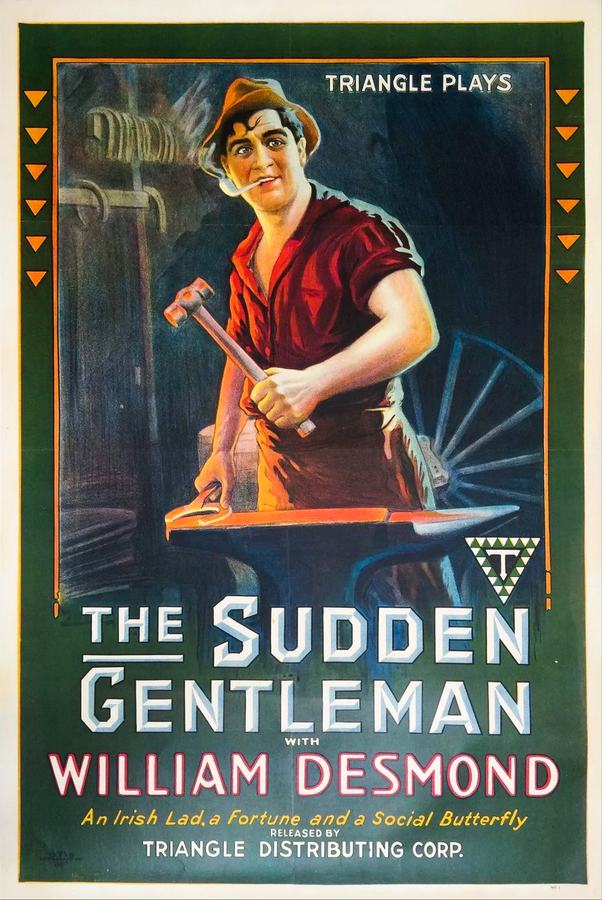
A blacksmith from the bogs inherits a skyscraper soul—then learns that steel bends faster than honor in the Midwestern glare.
Picture the moment celluloid itself exhales: the first intertitle of The Sudden Gentleman flickers like a candle in a coalmine, announcing Garry Garrity’s transmutation from provincial farrier to reluctant millionaire. Director Joseph Anthony Roach—never celebrated in the same breath as Griffith or DeMille—nevertheless understands that silence can be a scalpel. In the opening Irish sequence, the camera lingers on an anvil until its surface becomes a dark mirror; we see not sparks but the reflection of a man who believes geography is destiny. When the letter from America arrives, carried by a boy whose cap is too large, Roach cuts to an insert shot of the envelope’s wax seal—an eagle clutching arrows. The metaphor is blunt yet chilling: empire devours whoever opens its missives.
Chicago, 1924, behaves like a secondary character suffering from gilt delirium. Cinematographer Alfred Hollingsworth bathes the LaSalle Street canyon in sodium glare, then tints the night scenes a venomous aquamarine that makes every tuxedo look soaked in poison. During Garry’s first society soirée, the camera glides past champagne flutes whose bubbles rise like tiny stock-market graphs. The mise-en-scène is so congested with pearls and cigarette holders that you can almost smell the bear-grease pomade. Into this hive strides our protagonist, wearing a hand-stitched coat that screams paycheck rather than old money. Jack Richardson’s performance is a masterclass in bodily awkwardness: when offered a Manhattan cocktail, he grips the stem like a horseshoe nail, uncertain whether to drink or hammer.
Mary McIvor’s Louise Evans is the film’s true mercury. Introduced in a sequence that borrows from Bella Donna’s femme-fatale playbook, she glides down a marble staircase wearing a dress the color of arterial blood. Yet McIvor subverts the vamp stereotype by letting curiosity gnaw at the edges of her cynicism. Watch her pupils dilate when Garry, drunk on elderflower cordial, recites a Gaelic lullaby to a footman’s child. In that instant Roach cuts to a close-up so tight we can see the actress’s nostril flare—an involuntary confession that the ward is more trapper than trapped. From here the narrative pivots into a screwball waltz: every glance exchanged between the cousins carries the metallic tang of forbidden ore.
The antagonists arrive as a matched set of predators. Count Caminetti, essayed by Walter Perry with pencil-thin mustache and voiceless sneer, is the kind of continental parasite who pronounces marriage as if it contains six syllables. Mrs. Hawtry—Margaret Shillingford in a role that should have catapulted her to stardom—enters every frame trailing a diaphanous shawl that behaves like rumor itself: clinging, translucent, impossible to pin down. Together they concoct a scam so baroque it borders on Jacobean: a forged hotel register, a torn garter belt, and a photographer hidden inside a chifforobe. The resulting still image—Garry apparently mid-tryst—circulates through jazz clubs and drawing rooms alike, a proto-revenge-porn Polaroid delivered by pneumatic tube.
What keeps the film from collapsing into farce is Roach’s tonal calibration of shame. When Louise confronts Garry with the photograph, the scene plays out in a private library where dust motes rise like accusations. Roach blocks the actors so that a mahogany globe stands between them; every time Louise rotates it, continents realign, suggesting that morality itself is cartographically unstable. Garry’s protestations emerge in intertitles rendered in a shaky typeface—an inspired flourish that visualizes his stammering integrity. McIvor responds by turning the globe again, this time stopping on Ireland, her gloved finger pressing the exact county where the blacksmith once shooved hooves. Geography, the gesture implies, is not enough salvation.
Midway, the film stages its most audacious gambit: a wedding ceremony conducted in a drawing room converted into chapel. The camera assumes a high-angle god-shot as Garry, dressed like a sacrificial steer, repeats vows that taste of rust. Roach intercuts the priest’s blessing with flash-frames of the Irish forge—sub-second images of sparks, anvil, and peat fire—creating a subconscious montage that equates wedlock with molten shackles. Meanwhile, Mrs. Hawtry’s smile is so triumphant it seems to bend the fisheye lens. Only when the innkeeper—played by grizzled Percy Challenger—bursts in with a sworn affidavit does the film exhale. The confession sequence is shot in a single take that lasts ninety seconds, an eternity in 1924. Challenger’s mouth moves frantically, but Roach withholds intertitles, forcing us to read lips and context. The effect is a meta-gesture: truth matters less than the performance of truth.
Visually, the picture revels in chiaroscuro that anticipates film noir by two decades. During the climactic confrontation, Garry chases Caminetti across a rooftop slick with rain. Hollingsworth backlights the actors so their silhouettes knife across the negative space, steam rising from chimney pots like moral uncertainty. When Garry throttles the Count, the image momentarily overexposes—white flames swallowing faces—until the fight becomes a shadow-play of animal outlines. Into this tangle steps Louise, coat billowing like a bruised flag. McIvor’s entrance is filmed in slow motion (achieved by cranking the camera faster then projecting at normal speed), her hair unpinning frame by frame until it lashes the air like ink in water. Overwrought? Perhaps. Yet the stylization externalizes the moment when pride liquefies into need.
Comparative cinephiles will detect DNA strands linking The Sudden Gentleman to Chicot the Jester’s courtly machinations and to Forgiven; or, the Jack of Diamonds’ obsession with reputational ruin. Yet Roach’s film is less interested in poetic justice than in the economics of forgiveness. Note how the final reconciliation occurs not in a cathedral but in the same drawing room where the false wedding took place—only now the furniture has been repossessed by creditors. Empty space replaces altar, implying absolution carries a price tag. When Louise kneels, she does so on bare floorboards that creak like penitent knees. Garry lifts her not into embrace but into debt: the estate is still entangled in legal liens, the fortune mostly paper. Love, the film whispers, is solvent but not wealthy.
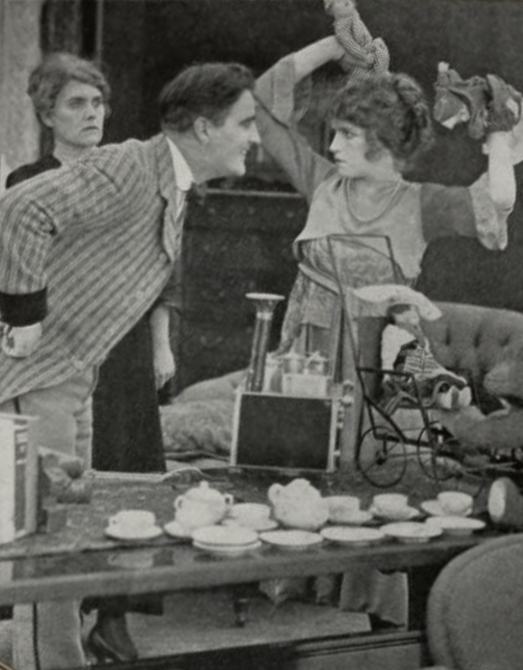
Performances oscillate between stylized mugging and proto-naturalistic subtlety. Richardson’s Garrity is all shoulders, a man who seems to carry the actual weight of an anvil in his thorax. Watch how his gait changes once innocence curdles: the blacksmith swagger becomes a defendant shuffle, feet testing floorboards as if each might give way to dungeon. McIvor counters with ocular precision; she can telegraph contempt with a left eye while the right eye leaks tenderness. In one exquisite shot—barely eight frames—her pupils track a falling teardrop on Garry’s cheek, the camera capturing the micro-moment when skepticism transmutes into solidarity. It’s silent-era quantum acting, invisible to the impatient yet luminous under magnification.
The screenplay, attributed to R. Cecil Smith, crackles with epigrams that flirt with Wildean cadence. When Caminetti boasts, "A woman’s virtue is a currency that appreciates in darkness," the line arrives in an intertitle ornamented with a silhouetted cobra—an illustrative redundancy that feels oddly modern, like a meme caption. Another card reads, "In America, even the shadows wear shoes." Such aphorisms risk preciosity, yet they serve a structural purpose: they remind us that every character speaks a second language—opportunism—fluently.
Scholars of silent-film music will lament that the original cue sheets are lost. Contemporary restorations often pair the picture with a pastiche of Irish fiddle and Dixieland brass, a shotgun marriage that undercuts the film’s tonal duality. Far better to imagine a score built on bodhrán heartbeat and single-trumpet lament, punctuated by player-piano rags whenever Chicago itself swaggers into frame. The absence of correct music underscores a larger tragedy: The Sudden Gentleman survives only in a 16-mm print preserved by a Montana collector who mistook it for a lost Ford travelogue. Scratches bloom across the image like lichen, and two scenes exhibit nitrate warping that turns ballrooms into Expressionist nightmares. Yet decay becomes aesthetic: the flicker of emulsion starvation mirrors the moral corrosion onscreen.
Gender politics, inevitably, prove double-edged. Louise begins as ward—essentially propertied—and ends as wife, trading one legal guardian for another. Yet the film slyly grants her the narrative’s final cut: she dictates the terms of reconciliation, insisting Garry donate half the fortune to the innkeeper’s foundling hospital. The last intertitle belongs to her: "Forgiveness is the only dividend that compounds nightly." Whether this constitutes proto-feminism or capitalist mystification depends on your ideological lens. At minimum, McIvor’s performance radiates enough agency to complicate the damsel label.
Technical fetishists should note the rooftop sequence’s miniature work. A maquette of Chicago’s skyline—no larger than a pool table—was submerged in a water tank, steam kettles providing atmospheric haze. When Caminetti plummets (off-screen, this is 1924), Roach cuts to a long shot of the miniature, the splash a single bucket of mercury lit by under-cranked arcs. The illusion lasts two seconds yet implants vertigo that CGI would envy. Similarly, the mansion interiors were shot in a Los Angeles warehouse draped with black velvet; chandeliers were lowered on piano wire to create floating pools of light, turning everyday space into cavernous moral tribunal.
Marketing ephemera from 1924 survives in the Library of Congress: lobby cards promising "A tempest of love and larceny across two continents!" and heralding Richardson as "the Irish Valentino." Such hype seems quaint until you realize the film delivered on every salacious bullet point while simultaneously interrogating them. It is both pulp and meta-pulp, a movie that knows inheritance is a blood sport yet cannot resist the allure of the ring.
Modern resonance? Replace iron forge with tech startup, telegram with phishing email, Count Caminetti with influencer crypto-scammer, and the plot hums like today’s Twitter scandal. The Sudden Gentleman prefigures our era where reputation is currency, privacy a tradable asset, and redemption a TED Talk. Watching it a century later feels like discovering your great-grandfather’s diary in which he confesses the same venal impulses you swore were birthed by social media.
So, is it a masterpiece? By auteurist criteria, no—Roach never achieved the thematic coherence of a Murnau, nor the kinetic lyricism of a Gish-era Henabery. Yet the film pulses with a guttering honesty: it believes in the possibility of ethical rebirth while cataloguing every mechanism that renders rebirth improbable. It is a cautionary flicker that cautions against caution itself, urging us to love loudly even when the ledger screams insolvent.
View it, then, not as relic but as raw ore—rough, slaggy, yet capable of striking sparks when hammered against the anvil of hindsight. And if, during the final silhouette kiss, you feel something metallic crawl up your throat, that is not nostalgia—it is recognition that the forge never cools, it merely moves across oceans and rekindles in new guises of neon.
IMDb 5.6
1929
Community
Log in to comment.