DbcultAccessing Vault...
6/10
Senior Film Conservator
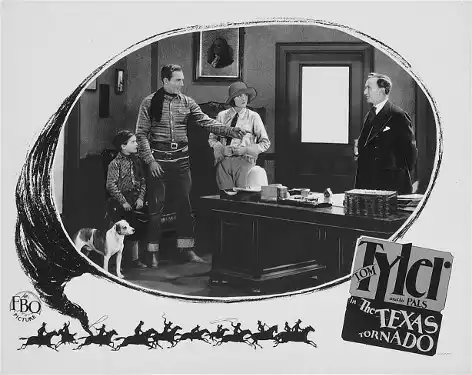
A definitive 6/10 rating for a film that redefined the boundaries of cult cinema. The Texas Tornado remains a cornerstone of transgressive art.
For most modern viewers, The Texas Tornado (1932) will feel less like a roaring success and more like a historical artifact. This early sound B-western, starring Tom Tyler, is strictly for the devoted genre enthusiast or the curious film historian. If you appreciate the foundational mechanics of the Western, or simply enjoy watching a hero on horseback dispense justice with a clear-cut moral compass, there's a certain unvarnished charm here. However, anyone seeking complex characters, nuanced plotting, or even consistently smooth pacing will likely find it a tedious watch, a relic whose rough edges have not softened with age.
Tom Tyler, as our titular 'Texas Tornado,' certainly looks the part. He's a towering, imposing figure, moving with a confident stride that defines the early Western hero. His performance is largely physical, a series of stern gazes and decisive actions. When he delivers a punch, it lands with a satisfying thud, and his horse-riding sequences are competent, though rarely spectacular. What's missing is much in the way of internal life. Tyler's Tom is less a character and more a force of nature, reacting to events rather than initiating them with complex motivations. There's a particular stiffness in his delivery during quieter moments, as if the dialogue is something to be endured before the next chase or horseback pursuit.
Nora Lane, as the film’s female lead, is given little to do beyond reacting to the men around her. She plays the concerned friend/potential love interest with a polite earnestness, but the script offers her no real agency. Her most memorable scene involves a rather prolonged shot of her watching Tom ride off into the distance, a moment that feels less about her character's emotion and more like padding to extend the runtime.
Frankie Darro, playing young Buddy, brings a predictable youthful energy, though his performance occasionally veers into the overly theatrical, typical of child actors of the era. Jack Anthony’s Latimer is the quintessential land-grabbing villain, all sneers and underhanded tactics, his motivations never extending beyond simple greed. His henchmen are equally one-dimensional, existing purely to be foiled. And of course, Beans the Dog, a veteran of many such films, gets his moments, mostly involving barking at opportune times or chasing after horsemen, adding a touch of predictable animal charm.
The pacing of The Texas Tornado is a mixed bag. When the film leans into its action sequences — the initial skirmish over the lease renewal, a particularly clumsy but earnest fistfight in a saloon, or the climactic chase involving Tom trying to clear his name — it moves with a brisk, if unpolished, energy. These moments are the film’s undeniable strength, delivering the expected thrills of the genre with a straightforward approach.
However, the film often stumbles in its quieter moments. Dialogue scenes, particularly those involving exposition about the oil lease or Latimer’s schemes, tend to drag. The camera often settles on static two-shots, letting the conversation unfold without much visual dynamism. There’s a noticeable tonal shift too; while the action aims for gritty realism, some of the comedic beats (often involving minor characters or the villain’s bumbling henchmen) feel forced and out of place, breaking the tension rather than alleviating it. The score is sparse, often just swelling during moments of high drama or action, without much subtlety.
Visually, the film is exactly what you’d expect from a low-budget 1930s Western. The outdoor locations are dusty and authentic, providing a strong sense of place, even if they aren't shot with much artistry. Cinematography is largely functional, favoring clear, well-lit shots over any kind of expressive camera work. There are few memorable frames, with the camera mostly serving as a passive observer.
Editing is straightforward, sometimes to a fault. Action sequences are cut for clarity rather than dynamism, which can make some of the stunts feel a bit less impactful than they might have been. There’s a particular shot during one of the horse chases where the background clearly repeats, a common budget constraint of the era that momentarily pulls you out of the moment. The sound design is rudimentary; gunshots sound thin, and ambient noise is often non-existent, creating a somewhat artificial sonic landscape.
Ultimately, The Texas Tornado is a film that exists more as a historical footnote than a compelling piece of entertainment for a broad audience today. It offers a no-frills example of the early sound Western, showcasing a genre in its infancy. For dedicated fans of Tom Tyler, vintage Westerns, or those studying the period, it’s a perfectly acceptable, if unremarkable, way to spend an hour. But for anyone else, its charms are likely too subtle and its flaws too pronounced to warrant a recommendation.
IMDb 6.8
1932
Community
Log in to comment.