DbcultAccessing Vault...
5.6/10
Senior Film Conservator
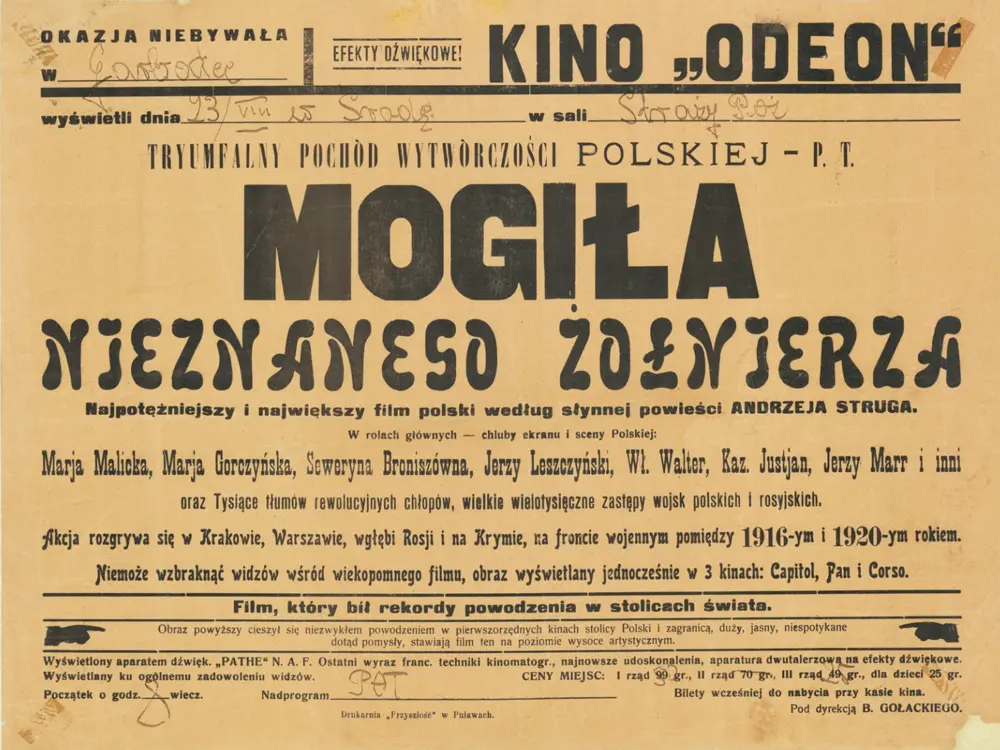
A definitive 5.6/10 rating for a film that redefined the boundaries of cult cinema. The Tomb of the Unknown Soldier remains a cornerstone of transgressive art.
Is The Tomb of the Unknown Soldier still relevant in today's crowded cinematic landscape? Short answer: yes, but with significant caveats that demand a certain cinematic palate. This 1927 Polish silent film offers a powerful, if at times ponderous, reflection on the human cost of World War I, making it a compelling watch for those deeply invested in historical dramas and the art of early cinema, yet it might prove a challenging experience for viewers accustomed to modern narrative conventions.
This film is unequivocally for cinephiles, historians, and anyone who appreciates the raw, expressive power of silent storytelling, particularly those interested in Polish cinema's contribution to the era. It is decidedly not for audiences seeking fast-paced plots, intricate dialogue, or contemporary action sequences; its deliberate pacing and reliance on visual melodrama require patience and an open mind.
Let’s get straight to the heart of it:
Ryszard Ordynski's The Tomb of the Unknown Soldier, co-written with Seweryn Romin and Andrzej Strug, isn't just a film; it’s a time capsule, a raw nerve of a nation grappling with the aftermath of an unimaginable conflict. The narrative, deceptively simple, follows Wanda and her husband, a young couple whose idyllic existence is shattered by the inexorable pull of World War I. This isn't a war film in the sense of grand battles or strategic maneuvers; rather, it’s a deeply intimate portrait of the home front's silent suffering.
The plot, which sees Wanda remarry after receiving news of her husband’s death, only for him to resurface, lost and disoriented, somewhere in the Eastern territories, taps into a universal fear of loss and the tragic irony of fate. It’s a narrative device that, while common in melodrama, gains significant weight from its historical backdrop. The 'unknown soldier' here isn't just a symbolic figure; it represents the countless individuals whose lives were irrevocably altered, whose identities were erased or distorted by the sheer scale of the conflict.
The film’s strength lies in its ability to translate this vast, abstract tragedy into personal agony. The agony of waiting, the agony of false hope, and the agony of an impossible choice. It's a testament to the enduring power of storytelling that even without spoken dialogue, the weight of these emotions feels palpable.
Silent film acting is an art form unto itself, demanding an exaggerated yet precise physical and facial expressiveness to convey complex emotions without a single spoken word. The cast of The Tomb of the Unknown Soldier, particularly Maria Malicka as Wanda, rises to this challenge with commendable skill.
Malicka, as the central figure, carries the emotional burden of the narrative with grace and intensity. Her initial joy as a newlywed is radiant, making her subsequent descent into grief all the more heartbreaking. The scene where she receives the telegram confirming her husband's death is particularly impactful; the camera lingers on her trembling hands and the slow, agonizing realization dawning on her face, a silent scream of despair that resonates deeply. It’s a moment that, despite the passage of a century, still manages to wrench the gut, showcasing the timeless power of human anguish.
Kazimierz Justian, as the presumed-dead husband, delivers a performance steeped in a quiet, enduring suffering. His return, not as a triumphant hero but as a broken, forgotten figure, is portrayed with a subtle pathos that avoids overt theatrics. The pain in his eyes, the weariness in his gait, speak volumes about the invisible scars of war.
Izabella Kalitowicz and Leokadia Pancewicz-Leszczynska, though in supporting roles, contribute significantly to the film’s emotional tapestry, their expressions of concern, sorrow, and societal expectation adding layers to Wanda's predicament. Their presence grounds the central tragedy in a community that, too, is wrestling with its losses.
Ryszard Ordynski's direction is a masterclass in silent-era storytelling, prioritizing visual narrative and emotional impact. Ordynski understands the power of the close-up, using it to draw the audience into the characters' inner turmoil, amplifying their expressions to communicate what dialogue could not. The framing often emphasizes isolation, particularly after the war separates the lovers, underscoring the vast distances, both physical and emotional, that tear lives apart.
The cinematography, while adhering to the technical limitations of its time, is remarkably effective. There are moments of striking visual poetry, such as the stark contrast between the vibrant pre-war scenes of domestic bliss and the somber, almost monochromatic depictions of wartime destruction and the subsequent melancholic peace. The use of shadow and light, a hallmark of early cinema, is employed to great effect, particularly in scenes depicting Wanda's internal struggles or the husband's desolate journey.
Consider the scene depicting the husband’s return. It’s not a grand, cinematic revelation. Instead, it’s a quiet, almost ghostly appearance in a somber setting, illuminated by a single, harsh light source. This choice amplifies the sense of alienation and the profound shift in his identity, making the audience feel his disconnection before a single intertitle explains his plight. This kind of visual nuance elevates the film beyond simple melodrama.
The pacing of The Tomb of the Unknown Soldier is deliberate, characteristic of silent films, allowing moments to breathe and emotions to fully register. This can feel slow to modern audiences accustomed to rapid-fire editing, but it serves to build a profound sense of anticipation and dread. The film takes its time to establish the idyllic life of Wanda and her husband, ensuring that the audience invests emotionally in their happiness before tragedy strikes. This investment makes the subsequent heartbreak all the more potent.
The tone is overwhelmingly melancholic, tinged with a pervasive sense of loss and the futility of war. Even moments of supposed joy or new beginnings are underscored by the lingering shadow of past suffering. There’s a palpable sense of a world forever changed, a generation scarred. This isn't a film about heroism or victory; it's about survival, sacrifice, and the enduring pain that war inflicts long after the last shot is fired. It’s a stark contrast to more overtly patriotic war films, offering a more somber, humanistic perspective.
The emotional resonance is surprisingly strong. Despite the period-specific acting styles and the absence of sound, the film manages to evoke genuine empathy. The universal themes of love, separation, grief, and the struggle to move on transcend the silent medium, connecting with contemporary viewers on a deeply human level. It's a testament to the power of pure visual storytelling when executed with sincerity and skill. I would argue that its emotional clarity rivals even some of its sound-era contemporaries, like American Methods, which often relied on dialogue to convey what this film achieves through expression.
The Tomb of the Unknown Soldier emerged from a Poland freshly re-established after over a century of partition, and still reeling from the scars of World War I. This context is crucial to understanding the film's profound resonance. The concept of the 'unknown soldier' held immense national significance, embodying the collective grief and memory of a generation lost to conflict. The film taps directly into this national psyche, offering a cinematic elegy for the countless unnamed heroes and the families they left behind.
Its portrayal of personal sacrifice and national remembrance speaks volumes about the societal healing process underway in Poland at the time. The film isn't just entertainment; it's a cultural artifact, a reflection of a nation coming to terms with its past and forging a new identity. It underscores the idea that while battles are fought by soldiers, the war is experienced by entire nations, leaving an indelible mark on every family, every community. This film, alongside others like Nuori luotsi from Finland, provides a window into the diverse post-war cinematic landscape of newly independent nations.
Absolutely, The Tomb of the Unknown Soldier is worth watching today for those with an appreciation for historical cinema and silent film artistry. It offers a powerful, emotional experience that transcends its technical limitations. While its pacing and melodramatic elements might not appeal to everyone, its sincere exploration of war's impact and the resilience of the human spirit remains deeply moving. It provides invaluable insight into a pivotal period of history and the cinematic language of an era long past.
This film serves as a vital document, not just of Polish cinema, but of a global consciousness grappling with unprecedented loss. Its themes of love, duty, memory, and the search for identity in the wake of catastrophe are timeless. While it might lack the kinetic energy of modern blockbusters or the intricate psychological depth of contemporary dramas, its raw emotional honesty more than compensates. It works. But it’s flawed. Yet, its flaws are often part of its charm, a reminder of a different cinematic era.
The Tomb of the Unknown Soldier stands as a powerful, albeit challenging, cinematic artifact. It is a film that demands patience and an appreciation for the unique artistry of the silent era, but rewards those who commit with a deeply moving and historically resonant experience. Its exploration of love, loss, and the profound, often invisible, scars of war is handled with a sincerity that transcends time and language. While it might not be a 'masterpiece' in the conventional, universally appealing sense, it is an essential piece of cinematic history, offering a window into a nation's soul and the enduring power of human emotion. For anyone serious about understanding the evolution of film and the impact of historical events on art, this is not merely a recommendation; it’s a necessary viewing. It’s a film that stays with you, not for its spectacle, but for its profound, quiet sadness.
IMDb 3.7
1929
Community
Log in to comment.