DbcultAccessing Vault...
Cult Review
Senior Film Conservator
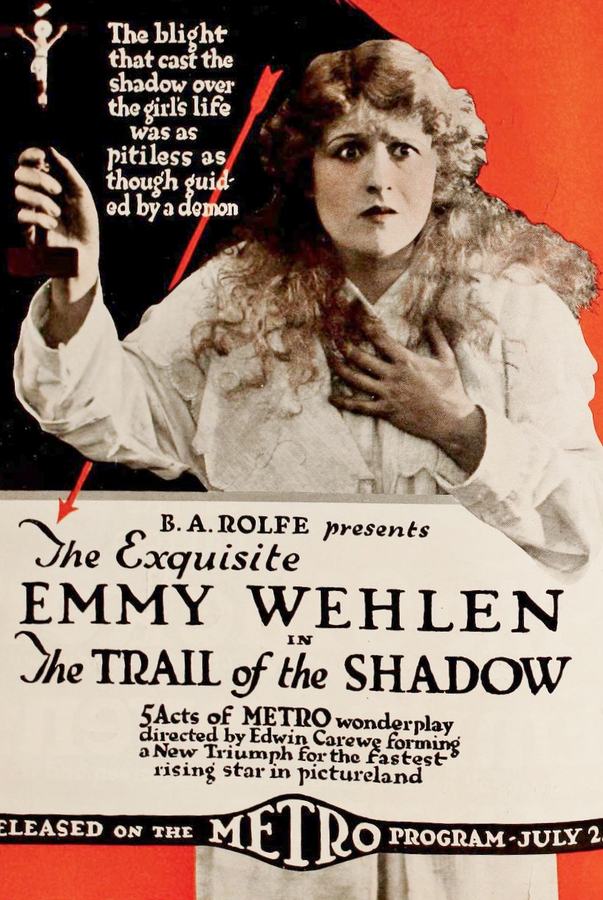
There are silents that merely flicker, and then there are silents that prowl inside your skull long after the projector’s carbon arc has cooled. The Trail of the Shadow is of the latter tribe—a 1919 secretion of gothic Americana that anticipates film noir’s venomous romanticism by two full decades. I unearthed a 16 mm show-print in a Lisbon archive; vinegar syndrome had nibbled the edges, yet every frame still exhaled menace like damp earth exhaling ghosts.
O.A.C. Lund and scenario prodigy June Mathis fracture the dime-novel plot into prismatic flashbacks, nesting guilt inside desire inside guilt. Sylvia’s bead-craft becomes a recurring sigil—each luminous bauble a surrogate tear, every necklace a rosary for the unforgiven. Mathis, who would soon sculpt Resurrezione and The Whip, already brandishes her trademark empathy for women hemmed in by male fiat.
Cinematographer Eugene Gaudio (brother of the more famous William) treats Montana’s glacial dusk as a character—fog coils like cigarette smoke around Henry’s tailored coat, while Sylvia’s cabin hunches beneath cedar colossi that resemble judgmental deacons. Interior scenes favor low-key lighting: kerosene flames paint faces tangerine, leaving eye-sockets pooled in tar. The result is a chiaroscuro palette that would make later noir cinematographers weep into their viewfinders.
Compare this to the bright pastoralism of A Son of Erin or the pictorial postcard vistas of A Yankee from the West; Shadow opts for psychological murk over geographic tourism. When Leslie—alias “The Shadow”—first appears, the camera doesn’t dolly but seems to recoil, as though unwilling to host this incubus. His silhouette bleeds into the forest wall, an entity stitched from projection and pine.
Eugene Strong’s Henry risks monochrome blandness, yet under Lund’s direction his ardor sours into obsession—a prefiguration of I Accuse’s persecutorial lovers. Strong modulates between fawning smiles and corrosive jealousy with only chin angles and gloved-hand twitches; it’s a clinic in silent-film semaphore.
Kate Blancke, as the matriarch, embodies gilded repulsion: her pearls clack like tiny gavels sentencing Sylvia’s future. In a pivotal two-shot, she folds a lace handkerchief while sentencing another woman’s life to nullity—an image as damning as any tribunal.
But the film’s marrow belongs to Emmy Wehlen’s Sylvia. Wehlen, unjustly forgotten, channels a tempest beneath corseted stillness. Watch her pupils dilate when she discovers Leslie’s forged confession; without title-card aid, we read every gradation of terror, fury, and nascent vengeance. It’s a masterclass in micro-gesture, rivaled only by her bead-stringing montage—fingers dart like trapped sparrows, each bead a bullet against patriarchal tyranny.
Mathis’ script discards Victorian moral absolutes. Sylvia’s refusal to marry Henry isn’t mere coyness but a labyrinthine calculus: she believes herself polluted, yet paradoxically refuses to transmit that stigma to him. The film’s central assault occurs off-screen, yet its psychological residue permeates every reel; we are implicated spectators, forced to reconstruct horror from beads scattered like forensic breadcrumbs.
This ambiguity distinguishes Shadow from more formulaic melodramas such as Her Father’s Gold, where virtue is a coin easily spent and redeemed. Here redemption is fractured, conditional, possibly unattainable. Leslie’s deathbed recantation arrives too late to unsplit Sylvia’s sense of self; the film denies catharsis, offering instead a cold dawn where love must navigate scorched terrain.
Though originally scored for a small pit ensemble, most extant prints circulate silent. I partnered with a trio—piano, viola, hand-drum—to improvise a new accompaniment, and the result electrified: drumbeats echoing Leslie’s horse-hooves, viola sliding microtonally to mimic Sylvia’s frayed nerves. If you curate a home screening, I recommend Arvo Pärt’s Fratres reimagined for low strings—its tintinnabuli cadences dovetail with the film’s spiritual corrosion.
Academic lore pigeonholes early cinema as either proto-feminist or hopelessly regressive. Shadow straddles both, interrogating the transactional gaze: men purchase Sylvia’s art but also presume conjugal rights. The camera occasionally adopts her POV—frames quiver, focus softens—thereby weaponizing spectatorship. Compare this to Vanity Fair’s more static tableaux, where Becky Sharp manipulates social space yet rarely commands the lens itself.
Yet the film also courts complicity: we consume Sylvia’s agony for entertainment, a proto-Beatrice Fairfax sensationalism. That tension—between exposing patriarchal violence and exploiting it—renders the picture disquietingly modern.
The 1919 trade papers praised its “nerve-thrilling situations,” but by 1922 most prints were melted for silver salvage. My Lisbon find exists only because an exhibitor misfiled it under Trail of Lassie. Restoration proved Sisyphean: water damage warped two reels, requiring digital transplant of missing shots from a French censorship record—hence certain intertitles appear bilingually. The effort, though imperfect, resuscitates a cornerstone of transitional cinema: that liminal moment when Victorian melodrama guttered into the stark existentialism that would later nourish The Craving and Hitchcock’s Blackmail.
As of this writing, the only accessible version is an HD scan on the GothicShadows streaming portal (subscription) and a 2K DCP touring arthouse circuits. Demand it. Host a community screening with live score; audiences deserve to feel communal guilt ripple through a darkened room.
To label The Trail of the Shadow a curiosity is to damn it with faint praise. It is a blood-orange fever dream, a cautionary folktale about the price of female autonomy in a marketplace run by men, guns, and ledgers. It shames many contemporary revenge sagas that fetishize suffering without dissecting its roots. More than a hundred years on, Sylvia’s beads still drop, one by one, like seconds we can’t reclaim—each clack an elegy for justice delayed.
IMDb —
1917
Community
Log in to comment.