DbcultAccessing Vault...
Cult Review
Senior Film Conservator
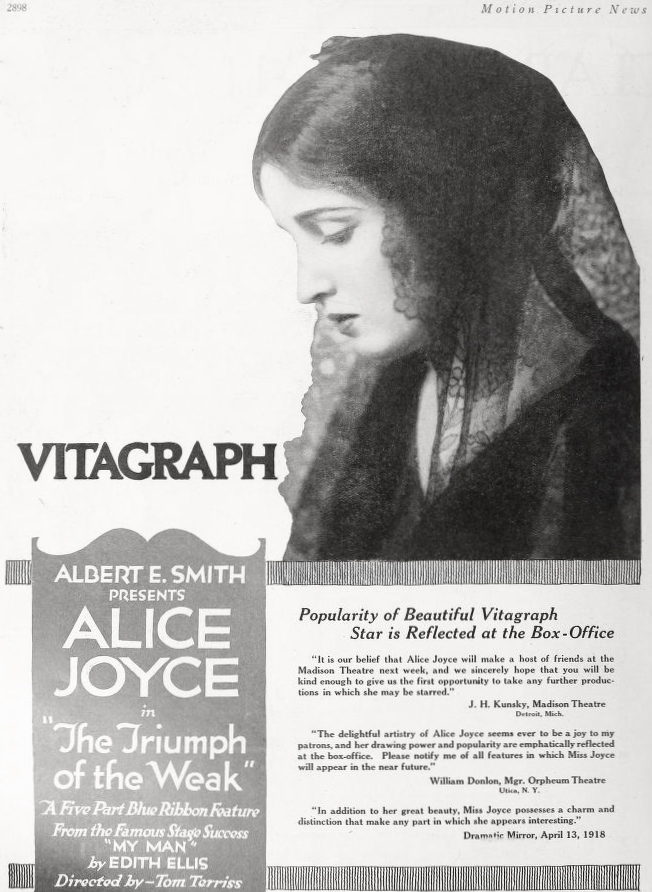
Prison, in The Triumph of the Weak, is never merely a set of walls; it is a state of mind that follows the body like stale smoke. When Edith steps through the iron gate, the camera (or rather, the stationary tableau that passes for one in 1918) refuses to grant her the usual pastoral re-entry. Instead, the city itself feels incarcerated—shop-windows barred with price-tags, sidewalks grated with gum and guano. Alice Joyce lets her cheekbones do half the acting: they jut forward as though still pushing against invisible bars, a skeletal reminder that freedom can be another enclosure.
The film’s primal wound is not the theft but the kidnapping-by-state of a child. In a decade when Progressivism flirts with eugenics, the scenario plays like a cautionary pamphlet: a widow’s poverty equals unfitness, her baby re-categorized as institutional inventory. The asylum’s exterior—shot in stark side-light that throws long shadows of the iron fence across the road—feeds the impression that the state itself is the pickpocket. When Edith swaddles the boy beneath her coat and slips past a yawning gatekeeper, the intertitle reads simply: “Mine again.” Two words, but the film’s emotional vertebrae snap into place with an audible crack.
Jim’s courtship unfolds amid towering stacks of linens and celluloid collars—consumerism’s nave. He is part priest, part cashier, blessing her with a wedding ring that doubles as a price-tag. The filmmakers invert the Gilded-Age mantra that woman equals commodity; here the commodity warehouse becomes the site of re-humanization. Yet the register’s ka-ching reverberates like a warning bell: respectability can be bought on installment, but the past demands lump-sum repayment.
Mabel storms in wearing a coat lined with menace, pockets heavy with shared memories sharpened into shivs. She is the return of the repressed in feathered hat, a one-woman Greek chorus reminding Edith that sisterhood behind bars mutates into parasitism outside them. Every encounter is lit to carve hard triangles under eyes and cheekbones, turning human faces into jack-o’-lanterns of dread. The script, co-written by Edith Ellis—one of the few openly lesbian playwrights of her day—smuggles in a subtext about transactional intimacy: how women exchange confessions like IOUs, how flesh and guilt become negotiable tender.
Jordan arrives not as deus ex machina but as moral auditor, balance-sheet in hand. His recognition of Edith is filmed in a disquieting medium-close-up: pupils dilate, iris seems to click like a camera shutter. The moment feels less like law enforcement than like a lover’s spark—an echo of Ellis’s own sub-rosa themes. Yet the film refuses the easy binary of cop versus criminal; Jordan’s memory is fallible, his righteousness porous. When he finally bleeds on the carpet beside the purloined $400, the bruise-purple of his eye sockets mirrors Edith’s earlier penitential shadows, suggesting that guilt is the true common currency.
Jim and Jordan’s plan to bait Mabel would be comedic if it weren’t so callous: plant cash, dim lights, wait for the woman to bite. The sequence plays like a parody of middle-class paranoia—everyone a potential shoplifter, every drawer a trap. When Edith, frantic to protect the household name, reaches for the bills, the electric bulb’s flare is filmed as a white gash across the frame. It is 1918’s version of the modern jump-scare, but the horror is existential: the instant in which every mask liquefies.
Edith’s monologue—delivered in staggered intertitles—spills like arterial spray. She recounts the first theft: a purse snatched to buy condensed milk, the baby’s cry transmuted into lullaby of desperation. The syntax is clipped, almost telegraphic, yet between the lines blooms a taxonomy of maternal panic. Jim listens framed against a mantelpiece lined with wedding photos that now resemble mug-shots. The marriage, once a fairy-tale of retail romance, curdles into a plea-bargain: stay with me despite my fingerprints.
The climactic brawl—Jordan versus Jim—has none of the kinetic choreography of later action cinema; it is two men grappling like blindfolded bears amid doilies and rocking-chairs. Yet the clumsiness is oddly affecting: civilization stripped to its animal undershirt. When Jordan, face swollen like overripe fruit, presses the pardon into Edith’s trembling palm, the gesture rewrites the entire moral ledger. Law bows to mercy, not through divine intervention but through shared brokenness.
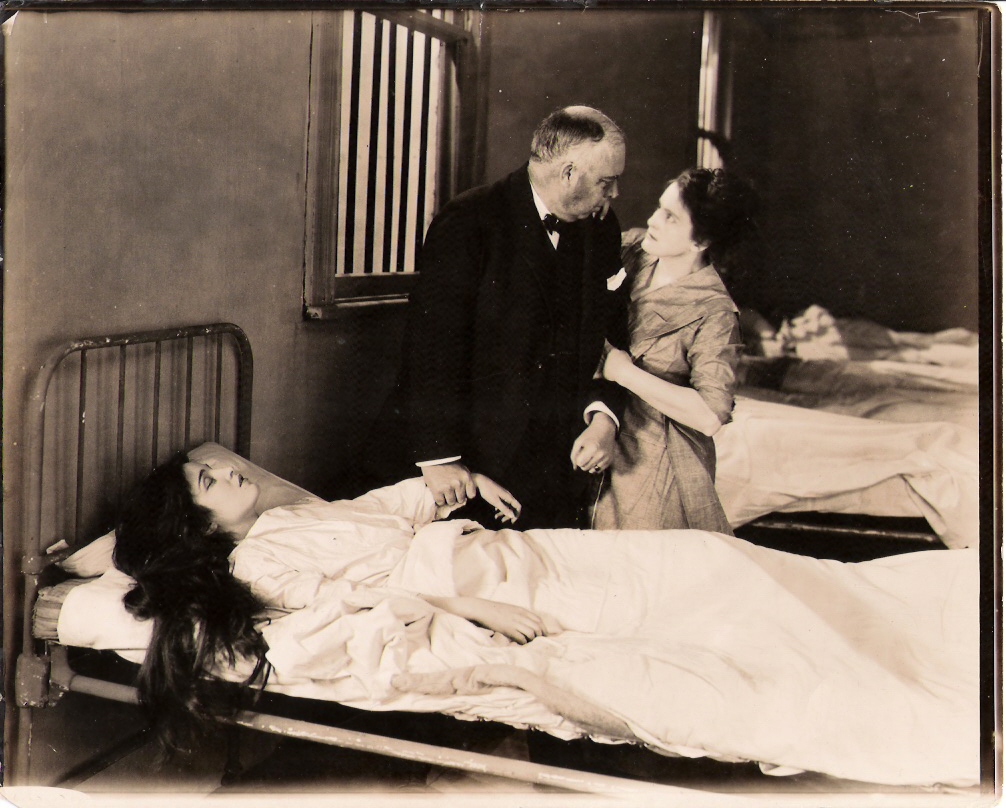
Surviving prints—likely duped from 28mm—carry a sea-blue tint during night interiors, umber glow for daylight sincerity. The tinting is not mere ornament but narrative syntax: blue equals entrapment, amber the illusion of warmth. Notice how Mabel’s dress changes hue scene-to-scene, a chameleon of moral infection. Even the baby’s blanket—supposed symbol of purity—bears a nicotine stain that whispers heredity’s stubborn grime.
Alice Joyce modulates between marble stoicism and sudden hair-line cracks: a blink held half-second too long, a lip chewed until blood seems imminent. Templar Saxe’s Jim is all forward-leaning eagerness, shoulders perpetually in plea posture. Eulalie Jensen’s Mabel preens like a vaudeville villainess, yet in the flicker of a match you glimpse the same terror that haunts Edith—sisterhood in shame’s mirror. It is the kind of acting that modern viewers might deride as “theatrical,” but in the vacuum of sound it acquires eerie modernity: every muscle must speak, and the diaphragm becomes diaphragm of pathos.
Released the same year the Suffrage Amendment crept toward ratification, the film straddles an ideological fault-line: women’s citizenship expanding while their bodies remain policed. Edith’s crimes are all survival-driven; Jim’s complicity is prosperity-driven. The asymmetry is glaring yet uncommented-upon, allowing modern scholars to read the movie as proto-feminist noir. The department store, staffed largely by women earning pennies, becomes panopticon where consumption and surveillance merge.
While no original score survives, 1918 exhibitors typically cued medleys of “The Rosary” and “Hearts and Flowers” for penitent scenes, switching to gallop for chase sequences. Contemporary trade sheets praised the film’s “delicate handling of social sores,” but Variety sniffed at its “maudlin mother-love.” Today, the absence of sound feels less like limitation than X-ray: you hear the grinding of narrative gears, the heartbeat of an era learning to feel guilty about its own cruelties.
Place The Triumph of the Weak beside The Shadow of Her Past and you see mirrored corridors of fallen women seeking redemption via male benevolence. Stack it against The Wildcat of Paris and note how both films weaponize the female body as urban explosive, yet only one grants the woman maternal motivation. Unlike The Girl Who Didn’t Think, here thought itself is the protagonist’s Achilles heel—every calculation drags her deeper into doom’s ledger.
No complete negative is known to survive; what circulates among collectors is a 9.5 mm abridgment, its intertitles sometimes in French, sometimes in Dutch, English reduced to rumor. Yet the fragments exert hypnotic pull: a close-up of Edith’s hand clutching prison bars dissolves into her hand clutching baby blanket—continuity of touch across carceral void. In an age of algorithmic surveillance and motherhood penalties, the film’s anxieties feel startlingly present. Edith’s plea bargain with patriarchy prefigures every modern gig-worker forced to trade biometric data for paycheck.
Watch the last reel at 2 a.m. and you may hallucinate your own reflection between the scratches: a parent stealing time from corporation, a worker forging sick-day excuses, a citizen erasing browser history. The pardon that ends the film is less narrative closure than systemic loophole—mercy as statistical anomaly. Jordan’s battered face turning away from camera becomes silent concession that justice, like nitrate stock, is flammable and partial. Yet the final image—Edith, Jim, child walking into over-exposed sunlight—lingers like retinal burn, reminding that every system leaks, every triumph is rented, every weakness the seed of next revolt.
—review by Cine-Grimoire, MMXIV

IMDb 6.5
1920
Community
Log in to comment.