DbcultAccessing Vault...
Cult Review
Senior Film Conservator
Picture a canvas where chiaroscuro trenches slice through the Lombard plain, where the flicker of nitrate ignites both gunpowder and conscience, and you have The Two Sergeants—a 1913 Italian one-reel marvel that distills the entire emotional spectrum of Victorian melodrama into a breathless twenty-seven minutes.
From its opening tableau—an immaculate line of bayonets glinting like piano wires under sunrise—the film announces itself as a study in vertical hierarchies: the ramrod Captain Derville, all epaulettes and posture, versus the slouching private whose wrinkled collar becomes the butterfly wing that triggers a hurricane of disgrace. The theft of the payroll is staged with Hitchcockian parsimony: a glance, a rustle, a empty tin chest, and suddenly the frame is bereft of certainty. Notice how director Umberto Paradisi tilts the camera a hair’s breadth, as though the world itself has begun its slide into chaos.
Cut to the Apennine highlands, charcoal clouds scraping granite peaks; here Derville, now cloaked in anonymity, rescues Gustave from a cascade that roars like an artillery barrage. The rescue is shot in depth: foreground scrubs thrash, mid-ground water hammers rock, background mist swallows sky—an elemental trinity foreshadowing the baptismal ordeal of the finale. When war erupts, the narrative accelerates like a locomotive whose brakes have been severed. Battlefields are conjured with smoke pots, painted cycloramas, and a battery of extras who charge toward the lens until the very frame seems to hemorrhage.
Inside this maelstrom, the friendship of the two sergeants flowers with a tenderness rarely accorded to male camaraderie in early cinema. Robert’s grin—crooked, sun-scorched—contrasts with William/Derville’s mournful eyes that forever scan the horizon for absolution. Their shared cigarette becomes a secular communion, smoke wreathing two faces in fleeting unity. The quarantine gate sequence, lit by guttering oil-lamps, stages morality as geometry: the diagonal line of the widow’s supplication intersects the vertical rifles of authority, while the horizontal threshold of the gate becomes a frontier between mercy and regulation.
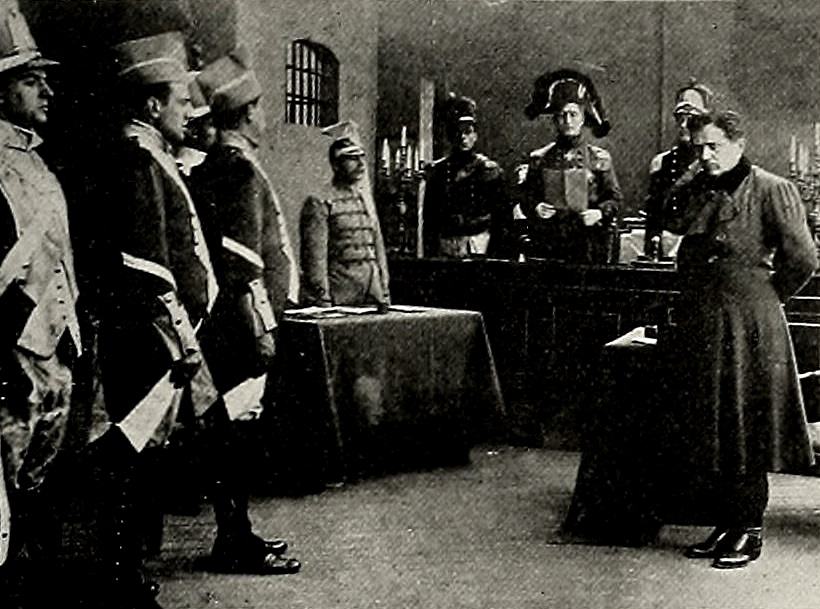
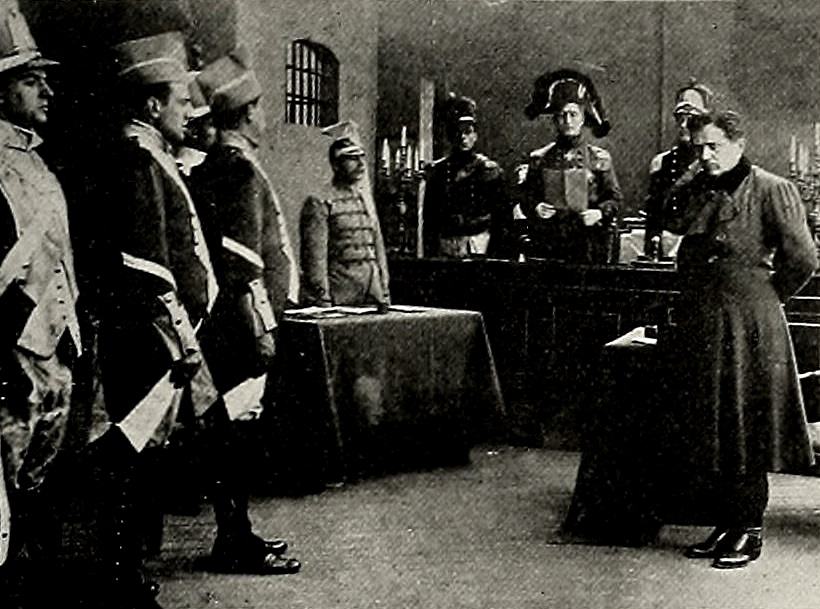
When the aide-de-camp, Valmore, slithers into frame, the lighting curdles; his face is half-eclipsed by a lantern, the other half aglow with serpentine calculation. The court-martial unfolds in a stone hall where shadows of past centuries seem to seep from the mortar. The dice—ivory cubes that clatter like distant musketry—are shot in macro before the faces of the condemned, an Eisensteinian synecdoche for the randomness of fate.
Yet the film’s emotional apotheosis arrives not with the verdict but with the dispatch-boat ride across gunmetal waters. The captain, Gustave, stands at the wheel, torn between gratitude and manipulated guilt; behind him, Derville clutches a daguerreotype of his wife as if it were a passport out of damnation. On Rozès, domesticity—cottage smoke, children’s laughter—collides with martial time: the fortress cannon that will signal doom. Paradisi intercuts these spheres with accelerating alternation, each cut shaving seconds off the temporal fuse.
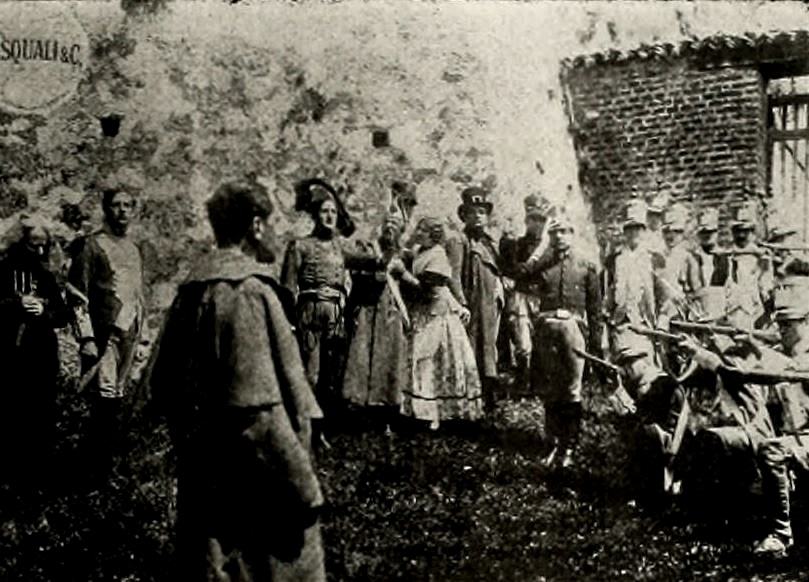
Then the swim: a sequence so primal it feels dredged from myth. The camera bobs at water level, waves slapping the lens, turning the spectator into flotsam. Derville’s limbs, back-lit by moon-ringed clouds, become calligraphic strokes against obsidian. Cutaways to the fortress—Robert bound, Laura swooning, Valmore smirking—compress space into a single throb of suspense. When the protagonist finally collapses on the opposite shore, the image irises in on his trembling hand smearing wet sand—an abstract gesture that says life persists.
Performances oscillate between operatic and intimate. Alberto Capozzi modulates Derville’s anguish with the precision of a violin string—one instant taut with command, the next frayed by paternal longing. Opposite him, Orlando Ricci endows Robert with a jaunty fatalism, a man who jokes with death because flirtation is the only armor left. The child actors—nonprofessionals recruited from a Turin orphanage—impart a documentary rawness; their saucer-wide eyes absorb horror the way blotting paper absorbs ink.
Technically, the film straddles eras. While 1913 contemporaries like Les Misérables still rely on proscenium-wide tableaux, The Two Sergeants experiments with reverse-angle cuts during the bombardment, giving spatial coherence to chaos. Tinted prints—amber for interiors, cerulean for night exteriors, crimson for battle—survive in the Turin archive, and these chromatic waves amplify emotional thermostats without needing intertitles. The restoration by the Cineteca di Bologna reveals grain like shrapnel, each speck a fossilized flake of history.
Scholars often pigeonhole the movie as nationalist propaganda anticipating Italy’s 1915 entry into WWI, yet its heart beats with pacifist irony: the same army that brandishes justice is shown to devour its most virtuous. Compare it to From Dusk to Dawn or The Redemption of White Hawk—both contemporary morality tales—but none fuse personal redemption and institutional critique with such compact ferocity.
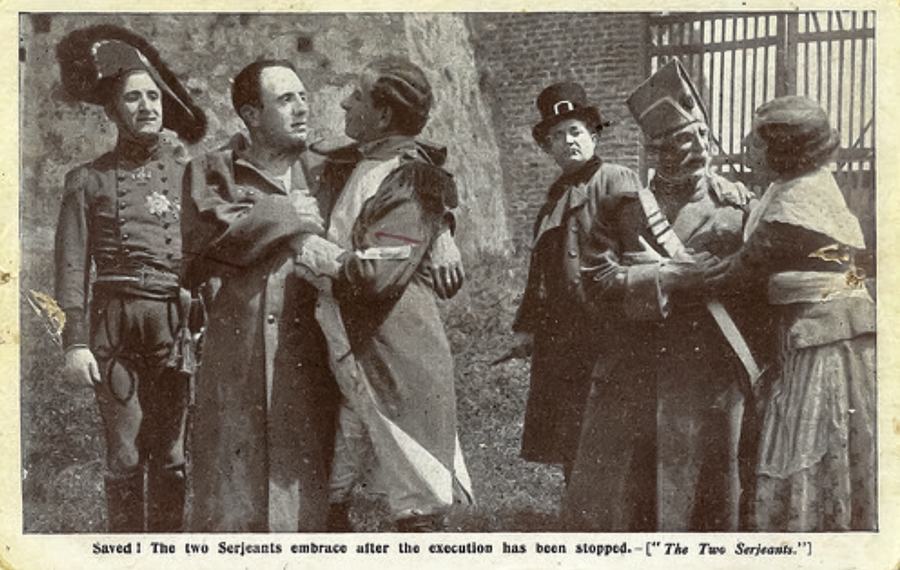
Modern viewers may smirk at the contrivance of a last-second swim, yet the trope is earned by the film’s relentless interrogation of honor. Derville’s earlier disappearance was an abdication; his aquatic return is a baptismal reclamation of agency. The final unmasking of Valmore, dragged away in shackles, offers catharsis less because evil is punished than because transparency itself becomes the ultimate victor.
So why does this obscure one-reeler matter? Because it distills the quintessential silent promise: that faces, landscapes, and light alone can conduct a symphony as nuanced as any talkie. Because its DNA—cross-cutting, subjective POV, chiaroscuro—would inoculate The Student of Prague, Fantômas, even Lang’s Die Nibelungen. And because, in an age of algorithm-fed content, the film reminds us that narrative urgency is timeless; tension is not measured by reel count but by how deeply the human face can tremble before the lens.
If you’re scavenging film history for missing links between Méliès’ moon-men and Griffith’s Babylon, dock here. Watch The Two Sergeants once for its plot pyrotechnics, again for its proto-film grammar, and a third time to witness how the silent era could whisper more loudly than any Dolby roar. The cannon will sound, the dice will roll, and somewhere between the first flicker and the final iris, cinema itself seems to hold its breath alongside two men wagering life on the throw of fate.
IMDb —
1919
Community
Log in to comment.