DbcultAccessing Vault...
Cult Review
Senior Film Conservator
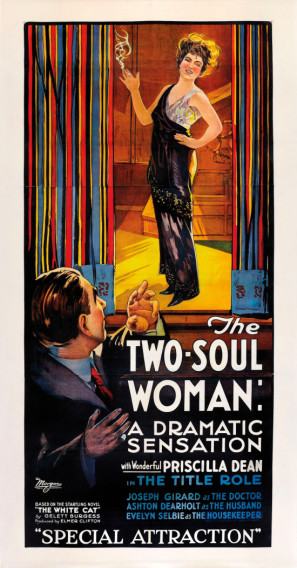
The Two-Soul Woman is not merely a film about a woman with two souls—it is a cinematic séance summoning the ghosts of early 20th-century anxieties, where identity is a fragile construct and love is a battlefield of manipulation. Directed by Elmer Clifton with the precision of a neurosurgeon wielding a scalpel, this 1920s silent picture carves into the psyche of its protagonist, a woman torn between two selves, as she becomes the pawn in a deadly game between a calculating hypnotist and a man whose love is both his salvation and his curse. The film’s enduring power lies in its ability to make the viewer complicit in her unraveling, a feat achieved through haunting close-ups, disorienting editing, and a score that thrums like a second heartbeat.
Priscilla Dean’s performance is a tour de force of subtlety and raw intensity. Her portrayal of a woman with dual personality disorder is not reduced to mere histrionics; instead, she channels the duality through minute shifts in posture, glances that flicker between innocence and defiance, and a voice modulated to suggest two distinct souls sharing a single body. This technique, reminiscent of Evelyn Selbie’s work in The Slave Mart, elevates the film beyond dime-store melodrama into the realm of tragic poetry. Dean’s character is both victim and architect of her own disintegration, a duality that Clifton and co-writer Gelett Burgess exploit with surgical precision.
The hypnotist, played with chilling magnetism by Ashton Dearholt, embodies the era’s fascination with and fear of scientific experimentation gone rogue. His introduction—a slow pan across a cluttered study filled with tomes on psychology and apparatuses that seem to hum with malevolent energy—sets the tone for a villain who is less a man than an idea: control. His methods are not overtly violent but insidious, a series of whispered suggestions and sidelong glances that unravel the protagonist’s grip on reality. This contrasts sharply with Joseph W. Girard’s performance as the tormented suitor, whose desperation to save his lover from the hypnotist’s clutches is both earnest and tragically misguided. Girard’s character is the film’s moral center, though Clifton refuses to let him off the hook for his own complicity in her disintegration.
What sets The Two-Soul Woman apart from its contemporaries is its refusal to sanitize its subject matter. Unlike the lurid sensationalism of The Siren, which reduces its protagonist to a symbol of sexual chaos, this film treats its heroine’s condition with a clinical yet deeply humanistic eye. The script, co-written with Gelett Burgess, avoids the temptation to provide easy answers. There is no triumphant resolution, no neat separation of the two souls; instead, the film ends with a lingering shot of the woman’s face, her eyes reflecting the fractured light of a chandelier, as if to ask whether the self is ever truly whole. This ambiguity, rather than being a narrative weakness, is its greatest strength—a mirror held up to the viewer’s own uncertainties about identity and autonomy.
Cinematographically, the film is a masterclass in visual storytelling. The use of mirrors, shadows, and split-screen techniques creates a sense of claustrophobic duality. One particularly striking sequence features the protagonist’s two personas confronting each other in a mirrored hallway, their reflections multiplying into an endless corridor of selves. This scene, shot in a single take with meticulous precision, is a precursor to the psychological horror of later films like Her Second Husband, though Clifton’s approach is more restrained, preferring suggestion over shock. The lighting, too, is a character in its own right—harsh, unflinching in moments of crisis, and diffused to a ghostly pallor during the protagonist’s most vulnerable states.
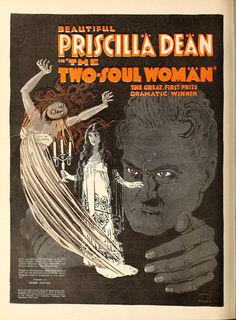
The film’s sound design (even within the constraints of a silent picture) is another revelation. The absence of dialogue forces the viewer to attune themselves to the rhythm of the editing, the creak of a floorboard, the sudden silence that follows a hypnosis session. These auditory cues are as telling as any spoken line, creating a soundscape that thrums with tension. When the score does intervene, it is with a mournful waltz that seems to echo the protagonist’s internal conflict, a melody that is at once beautiful and maddening.
Thematically, The Two-Soul Woman resonates with a modern audience precisely because it grapples with questions that remain unresolved: Can a person be held accountable for the actions of another self? Is love a form of control or liberation? The film’s exploration of these ideas is not didactic but immersive, drawing the viewer into the protagonist’s fractured world. This is particularly evident in the scenes where the two men—Dearholt’s hypnotist and Girard’s suitor—engage in a silent power struggle over her fate. Their rivalry is not merely over possession but over the right to define her identity, a battle that mirrors the societal forces of the time that sought to categorize and confine women’s roles.
Comparisons to other films of the era are inevitable. The hypnotist’s lair, with its occult trappings and pseudo-scientific jargon, owes a debt to The Code of Marcia Gray, though Clifton elevates the trope by grounding it in real psychological theories of the time. Similarly, the film’s structure—a woman caught between two men—echoes The Voice of Love, but with a far darker undercurrent. What sets The Two-Soul Woman apart is its refusal to romanticize its heroine’s condition. She is not a madwoman in a tower; she is a woman in a world that refuses to see her as a whole.
In the pantheon of early psychological thrillers, The Two-Soul Woman stands as both a relic and a revelation. It is a film that dares to ask uncomfortable questions about identity, agency, and the cost of control, and it does so with an artistry that transcends its era. For modern viewers, it is a stark reminder of how far cinema has come—and how much it has always owed to the pioneers who dared to explore the shadows of the human mind. The film’s final act, in which the protagonist’s two selves fuse into a single, defiant gaze at the camera, is a silent challenge to the viewer: to look beyond the surface, to see the multiplicity within us all.
In an age where psychological complexity is often reduced to plot devices, The Two-Soul Woman remains a testament to the power of cinema to reflect the chaos of the human soul. It is not a film to be watched passively but one to be lived, to be felt in the marrow of the viewer’s bones. And in that sense, it is as much a two-soul masterpiece as it is a two-soul warning: that in the end, the greatest enemy may not be the hypnotist, nor the lover, but the self we are too afraid to confront.
IMDb 6.7
1933
Community
Log in to comment.