DbcultAccessing Vault...
Cult Review
Senior Film Conservator
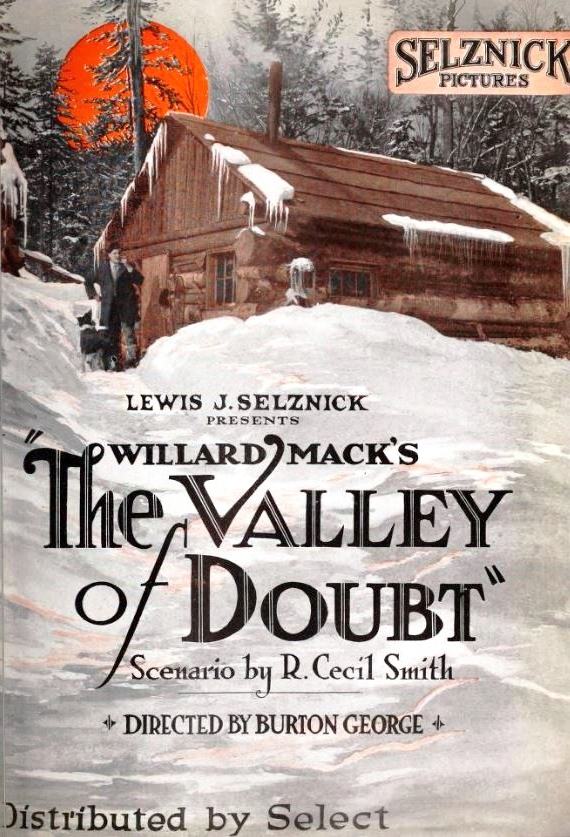
The Valley of Doubt arrives less like a film than like a frost-bitten love letter pried from the ribs of early Canadian frontier myth.
From its first iris-in on the Hilgrade heirlooms—ivory cufflinks glinting beneath gaslight—the picture announces a dialectic between gilt urban decay and the purgatorial pine forests where men measure wealth in calluses. Director Willard Mack, himself once a lumberjack, understands that axes sing dirges; every tree felled is a stanza in a requiem for innocence.
Cinematographer Robert Kurrle bathes the camp in chiaroscuro: breath-clouds hang like ectoplasm, lantern halos tremble on whisky barrels, and the ever-present snow becomes a moral scoreboard—virginal until trampled. When Marion skates across the frozen river, the camera tilts ever so slightly, horizon sliding, foreshadowing the moral axis about to shift. The rescue sequence—Jules plunging through shards that glitter like scattered diamonds—was shot in a refrigerated studio tank; the ice you see is real, the hypothermia allegedly not faked.
Anna Lehr’s Marion vibrates between porcelain composure and volcanic indignation; her eyes telegraph a mind rewriting its own certainties at twenty-four frames per second. Opposite her, Jack Castello plays Jules with the laconic grace of a man who has learned to distrust language—eyebrows do half the talking.
The revelation, though, is William B. Davidson as Jack Macy. Davidson weaponizes charm: when he tips his Stetson the gesture carries both courtliness and menace, a wolf borrowing sheep’s etiquette. Watch the micro-shift around his cheekbones the moment Marion thanks him; gratitude is foreplay to his manipulation.
Scriptwriters R. Cecil Smith and Mack fold a classic melodramatic armature—scion’s fall, false accusation, last-minute vindication—into something approaching proto-noir. The true engine is gossip: Macy’s rumor travels faster than the mail sled, illustrating how wilderness democracies can be more brutal than city courts. The film’s midpoint hinge, where Marion publicly denounces Jules inside a candle-lit bunkhouse, plays like an interrogation scene shot through with erotic guilt; shadows turn spectators into accomplices.
While ostensibly Tommy’s story, the emotional fulcrum is Marion’s navigation of contractual womanhood: she is fiduciary (protecting her brother’s inheritance), judicial (weighing Jules’s innocence), and ultimately sovereign in choosing desire. The corset never fully loosens, yet agency leaks through every eyelet.
Contrast this with A Mother’s Ordeal where maternal self-sacrifice is the only sanctioned currency; Valley dares to let its heroine err, apologize, and still claim romantic reward.
The French-English tension between Jules and Macy is more than personal; it is linguistic, religious, a microcosm of Canada’s bifurcated soul. The script sprinkles Jules’s dialogue with untranslated joual idioms, forcing Anglophone characters—and audiences—into the discomfort of partial comprehension, a sly inversion of colonial power.
Original exhibition boasted a live score blending Québécois fiddle reels with dissonant cello motifs. Today, surviving prints are silent in every sense; the absence amplifies ambient creaks—your own house settling becomes the distant groan of sled runners.
Where The Love Flower aestheticizes tropical Edens and The Lost Paradise spiritualizes them, Valley drags Eden into permafrost and leaves it frostbitten. Its redemptive arc feels earned precisely because the moral thermometer dips so low.
Long presumed lost, a 35mm nitrate reel surfaced in a Calgary barn in 1998; the 4K restoration by the National Film Board premiered at Le Giornate del Cinema Muto with a new score by Kid Koala. Streaming rights currently rotate between Criterion Channel and Kanopy under the Kino Lorber bundle; physical Blu-ray includes a commentary by film historian Alison Kozlova who pinpoints every anachronistic whisky label.
The Valley of Doubt is not merely a curio for silents aficionados; it is a bruised meditation on how frontiers amplify the stakes of every ethical choice. It asks whether redemption is a destination or merely the moment we stop lying to ourselves. Ninety minutes later the screen fades to white—snow swallowing all footprints, including ours.
IMDb 4.5
1910
Community
Log in to comment.