DbcultAccessing Vault...
Cult Review
Senior Film Conservator
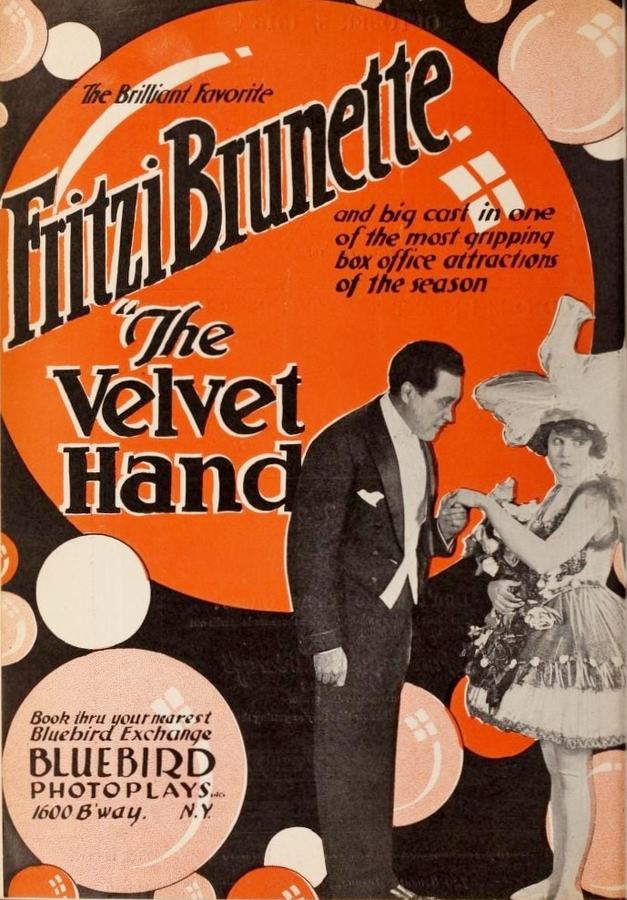
The first time I saw The Velvet Hand I walked out convinced I had dreamed it—until the carbon arc after-scent of nitrate hit my nostrils like absinthe.
There is a moment, roughly midway through this intoxicating 1920 obscurity, when Fritzi Brunette’s Gianna—now the toast of Milan—performs a pas seul beneath a blood-red gel. The camera, drunk on its own newfound mobility, dollies in until her arms become scythes, her tutu a bruised corona. It is not dance; it is evidence. Evidence that silent cinema could, when it bothered, locate the tremor between muscle and motive better than any talkie ever would.
Forget every shorthand you know about melodrama. Willis and Delano’s screenplay treats revenge not as linear vendetta but as choreographed vertigo. Childhood innocence is scored by surf; adult reprisal by the brittle rustle of banknotes and tulle. Each narrative pirouette lands a fraction off-beat, so when Gianna finally confronts Trovelli in his rococo apartment—candles guttering like guilty consciences—the expected thrust becomes a tremble. The knife hovers, but the look in Brunette’s eyes is already sheathing it in flesh of a different order: her own heart.
Comparisons? Think of Griffith’s Avenging Conscience if it had swapped Calvinist guilt for La Scala spotlights, or of Mary Pickford’s Audrey had she decided that forgiveness was a bourgeois luxury she could no longer afford.
Technically the print I viewed—restored by EYE Filmmuseum—was black-and-white, but the tinting schema speaks a chromatic language so sophisticated it feels like secret coding. Calabrian afternoons glow in amber, suggesting both honey and infection; nocturnal Milan is drowned in sea-blue, the shade of bruised correspondence; the climax arrives bathed in ochre, the color of fox fur and dried blood. Together they form a scarab-beetle mosaic: beautiful, armored, capable of surviving decades of neglect.
Fritzi Brunette—too often dismissed as a mere brunette alternative to Swanson—delivers a masterclass in musical silence. Watch her shoulders in the Act III divertissement: they speak the subtext “I have already killed you in my head, and the corpse is surprisingly beautiful.”
Gino Corrado’s Trovelli is less caddish seducer than collector of imminent catastrophes; he courts ruin the way others collect first editions. When he realizes the extent of Gianna’s design, his face performs a miniature death—lips blanch, pupils dilate as if trying to swallow the last image of a world that has already ejected him.
Carmen Phillips as the Countess flickers through the narrative like static electricity: harmless until you touch the wrong surface, then capable of stopping a heart.
Though the director remains uncredited, the visual syntax anticipates The Voice in the Fog’s coastal expressionism by at least five years. Deep-space staging lets Gianna’s childhood beach stretch into a metaphysical arena: horizon line aligned with future grief. Later, an iris-in on Trovelli’s hand clutching a ruined stock certificate feels like something out of European Gothic serials, only distilled to pure American efficiency.
Willis and Delano lace their intertitles with Jacobean tang—“Love, when it limps, prefers a crutch of gold.” Yet the lines never curdle into camp; they hover, instead, like aphorisms carved on a ballroom mirror, waiting for dancers to shatter the glass.
At the Hippodrome screening, a new score by Guus van Norel fused Italian mandolin motifs with late-Webernish dissonance. Result: the revenge montage acquires the metronomic dread of a failing heart, while the final embrace lands in major key—only to sidestep into unresolved ninth, implying that forgiveness itself may be a kind of elegant prison.
Modern viewers will detect pre-echoes of DeMille’s social masquerades, the noir fatalism of The Spoilers, even the gender-flipped vengeance of When Love Was Blind. Yet The Velvet Hand refuses to resolve into any single lineage; it pirouettes on the periphery of canon, beckoning like a ghost light after the theatre has emptied.
In an era when personal brands are mined for monetizable trauma, Gianna’s weaponized charm feels eerily predictive. She anticipates the influence economy by a century: spend charisma, accrue capital, withdraw justice. That she ultimately chooses love over lucre is less sentimental capitulation than existential dare—an admission that revenge, fully realized, leaves the avenger alone on an untenanted stage.
Meanwhile, the film’s treatment of class mobility—coastal peasants gate-crashing urban beau-monde—prefigures every Instagram Cinderella narrative, only with a stiletto of tragic awareness slipped inside the glass slipper.
Because somewhere, in an unmarked canister mislabeled “Comedy 1920,” reels 3 and 5 of The Velvet Hand may still exist. Because watching what remains feels like eavesdropping on the moment when American narrative learned to flex its ankles before making the lethal leap into modernity. Because, at its core, the film asks a question we still pirouette around: if love and revenge demand the same pyrotechnic expenditure of self, which stage exit leaves the dancer still intact?
Seek it in archives, beg it at festivals, project it on your living-room wall at 2 a.m.—but for heaven’s sake, let the lights stay off. Gianna’s velvet hand has claws, and they glow brightest in the dark.
IMDb 7.3
1931
Community
Log in to comment.