DbcultAccessing Vault...
Cult Review
Senior Film Conservator
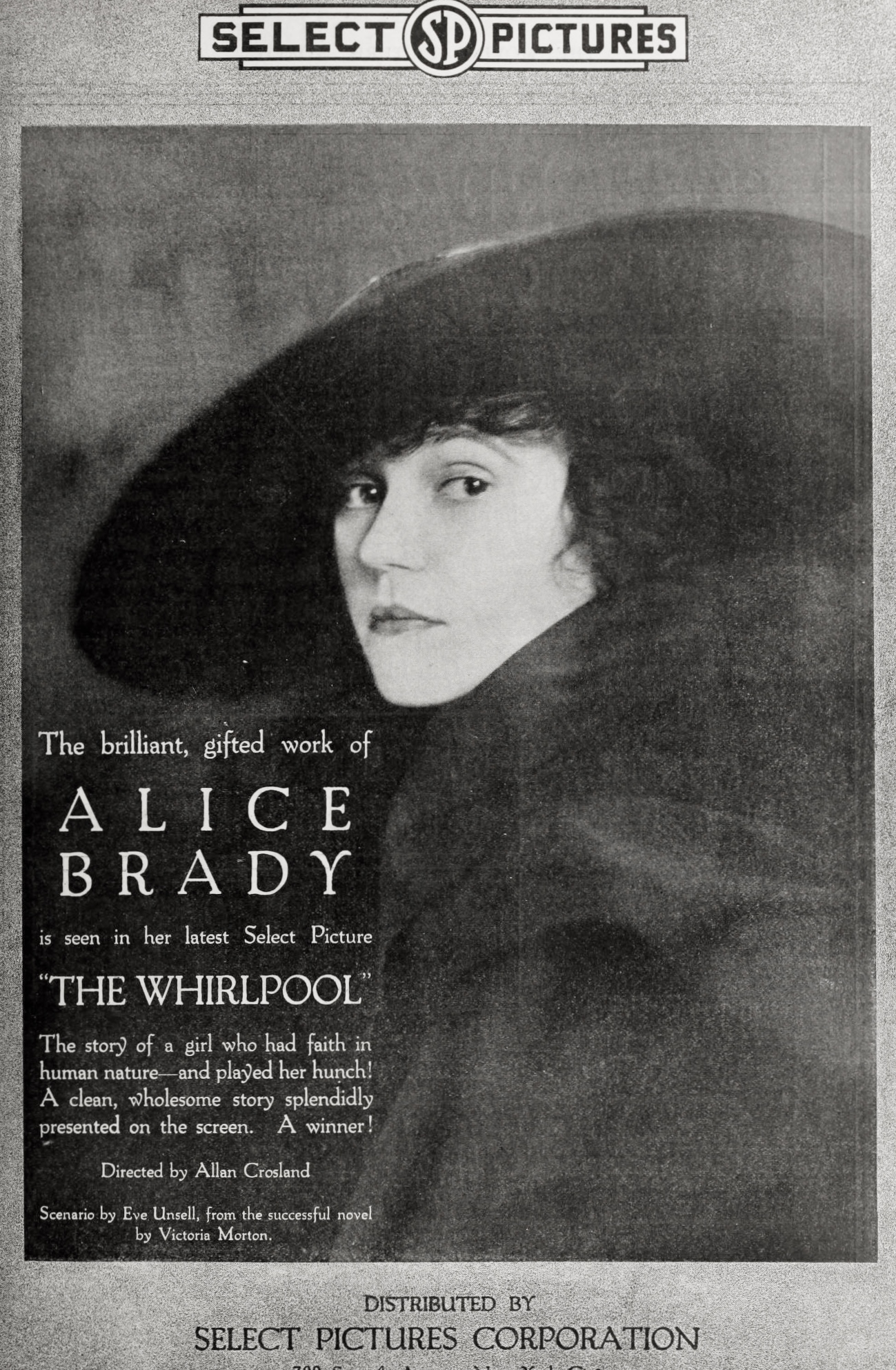
Stepping back into the nascent years of cinema, one encounters a fascinating tapestry of storytelling, where the dramatic flourishes were often as grand as the gestures of its silent stars. Among these early gems, 'The Whirlpool' emerges as a compelling artifact, a narrative that, despite its century-plus vintage, pulsates with themes as evergreen as human folly and the redemptive power of love. Released in 1917, this picture, penned by Eve Unsell and Victoria Morton, plunges its audience into a world rife with moral ambiguities, judicial quandaries, and the indomitable spirit of a woman caught in a societal maelstrom. It's a testament to the era's storytelling prowess, demonstrating that even without spoken dialogue, a film could weave a complex web of intrigue, injustice, and ultimate vindication.
The film immediately draws us into the shadowy corners of the Tenderloin, a district synonymous with vice and illicit pleasures, where Bella Cavallo (Alice Brady) exists as a reluctant siren. Her stepfather, Ferris, a man of dubious morals, exploits her beauty, forcing her into the unenviable role of a decoy in his clandestine gambling den. This grim existence forms the backdrop against which the impulsive Richard Brettner (Joseph Burke) makes his fateful entrance. Smitten by Bella's allure, Richard, in a desperate, misguided attempt to impress her, commits a minor robbery. This act of youthful folly brings him before Judge Reverton (J.H. Gilmour), a figure of stern but ultimately compassionate justice. The judge, swayed perhaps by the perceived innocence of the love-struck young man, extends a pardon, a decision he soon comes to rue with profound regret.
The narrative quickly thickens as Richard, despite his reprieve, is subsequently arrested for a far graver offense: murder. This turn of events casts a pall over Judge Reverton's earlier clemency, forcing him to confront the potential fallibility of his own judgment. It is through his physician, Dr. Comyns (Holmes Herbert), that the judge's path unexpectedly converges with Bella's once more. What begins as a professional introduction soon blossoms into an improbable romance, culminating in their marriage. Here, the film deftly explores the societal constraints and expectations placed upon women, particularly those with a past deemed 'unseemly.' Bella, despite her new station, cannot escape the specter of her former life, a shadow cruelly cast by Dr. Comyns's revelation to the judge about her profession. This disclosure sows seeds of corrosive distrust, poisoning the nascent marital bliss and setting the stage for the film's most potent dramatic sequences.
Alice Brady's portrayal of Bella Cavallo is, without hyperbole, the pulsating heart of 'The Whirlpool.' Brady, a prominent star of the silent era, imbues Bella with a compelling blend of vulnerability, resilience, and steely resolve. Her Bella is not merely a victim of circumstance but a woman capable of extraordinary agency, navigating a world that seeks to define and confine her. The film's central conflict hinges on the judge's escalating suspicion, fueled by societal prejudice and the doctor's ill-advised revelation. The tension reaches its zenith when Judge Reverton returns home to discover Bella meticulously planning a nocturnal rendezvous with Arthur Hallam (William B. Davidson), the nephew of the murdered man. The judge, consumed by a cocktail of jealousy and confirmation bias, expects the worst – another betrayal, another stain on his already compromised faith.
However, 'The Whirlpool' is too clever to merely tread the path of predictable melodrama. In a breathtaking twist, the judge's darkest fears are spectacularly subverted. Bella's clandestine meeting is revealed not as an act of infidelity, but as a daring, meticulously orchestrated gambit to coax a confession from Arthur Hallam. It is a brilliant, high-stakes charade designed to unveil the true murderer and, in doing so, exonerate Richard Brettner. This pivotal moment not only showcases Bella's intellectual acumen and moral courage but also serves as a powerful indictment of the judge's hasty judgment and the societal propensity to condemn women based on their pasts. It is a moment of profound vindication for Bella, where her perceived 'weakness' transforms into an unparalleled strength, her cunning deployed for the purest form of justice.
The resolution sees Richard released from the shadow of a crime he didn't commit, and the married couple, Judge Reverton and Bella, reunited. Yet, their reunion is not one of facile sentimentality but rather a testament to a love that has been tested by fire, rebuilt on a foundation of hard-won understanding and respect. The film, in its quiet closing moments, suggests that true love demands not just forgiveness, but a willingness to look beyond superficial judgments and embrace the complex, often contradictory, facets of another's character.
Alice Brady's performance as Bella is a masterclass in silent film acting. Her expressive face, subtle gestures, and commanding screen presence convey a depth of emotion that transcends the absence of dialogue. She effortlessly navigates Bella's journey from a pawn in her stepfather's scheme to a woman who seizes control of her destiny, culminating in her audacious plan to expose the real killer. It's a performance that holds its own against contemporaries and elevates the film beyond a simple potboiler. Joseph Burke, as the impetuous Richard, effectively portrays youthful indiscretion and subsequent despair, making his character's journey from misguided lover to wrongfully accused man palpable. J.H. Gilmour, as Judge Reverton, embodies the conflict between his professional duty and personal biases, his eventual enlightenment providing a satisfying arc. The supporting cast, including Holmes Herbert as the unwittingly divisive Dr. Comyns and William B. Davidson as the villainous Arthur Hallam, contribute effectively to the dramatic tension, each playing their part in the intricate machinery of the plot.
The screenplay by Eve Unsell and Victoria Morton deserves significant commendation. Their collaborative effort crafts a narrative that is both intricate and emotionally resonant. The pacing, a crucial element in silent cinema, is expertly handled, building suspense gradually and releasing it in satisfying bursts. The intertitles are concise and impactful, guiding the audience through the plot without bogging down the visual storytelling. This is a film that understands the power of visual metaphor, with the 'whirlpool' itself serving as a potent symbol of the inescapable forces that threaten to engulf its characters. It's a far cry from the more simplistic narratives often associated with early cinema, showcasing a sophisticated understanding of character development and thematic depth.
While specific directorial credits for this era can sometimes be fluid, the visual language of 'The Whirlpool' is remarkably assured. The cinematography, though adhering to the conventions of the time, effectively utilizes lighting and composition to enhance the dramatic mood. Shots of the Tenderloin are appropriately gritty, contrasting sharply with the more refined settings of Judge Reverton's world, visually underscoring the class divides and moral landscapes at play. The film's aesthetic choices contribute significantly to its atmosphere, drawing the viewer into its world of secrets and revelations. The blocking of actors, crucial for conveying emotion and narrative progression without dialogue, is thoughtfully executed, allowing the audience to follow the intricate emotional currents flowing between the characters.
Compared to other films of the period, 'The Whirlpool' stands out for its nuanced portrayal of a complex female protagonist and its willingness to delve into the murkier aspects of human nature. While films like The Romance of the Utah Pioneers focused on historical epics, or Master of His Home explored domestic dramas, 'The Whirlpool' carves its own niche as a gripping crime drama infused with intense personal stakes. It shares a thematic kinship with films that explore the consequences of deception and mistaken identity, perhaps even echoing the clever machinations found in a film like A Game of Wits, though with a far more dramatic and morally charged core. The film's engagement with judicial process and the concept of 'truth' also resonates with the broader societal conversations reflected in cinema of the time, making it more than just a simple entertainment piece.
The exploration of societal judgment and the struggle for redemption is a recurrent theme across various cinematic eras, but 'The Whirlpool' tackles it with a directness and emotional honesty that feels remarkably modern. Bella's journey, in particular, resonates as a proto-feminist narrative, where a woman reclaims her narrative and agency in a patriarchal society. This makes it a valuable watch for anyone interested in the evolution of character portrayal in film, especially for female roles that defied simplistic categorization. The film's ability to maintain suspense and deliver a satisfying, albeit complex, resolution speaks volumes about the craftsmanship involved in its creation.
In the grand tapestry of early American cinema, 'The Whirlpool' occupies an intriguing, if sometimes overlooked, position. Its sophisticated plotting, combined with powerful performances, particularly from Alice Brady, elevate it beyond a mere historical curiosity. It's a film that challenged audiences to look beyond appearances, to question moral certitudes, and to appreciate the profound strength that can emerge from adversity. The film's exploration of trust, betrayal, and the pursuit of justice remains compelling, providing a window into the social anxieties and narrative conventions of its time. It reminds us that even in an era without synchronized sound, filmmakers were capable of crafting deeply human stories that explored complex ethical dilemmas. Its influence might not be as overtly cataloged as some blockbusters of the period, but its narrative ingenuity certainly contributed to the evolving language of cinematic storytelling.
The intricate dance of deception and revelation, so central to 'The Whirlpool,' finds echoes in later crime dramas and thrillers, demonstrating the timeless appeal of a well-constructed mystery. The film's bold decision to center its climax on Bella's intelligence and courage, rather than relying on a male savior, is particularly noteworthy for its time. It’s a narrative choice that grants Bella a powerful, active role in her own salvation and the salvation of others, distinguishing her from many passive heroines of the period. This makes 'The Whirlpool' not just a historical document, but a vibrant piece of storytelling that continues to engage and provoke thought about justice, reputation, and the enduring power of the human spirit. It serves as a potent reminder that the foundations of cinematic drama were laid with considerable skill and foresight, offering rich narratives that still resonate today. Films like Playing with Fire, which also features intricate plotting and personal stakes, show a clear lineage of such narrative ambition.
Ultimately, 'The Whirlpool' is a compelling argument for the enduring power of silent cinema. It’s a film that manages to be both a product of its time and remarkably ahead of it, particularly in its characterization of Bella. For enthusiasts of early film, or indeed anyone with an appreciation for a well-told story of love, lies, and redemption, this film offers a captivating journey into the heart of a moral labyrinth. It is a cinematic experience that proves that even in the absence of dialogue, the human condition can be explored with profound depth and exhilarating dramatic flair. Its intricate plot, memorable performances, and courageous protagonist ensure its place as a significant, if often understated, contribution to the silent film era's legacy. It's a film that truly pulls you into its currents, leaving you pondering its depths long after the final frame.
IMDb —
1922
Community
Log in to comment.