DbcultAccessing Vault...
Cult Review
Senior Film Conservator
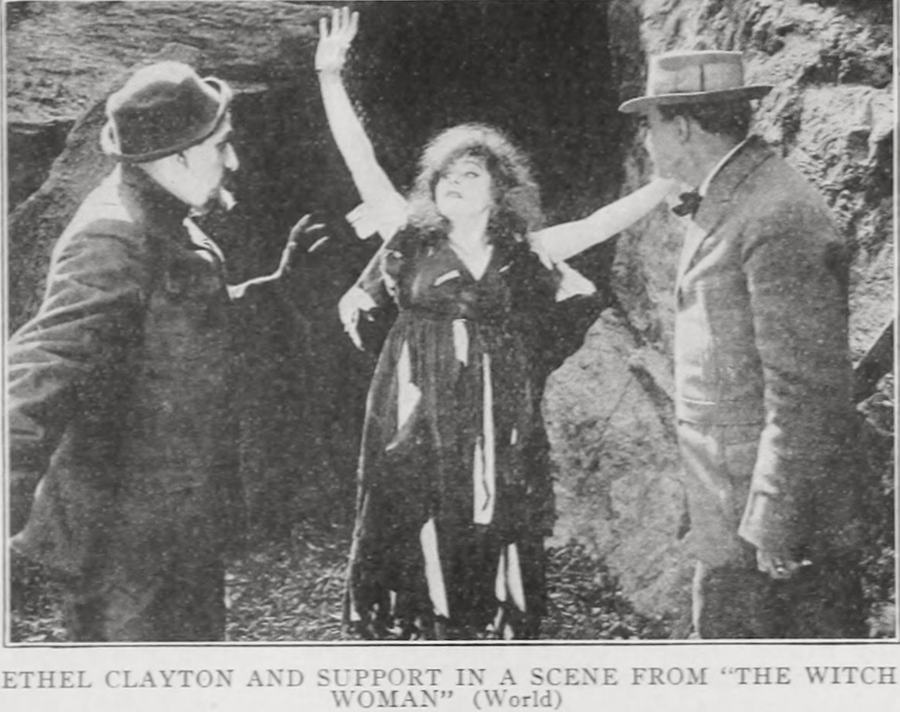
Willard Mack’s The Witch Woman arrives like a frost-bitten love letter forgotten in the pocket of a discarded greatcoat—its edges singed, its ink blurred by mountain mist. Shot on the cusp of 1923, while Expressionist shadows crept across German screens and America flirted with flapper frivolity, this independently produced melodrama chooses the vertiginous ridges of Alsace as its emotional fault line. What unfolds is less a linear narrative than a fever chart: a woman’s sanity plotted on a graph that plummets below the zero of language and climbs, gaslit and gasping, into the chandeliered salons of Paris.
Cinematographer Robert Emmett Tansey—years away from carving Poverty Row westerns—treats the French countryside like a copper plate primed for aquatint. Dawn exhales over granite; dusk bleeds into pasture; each frame feels etched with acid rather than merely photographed. When Marie is banished, the camera lingers on her bare feet sinking into sheep-tracked loam, the soil squelching as though the earth itself were reluctant to release her. Later, inside Cochefort’s hypnotic parlor, the image blooms with phosphorescent overexposure: Marie’s pupils dilate until the iris becomes a halo of sea-blue (#0E7490) ringing the void. The color reference is no accident—intertitles are tinted cyan to mirror her trance, while ballroom sequences spasm with tangerine (#C2410C) strokes that anticipate the coming bloodshed.
Frank Mayo’s dual performance hinges on micro-gesture: Louis’s lips curl with cartographer entitlement, always half-smiling at some private经纬度 only he can survey; Maurice carries the same mouth, but gravity pulls it southward, a man forever apologizing for existing. The split-screen work is crude by today’s measure—black velvet masks, double exposure, a hinge of shadow down the center—yet the illusion holds because Mayo differentiates the brothers through breath. Watch Louis’s chest inflate before he speaks, as though words were stored under pressure; Maurice exhales first, deflating, already conceding the argument.
As Marie, Ethel Clayton shoulders the film’s emotional alpine pass. In early reels she glows like a Millet painting lit from within, all wind-chapped cheeks and wrists brown from sun. Once exiled, her body begins to de-synchronize: arms lag behind intentions, laughter arrives a beat too early, eyes freeze mid-blink. It is madness choreographed as modern dance. Clayton reportedly spent nights at the L.A. County Hospital’s psychiatric ward, sketching catatonic postures; the result is a performance that never succumbs to operatic excess. When Paris doctors pronounce her “cured,” her fingers still tremble as though plucking invisible wool from air—an indelible residue of trauma.
Dr. Cochefort—played with oily magnetism by Jack Drumier—embodies the early-twentieth-century obsession with hypnotic cure-alls. His goatee tapers to a compass point; his monocle flashes like a heliograph signaling domination. Under his gaze, Marie’s story is re-written: no longer shepherdess, no longer mother-of-shame, but tabula rasa heiress. The film thus exposes a brutal truth prevalent in silent-era melodrama: a woman’s narrative is only as bankable as the man who holds the pen, the purse, or the swinging pocket watch. In one chilling insert, Cochefort’s silhouette looms over Marie’s prostrate form, the shadow-puppet of patriarchal authorship literally draped across her body.
Yet Mack’s script allows Marie to weaponize the education they force upon her. She learns the lexicon of flowers, the geometry of fan-language, the etiquette of the cotillion—only to redeploy each cipher as camouflage for retribution. By the time she steps into the masked ball—her gown a flare of yellow (#EAB308) silk—she is both performer and puppet-master, a marionette who has stolen the strings.
Because the film is mute, every off-screen gunshot lands inside the viewer’s ribcage. When Andrea’s pistol finally bucks, Tansey cuts to an extreme close-up of Marie’s eye: the pupil contracts, the iris seems to ripple like pond water into which a stone has been hurled. The next intertitle contains only four words: “The echo swallowed them.” It’s a masterstroke of narrative compression, letting the vacuum after violence speak louder than any courtroom confession.
Cinephiles will detect whispers of A Butterfly on the Wheel in the way both films punish female desire with societal brimstone. Yet whereas that British morality play ultimately kneels before marital redemption, The Witch Woman staggers into the darker thicket where forgiveness must be extorted rather than bestowed. Its DNA also shares strands with The Dawn of Understanding—another tale of rural innocence corrupted by urban predators—though Mack’s feature refuses the DeMille-esque sermon, opting instead for a pagan sense of cyclical doom.
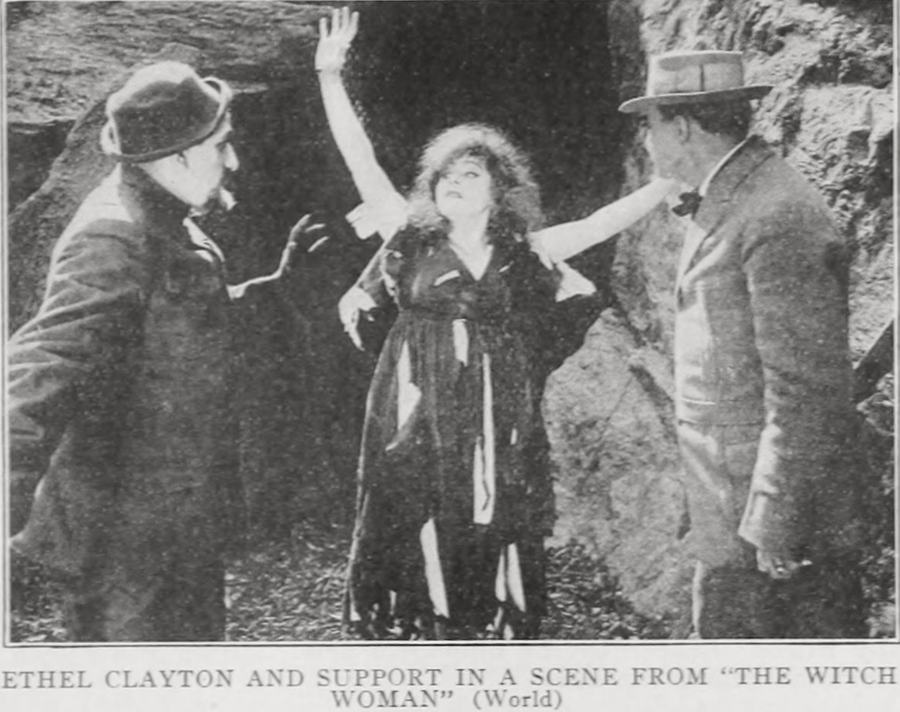
For decades the picture was a ghost, referenced only in 1923 trade papers and a lone lobby card showing Clayton draped in counterfeit ermine. In 2019 a 35 mm nitrate reel surfaced at a Czech flea market; the George Eastman Museum spearheaded a 4K restoration, grafting in a French print discovered at EYE Filmmuseum. The resulting Blu-ray, released through Kino Lorber’s “Shadow Silents” line, offers two scores: a traditional chamber arrangement heavy on viola, and an experimental electronic track that pulses like Cochefort’s hypnotic metronome. Streaming is currently exclusive to the Criterion Channel under their “Tempestuous Love” carousel, though occasional 16 mm prints tour repertory houses with live accompaniment.
Contemporary reviewers fixated on the salacious tagline “She followed one man to shame, another to fortune, a third to doom!” and dismissed the film as “women’s-picture hysterics.” Variety complained of “over-ripe emotional cheeses,” while a New York Times squib praised the alpine cinematography yet shrugged at the plot as “a tempest in a corset.” Modern reappraisal, however, locates the movie at the confluence of feminist proto-noir and rural gothic. Scholar Miriam Posner argues that Marie’s exile prefigures the “final girl” trope, her madness a rational response to patriarchal gaslighting. Podcasts like “Silent But Deadly” hail the final forgiveness scene as one of the most radical of the era: a man absolving a woman for a crime she never technically committed, thereby indicting the social order that drove her to the brink.
Production designer Louise Vale (also memorable in Miss George Washington) employs a strict chromatic schema. Yellow—associated with Marie’s pastoral freedom—recurs in her sun-flecked frock, the primrose tucked behind her ear, the candle glow of the ballroom. Sea-blue denotes the clinical, the authoritarian: Cochefort’s waistcoat, the asylum walls, the nocturnal key-light that silhouettes Marie during hypnosis. Orange (#C2410C) explodes only three times: the ember of a shepherd’s campfire, the flicker of a bedside candle when Louis seduces her, and finally the gun-muzzle flash. The trinity of hues forms a visual fugue, propelling the viewer toward the inevitable conflagration.
Louis Vale as Andrea Montignac delivers a masterclass in peripheral desperation. Constrained by the Hays-adjacent morality of 1923, the character of the mistress could have slid into caricature. Instead, Vale plays her like a woman who has read all the operas and knows she is doomed to reenact one. In the moments before the masked ball, Andrea adjusts Marie’s gown with sisterly tenderness, her fingers betraying the tremor of someone who already hears the distant gunshot. It is a quiet gesture that complicates the love-triangle geometry, suggesting complicity, envy, and a spectral yearning for the very innocence she helped annihilate.
The film’s spatial politics invert traditional gendered zones. The mountain—coded masculine in adventure serials—becomes Marie’s cloistered refuge, a womb-like cradle where she unlearns language. Conversely, Paris’s drawing rooms—typically feminine sanctuaries—are rendered predatory, their mirrors and monied whores dissecting her like scalpels. This inversion reaches its apex in the hypnotic parlor: a room overstuffed with Ottoman cushions, yet governed by the masculine science of mesmerism. Marie’s body, laid supine on a rosewood chaise, becomes contested territory where pastoral memory grapples with metropolitan inscription.
Trace the lineage and you’ll find its fingerprints on Hitchcock’s Vertigo: the same obsession with molding a woman into the shape of another’s desire, the same vertiginous punishment for the creator when the creation slips the leash. You’ll spot it in Dreyer’s Day of Wrath, where the witch is again a scapegoat for communal guilt. Even the Coen Brothers’ Burn After Reading winks at the trope of capricious city folk toying with rural innocence, though played for absurdist yuks rather than tragic thunder.
Does the film have flaws? Assuredly. Its intertitles sometimes sermonize, the comic-relief stable boy belongs in a Keystone two-reeler, and the climactic suicide dissolves perhaps too hastily. Yet these blemishes feel like scuffs on a cathedral floor—evidence of pilgrimage, of human traffic, of a story that refused to stay politely within its frame. Nearly a century later, The Witch Woman still breathes, still seduces, still terrifies. It reminds us that the cruelest enchantments are those practiced not with wands but with wallets, wills, and the wicked convenience of a man’s forgettable goodbye.
IMDb 5.4
1924
Community
Log in to comment.