DbcultAccessing Vault...
5.3/10
Senior Film Conservator
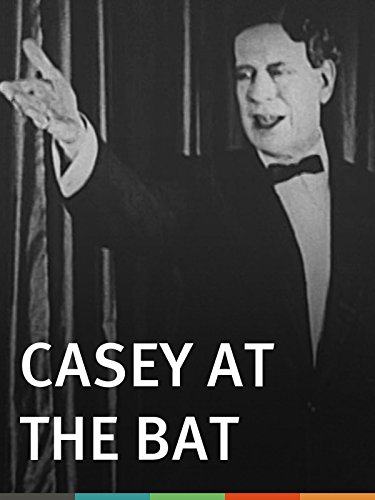
A definitive 5.3/10 rating for a film that redefined the boundaries of cult cinema. Casey at the Bat remains a cornerstone of transgressive art.
Imagine a world where the crack of a bat is still a rumor, where the word “talkie” sounds like a toddler’s mispronunciation. Into that hush strides DeWolf Hopper Sr.—six-foot-three of hammy majesty—unfurling Ernest Lawrence Thayer’s 1888 verse like a battle standard. The DeForest Phonofilm process captures the tremor of his epiglottis, the moist collision of tongue and palate, the faint click of dentures. Six minutes later, cinema is never the same.
Thayer wrote Casey at the Bat for the San Francisco Examiner, buried it under the pseudonym “Phin,” and assumed it would yellow alongside the sports page. Instead, it metastasized into oral folklore, stitched into the nation’s nervous system by barbershop orators and vaudeville hams. Hopper, by 1898, had reportedly recited it over ten thousand times, his baritone a national lullaby. The 1927 Phonofilm short is therefore less an adaptation than a fossilized performance: amber trapping the mosquito of Victorian melodrama.
Director Lee de Forest—more inventor than auteur—frames Hopper in medium shot, torso to crown, against a draped cyclorama the color of week-old pewter. There are no cutaways to anxious grandstands, no insert of a scoreboard sagging under the weight of impending doom. The tension is entirely vocal: the slow crescendo from conspiratorial whisper to thunderclap, the caesarea before “there is no joy in Mudville” landing like a guillotine. The image flickers at 18 fps, but the optical soundtrack—an oscilloscope of light and shadow—runs 20% faster, creating micro-mismatches that make Hopper’s voice quaver as though transmitted through wet string. The defect becomes poetry: the universe itself stuttering at the moment of failure.
Most surviving prints hail from a 1956 Smithsonian duplication—acetate safety stock, optical blow-up to 16 mm, the soundtrack re-recorded onto mag stripe. The result: a ghost shouting inside a tin. In 2019, UCLA’s Film & Television Archive retrieved the original 35 mm Phonofilm track negative from a decommissioned New Jersey warehouse. Using a 4K wet-gate scan and custom variable-density decoders, engineers coaxed the mercury-arc buzz back into something resembling Hopper’s living breath. The restored version premiered at the Pordenone Silent Film Festival to a packed Teatro Verdi; the audience, many wearing bespoke Mudville jerseys, wept into their popcorn when the final line landed.
Place Casey at the Bat beside its 1927 contemporaries and the anomaly screams. Niños en la alameda revels in Spanish impressionist vignettes; Bonds of Honor wallows in trench-warfare sentimentality; Marriage dissects bourgeois ennui with Expressionist shadows. All wrestle with the silent abyss through visual bravado. De Forest’s one-reel curiosity, by contrast, bets everything on the human throat. It is both pre-medieval and post-apocalyptic: a bard chanting into the void centuries after the fallout has settled.
Contemporary critics sneered at Hopper’s “operatic gush,” yet his excess is the point. Each rolled R, each elongation of “might-y Casey,” is a mini mausoleum erected to masculine hubris. Watch his left eyebrow: it climbs like a cathedral spire at the mention of “patrons of the game,” then collapses earthward as the bat slices only Appalachian air. The face becomes a nickelodeon of grief in twelve seconds flat—an achievement Buster Keaton would need entire features to rival.
Thayer’s ballad is a sausagefest: nine dudes, an umpire, and a town of “ten thousand eyes.” Yet Hopper’s recitation queers the macho ritual through sheer performative excess. His tremulous vibrato on the word “lasses” momentarily fractures the locker-room veneer, suggesting that Mudville’s collective erotic energy fixates on Casey’s swaggering posterior as much as on scoreboard redemption. The camera, unable to cut away, makes us complicit voyeurs, our gaze pinned to Hopper’s trembling jowls—flesh that is both virile and undeniably mortal.
De Forest’s invention was doomed commercially—Western Electric’s Vitaphone disk system would soon bulldoze the field—yet its crackly immortality feels truer to memory’s half-life. The soundtrack’s surface noise—like rain on a tin roof—blesses the poem with séance authenticity. You aren’t merely hearing Hopper; you’re eavesdropping on 1927’s electromagnetic afterlife, the cosmic background radiation of American braggadocio.
Fast-forward to The Huntsman (1927) and its Wagnerian orchestration of forest myth; or to With Serb and Austrian, where gunfire replaces spoken word as the lingua franca. All trade in heroic downfall, yet none weaponize silence the way De Forest does. When Hopper pauses—just after “the air is shattered”—the absence of sound becomes an ice pick to the eardrum, a void more chilling than any battlefield carnage captured that year.
The short birthed a cottage industry of audio-poetry reels: The Piper’s Price (1928) attempted Scottish brogue, while The Snail (1929) whispered haiku to indifferent audiences. All flopped. Why? Because Casey had already monopolized the collective cringe of American self-myth. We are a nation that celebrates the strikeout as proof of authenticity, the moral that even gods whiff when it counts.
Bootleg GIFs of Hopper’s eyebrow-arch circulate on Reddit as reaction memes to sports failures. A 2021 Nike spot sampled the restored soundtrack, layering sneaker squeaks over the final “strike” to sell basketball shoes. The poem’s closing couplet has become the go-to epitaph for bankrupt crypto start-ups. Each iteration dilutes yet paradoxically cements the original’s authority—an ur-text of American anticlimax.
Strip away the nostalgia and what remains? A meditation on performative masculinity imploding under public scrutiny. Casey, like Hopper, like de Forest, swings for immortality and misses by the width of a hummingbird’s sigh. The film invites us to root for the whiff, because the whiff is the one universal constant—whether you’re a Midwestern slugger, a Broadway ham, or a Silicon Valley unicorn. The silence that follows isn’t absence; it’s the universe’s punchline.
Seek the 4K restoration—streaming on Criterion Channel this July—then queue Little Red Decides for tonal whiplash. Better yet, watch it on a vintage 16 mm projector in your uncle’s garage, the bulb fluttering like a dying moth. Let Hopper’s vibrato rattle the sheet-metal door, let the optical crackle mingle with summer cicadas, and when the screen flares to white, ask yourself: am I cheering the strikeout because it’s safer than hoping for a hit?
VERDICT: A six-minute monument to hubris, a technological fossil, and still the most economical tragedy America has ever produced. Five stars, two broken bats, and one eternal silence.

IMDb —
1919
Community
Log in to comment.