DbcultAccessing Vault...
Cult Review
Senior Film Conservator
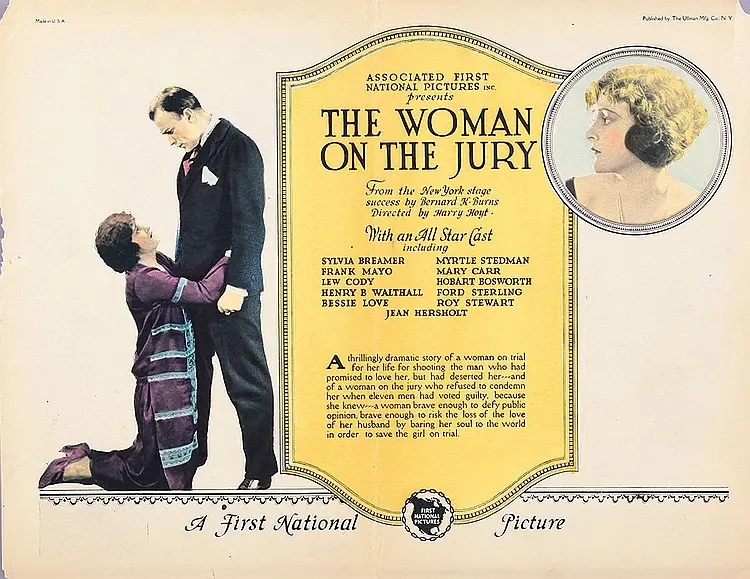
The Woman on the Jury
In the silent era of cinema, a period marked by the burgeoning of an art form, The Woman on the Jury emerges as a poignant exploration of the human condition. This 1924 film, directed by Frank Mayo and written by Bernard K. Burns and Mary O'Hara, presents a compelling narrative that probes the complexities of love, betrayal, and redemption.
At its core, the film revolves around a woman on trial for her life. Her crime? Shooting the man who had promised to love her but ultimately deserted her. This act of desperation sparks a chain of events that not only scrutinizes the defendant's actions but also challenges the societal norms of the time.
The trial serves as the backdrop for an examination of the human psyche, particularly in the face of adversity. Eleven men on the jury have voted guilty, a decision that seems to align with the prevailing public opinion. However, one juror dares to dissent, refusing to condemn the defendant without a fight. This act of bravery is not without consequence, as the juror faces backlash, including the loss of her husband's love and support.
The film boasts a talented cast, including Stanton Heck, Frank Mayo, Bessie Love, and Mary Carr, who bring depth and nuance to their respective roles. Their performances are complemented by the direction of Frank Mayo, who skillfully navigates the complexities of the narrative.
Upon closer inspection, The Woman on the Jury reveals thematic resonances with other films of its era. For instance, Nothing But Nerve and The Black Night also explore themes of love, loss, and redemption, albeit through different narrative lenses. Similarly, films like Menschen im Rausch and Die weißen Rosen von Ravensberg probe the complexities of human relationships, highlighting the universality of these themes across different cinematic works.
The cinematography of The Woman on the Jury is noteworthy, with each frame meticulously crafted to convey the emotional depth of the narrative. The use of lighting, composition, and camera angles serves to heighten the tension and drama of the trial, drawing the viewer into the world of the film.
Furthermore, the film's exploration of social commentary adds a layer of complexity to its narrative. The Woman on the Jury challenges the societal norms of the time, particularly with regard to the treatment of women. The defendant's actions, though extreme, serve as a catalyst for an examination of the patriarchal structures that govern society.
In conclusion, The Woman on the Jury is a masterful film that probes the complexities of the human condition. Through its exploration of love, betrayal, and redemption, the film offers a poignant commentary on the human experience. With its talented cast, nuanced direction, and thematic resonance, this 1924 film is a must-see for cinephiles and scholars of silent cinema.
In an era marked by the rise of streaming services and the proliferation of cinematic content, The Woman on the Jury serves as a reminder of the power of film to challenge, inspire, and educate. This film, along with others like Gypsy Anne, Cora, and God's Country and the Woman, highlights the diversity and richness of silent cinema, an era that continues to captivate audiences with its beauty, nuance, and historical significance.
Ultimately, The Woman on the Jury is a film that defies easy categorization. It is a drama, a romance, and a social commentary, all at once. Its exploration of the human condition, coupled with its historical significance, makes it a valuable addition to any film canon.
IMDb —
1919
Community
Log in to comment.