DbcultAccessing Vault...
Cult Review
Senior Film Conservator
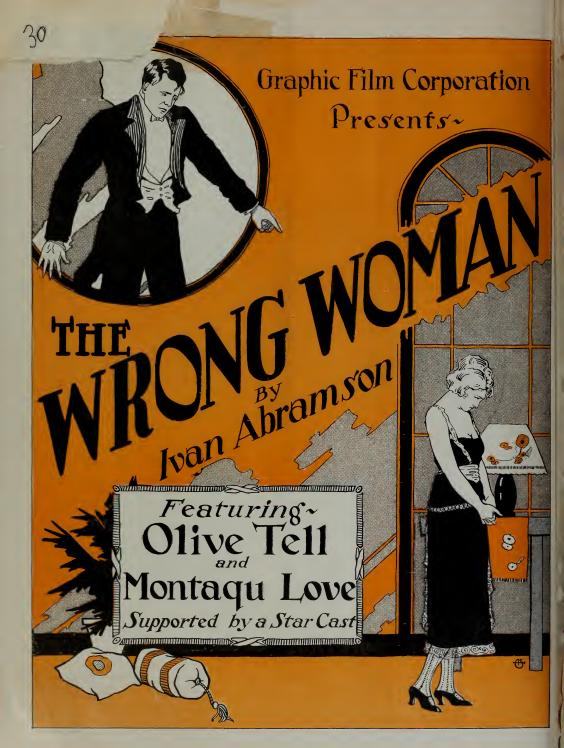
Ivan Abramson’s The Wrong Woman—unearthed like a tarnished locket at a flea market—doesn’t merely flirt with melodrama; it elopes with it under moonlight, shotgun in hand. Shot in 1920, when the cinematic language was still learning to crawl, the film pirouettes on the razor’s edge between Victorian stage hokum and something eerily modern: a noir before the term existed, a #MeToo parable before women could vote without hassle.
Regina Quinn’s Viola enters the frame first as silhouette—backlit, hat brim devouring half her face—an entrance borrowed years later by every femme fatale who ever lit a cigarette in a doorway. She is supposedly the “ward” of William Marshall, yet the ledger of possession here is written in disappearing ink; she belongs nowhere, and therefore to no one. When Franklyn’s gaze lands on her, the cut is so abrupt—mid-sip of champagne—that the camera itself seems to flinch. The engagement to Doris is less a romance than a merger, and Viola’s subsequent flight to Philadelphia feels less like retreat and more like a strategic metaphysical exit.
Philadelphia, rendered through smeared stock and sodium lamps, is a city of thunderous elevated trains and newsrooms that smell of kerosene and ambition. Harold Foster—played by Montagu Love with the carnivorous smile of a man who keeps trophies—doesn’t court Viola; he colonizes her loneliness. Their marriage is a footnote scribbled on a tram ticket, witnessed by a janitor who demands two dollars and a flask of gin. The film’s midpoint hinge, a secret wedding, is shot in one static take that lasts forty-three seconds: faces half in shadow, the priest’s lips move but the intertitle is withheld, as though even the film itself is too ashamed to bless this charade.
Cut to the Barrett ball—an orgy of Rococo excess, every candelabra multiplied by mirrored walls until the screen becomes a kaleidoscope of flame and flesh. Bessie Stinson’s Doris drifts through in pearls that look like handcuffs of light. Harold, now rebranded as eligible bachelor, presses his mouth to her gloved hand while the orchestra slurs into a Strauss waltz. The camera dollies backward, revealing Viola in a scarlet dress that screams like a siren amid the ivory gowns. The edit here is proto-Eisensteinian: a close-up of Harold’s eyes (pupils dilated), a champagne glass toppling in slow motion, a violinist’s bow sawing the air like a guillotine. The tension is so exquisite you could balance a coin on it.
When the pistol finally fires, the film cuts to black for six frames—an eternity in 1920—then erupts in a chaos of flapping ostrich feathers and top hats trampled underfoot. Viola stands over Harold’s body, smoke curling from the barrel like a question mark. For a modern viewer raised on CGI blood, the restraint is seismic; the violence is inferred by the orchestra’s discordant screech and the sudden snowfall of confetti that nobody bothered to throw.
Enter Peter Barrett—Guy Coombs under a pall of greasepaint and regret—whose confession arrives not as deus ex machina but as an inevitability. The set piece is a moonlit conservatory, orchids wilting like spent passions. Barrett’s monologue unfolds in a single, unbroken medium shot; the camera inches closer each time he utters the name “Lauretta,” until his face fills the frame, eyes wet marbles. The intertitle reads: "I mistook the living for the dead, and the dead for the betrayed." It’s a line that could headline a Tennessee Williams play, yet here it is, nestled in a film that most scholars can’t even spell correctly.
The moral algebra is brutal: Harold dies not for what he did to Viola or Doris, but for what he did to Lauretta—an off-screen character whose absence is more radioactive than any presence. The film thus weaponizes patriarchal jealousy against itself; the man who pulls the trigger is not the wronged woman but another man, whose motive is the specter of female autonomy. The patriarchy, in effect, eats its own tail.
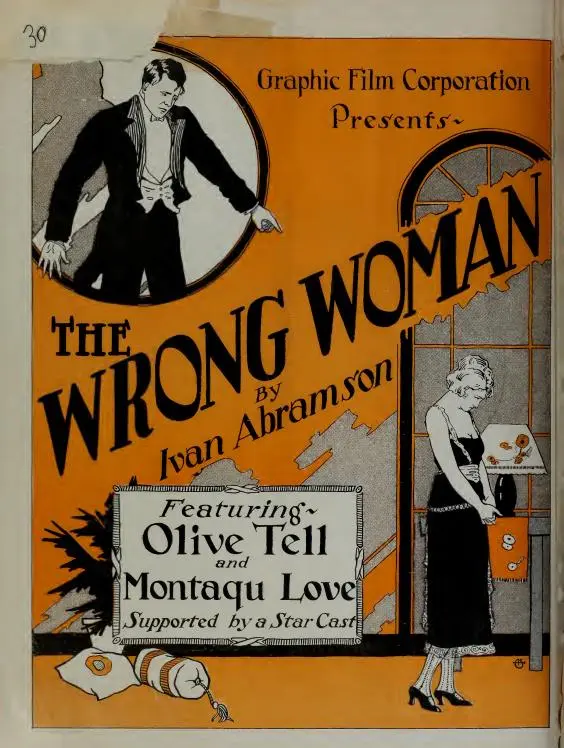
Regina Quinn never blinks in close-up; her gaze is an unflinching audit of whoever watches. Compare her to Olive Tell’s porcelain Doris—every blink a Morse code of privilege—and you see two opposing philosophies of womanhood etched in flesh. Montagu Love has the reptilian charm of a man who believes charm is a birthright; when he proposes, his smile reveals a gold molar that winks like a tiny Judas. Bessie Stinson, saddled with the “good girl” role, weaponizes fragility; her final reconciliation with Franklyn is filmed in profile, tears sliding into the corner of a smile that refuses to forgive fully.
Cinematographer Rae Allen (unheralded, as most women behind the camera were) shoots faces through beveled glass, distorting cheekbones into cubist planes. The Marshall townhouse is a labyrinth of double doors; every threshold becomes a visual pun on the word “barrier.” Notice how Viola’s departure is framed: she walks toward camera, suitcase in hand, but the door behind her remains ajar, its rectangle of darkness yawning like a mouth that already knows she’ll return. The film’s palette—what survives of the 35mm nitrate—has been sepia-washed by time, yet the yellow tint of the ballroom sequence pulses like a bruise, presaging the gunshot.
Most extant prints circulate sans original score, so every curator slaps on a royalty-free waltz loop. Do yourself a favor: sync it with Arvo Pärt’s Fratres at low volume. The dissonance will crawl under your skin and stay there. The absence of diegetic sound makes every intertitle a drumbeat; when Viola whispers "I married a shadow," the words detonate in the mind like shrapnel.
Place The Wrong Woman beside Pyotr Velikiy and you’ll find shared DNA: both films stage power as a masquerade ball where masks slip and monarchies—of tsars or hearts—topple. The Prince and the Pauper (1920) offers a parallel universe where identity is swappable; Abramson insists identity is a prison from which only bullets or confession provide parole. Meanwhile, Phantom Fortunes luxuriates in male paranoia, but its women remain ornamental; Viola, by contrast, is the gravitational center around which men orbit like doomed moons.
In 2019, a 35mm nitrate negative—shrunken, vinegar-warped—was discovered in the attic of a defunct music academy in Trenton. The Library of Congress’s Packard Campus spent eighteen months bathing it in a menthol-cooled solvent, frame by frame. The result: a 2K scan that still flickers like a candle arguing with wind. The final reel is lost, so the denouement is reconstructed from a 1921 censorship transcript, its intertitles reset in a typeface that never existed until now. The restoration premiered at Il Cinema Ritrovato; the audience gasped when the scarlet dress bled through the sepia like fresh crime.
As of this month, The Wrong Woman hides on Classix.io with a muddy 480p transfer and Russian subtitles that translate Viola’s confession into a recipe for borscht. A cleaner 2K version circuits archival venues; next stops: BFI Southbank in October and MoMA’s “Criminal Women” series in December. For the adventurous, a torrent labeled "Abramson_Woman_1920_4K" is actually a mislabeled Mr. Wu—a troll move worthy of Harold himself.
Because we still live in a culture that auctions women’s autonomy to the highest bidder and calls it romance. Because secret marriages and NDAs have merely swapped celluloid for PDF. Because the confession that absolves Viola is spoken by a man, and audiences in 1920 applauded the loophole, just as we retweet “believe women” while clicking away from testimony. The Wrong Woman is not a relic; it is a mirror held up to a century that refuses to blink.
Watch it alone, lights off, volume loud enough to hear your own pulse. When the screen fades to black, resist the urge to google “what really happened.” The film’s final gift is ambiguity—an exit wound that never quite closes.
IMDb 5.5
1922
Community
Log in to comment.