DbcultAccessing Vault...
Cult Review
Senior Film Conservator
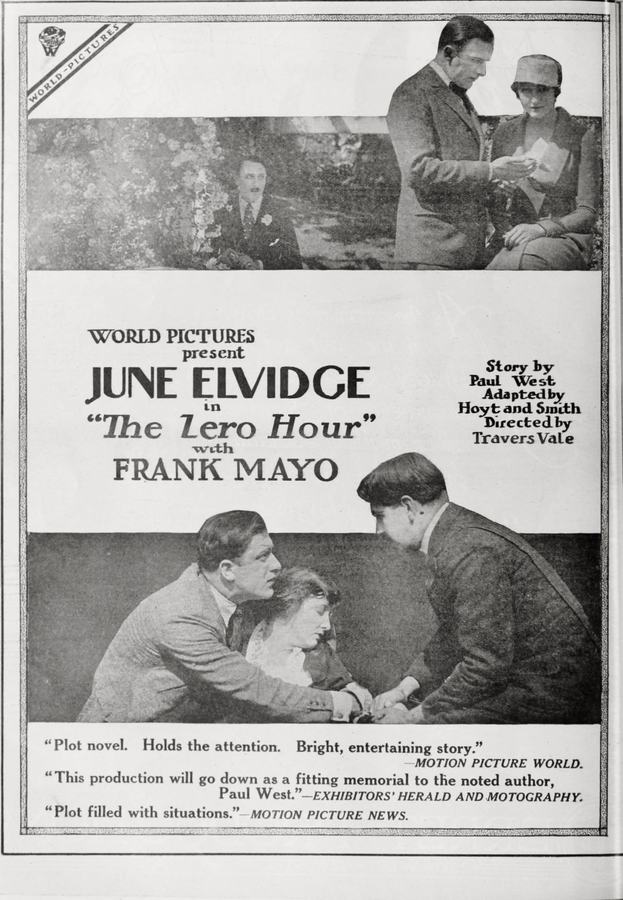
The Zero Hour (1920) is a masterclass in psychological tension and moral ambiguity, weaving the lives of twin sisters Fanny and Evelyn Craig into a labyrinth of spiritualist fraud and familial betrayal. Directed with a chiaroscuro sensibility that presages German Expressionism, the film dissects the corrosive effects of deception on both the perpetrator and the victim. Its narrative, though rooted in the conventions of 1920s melodrama, transcends its era through its unflinching exploration of grief and complicity.
At the film’s core is the disintegration of Fanny Craig, whose disdain for her stepfather Micah Parrish’s spiritualist antics sets her on a collision course with tragedy. Her flight from the family estate to become secretary to lawyer Bruce Taunton—a man whose idealism has been hardened by the death of his mother during a séance—forms a tenuous alliance that is both pragmatic and emotionally charged. Meanwhile, Evelyn’s complicity with Parrish and his more sinister associate, Esau Brand, is less a choice of ambition than a surrender to desperation. The sisters’ divergent paths, underscored by their visual duality onscreen—Fanny framed in soft, natural light, Evelyn often shrouded in shadow—becomes a metaphor for the film’s central conflict: the struggle between integrity and expediency.
Brand, portrayed with a reptilian charm by Frank Mayo, is the film’s moral anchor of villainy. His manipulation of spiritualist tropes—table-rattling, ectoplasmic veils, and the feigned communion with the dead—serves not as mere farce but as a chilling commentary on the commodification of grief. The sequence in which Brand forces Evelyn to impersonate Fanny’s spirit for Bruce is a tour de force of silent cinema. The camera lingers on Evelyn’s anguished face as she speaks in her sister’s voice, the dissonance between her physical presence and the spectral identity she’s coerced into embodying creating a tension that is both visceral and existential.
Armand Kaliz’s performance as Bruce Taunton is a study in repressed rage. His transformation from a principled crusader against spiritualist fraud to a man unraveling under the weight of personal loss is rendered with a nuance that belies the film’s era. The scene in which he confronts Evelyn, his voice cracking as he demands proof of her deception, is a masterclass in nonverbal acting. The supporting cast, particularly June Elvidge as Evelyn and Henry Warwick as the venal Parrish, elevate the material with performances that are both credible and emotionally resonant.
The film’s visual language is equally compelling. The Craig family home, with its decaying grandeur and creaking floorboards, becomes a character in its own right—a symbol of the moral rot festering beneath the surface. Director Hamilton Smith employs deep focus and high-contrast lighting to emphasize the claustrophobia of the sisters’ entrapment. The use of mirrors and reflections, particularly in scenes featuring Evelyn’s séance performances, reinforces the theme of identity as both a mask and a prison.
In comparing The Zero Hour to contemporaneous films like The Rival Actresses (1921) or Infatuation (1920), one notes a shared preoccupation with societal hypocrisy and the fragility of personal identity. However, The Zero Hour distinguishes itself through its unrelenting focus on the psychological fallout of deception. Unlike the more lighthearted social critiques of The Slim Princess (1920), this film delves into the darker recesses of human motivation, particularly in the portrayal of Brand’s manipulative genius.
Technically, the film is a marvel of early cinema. The editing, though rudimentary by modern standards, is effective in building suspense—particularly during the climactic séance sequence, where rapid cuts between Evelyn’s trembling hands and Bruce’s tear-streaked face heighten the emotional stakes. The score, though likely not composed specifically for this film, complements the narrative with a mournful, almost funereal motif that underscores the inevitability of the tragic denouement.
Critics of the era dismissed The Zero Hour as "overwrought" and "morbid," yet these very qualities contribute to its enduring relevance. The film’s examination of how grief can be exploited for personal gain resonates in an age where spiritual and emotional manipulation remain prevalent. It also raises questions about complicity—how individuals like Evelyn, though not the primary architects of the fraud, become its unwitting enablers through their silence and inaction.
Thematically, the film grapples with the paradox of justice. Bruce’s quest to expose the spiritualist frauds is noble in intent, yet his single-minded pursuit blinds him to the human cost of his crusade. The resolution—Brand’s release and Bruce’s consolations in Evelyn’s love—leaves a bitter aftertaste, suggesting that the true villains often escape unscathed while the innocent bear the scars. This narrative choice, while unsatisfying to modern audiences, reflects the cynicism that permeated postwar American cinema.
For cinephiles, The Zero Hour is a must-watch for its bold visual storytelling and psychological depth. It also serves as a fascinating artifact of an era when cinema was still grappling with its capacity to explore complex moral landscapes. The film’s influence can be traced in later works such as That Devil, Bateese (1921) and From the Valley of the Missing (1920), which similarly explore the intersection of personal morality and societal corruption.
In conclusion, The Zero Hour is more than a period piece—it is a haunting meditation on the cost of deception and the fragility of the human psyche. Its legacy is not in its predictability but in its unflinching honesty, a reminder that even in the shadowy world of spiritualist fraud, the most profound mysteries lie within ourselves. For those seeking a film that marries form and content with striking precision, this 1920 classic remains a compelling, if unsettling, journey into the heart of darkness.
IMDb 5.4
1921
Community
Log in to comment.