DbcultAccessing Vault...
Cult Review
Senior Film Conservator
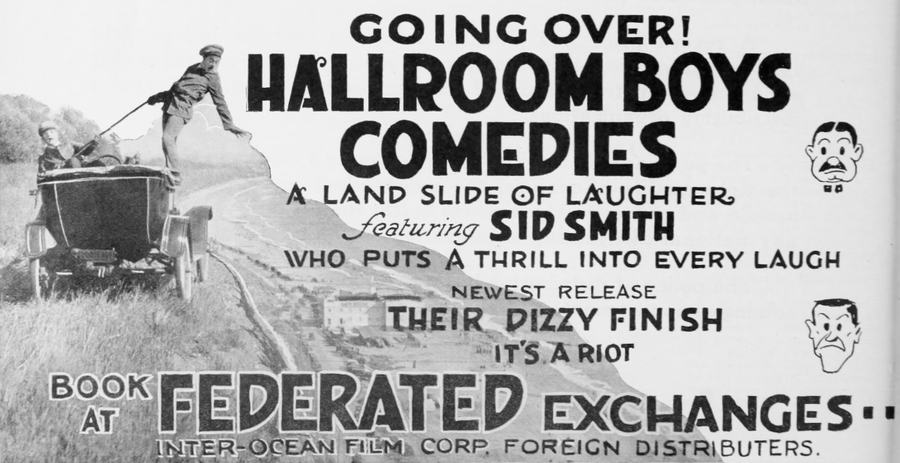
There’s a peculiar alchemy in the way Their Dizzy Finish transforms industrial detritus into a narrative of grandeur. Percy and Ferdie, armed with nothing but scrap metal and a spirit of reckless invention, construct a Ford from tin cans—a feat that feels less like engineering and more like a surrealist’s fever dream. The film’s opening act is a masterclass in escalating absurdity: tin cans are welded, riveted, and contorted into the semblance of a car, each rivet a testament to the characters’ delusional ambition. By the time the contraption, christened the "Ford Model C," lurches forward with a wheeze, the audience is complicit in the joke, hooked on the duo’s manic determination.
The collision that follows is both inevitable and revelatory. The Ford, a fragile monument to hubris, collapses back into its constituent cans in a burst of cinematic irony that feels almost Dadaist. There’s no slow-motion tragedy, no lingering on the wreckage—just a rapid cut to Percy and Ferdie staring at the pile of metal with expressions that oscillate between shock and bewilderment. The film’s genius lies in its refusal to dwell on the disaster. Instead, it spirals into a series of escalating mishaps, each more ludicrous than the last, as the duo attempts to salvage their invention using increasingly improbable materials (a cactus, a bicycle wheel, a typewriter ribbon).
Sidney Smith and Harry McCoy, the film’s stars, are a study in contrasts. Smith’s Percy is all twitchy energy, a man whose ideas are as fragile as the Ford itself. McCoy’s Ferdie, by contrast, is a stoic pragmatist, the voice of reason who somehow finds himself dragged deeper into the chaos. Their physicality—Smith’s rubber-limbed antics, McCoy’s deadpan reactions—is a reminder of the silent era’s reliance on nonverbal storytelling. One scene, where the duo attempts to drive the Ford using a horse’s reins, is a masterstroke of visual humor, the horse (presumably named "Henry") reacting with a mix of confusion and mild disdain.
The film’s aesthetic is a curious blend of Art Deco futurism and junkyard aesthetics. The Ford, with its tin-can body and mismatched parts, is a grotesque parody of the streamlined machines that defined the 1920s. This juxtaposition—between the aspirational and the absurd—is what gives Their Dizzy Finish its enduring appeal. It’s a film that laughs at the very concept of progress, suggesting that human ingenuity is as prone to self-destruction as it is to creation. The score, a jaunty blend of xylophone and accordion, amplifies the film’s tonal shifts, oscillating between whimsy and dread.
Comparisons to other works of the era—Untamed Ladies and Desert Gold—highlight the unique niche Their Dizzy Finish occupies. While those films lean into romantic entanglements and frontier adventures, this one is pure mechanized farce. The influence of The Kid is also palpable in the way it uses innocence (in this case, the duo’s childlike faith in their invention) to juxtapose against the harsh realities of the adult world. Yet, where The Kid is a tear-jerker, Their Dizzy Finish is a dry, often biting satire of the American Dream.
What elevates Their Dizzy Finish beyond mere farce is its thematic depth. The tin-can Ford, a symbol of transience, mirrors the impermanence of the silent film era itself. Just as the car disintegrates on screen, so too did many of the films and stars of the 1920s—lost to time, nitrate decay, and the advent of talkies. The film’s closing moments, where Percy and Ferdie sit amidst their rubble, are a poignant undercurrent to the humor. There’s a quiet resignation in their posturing, a suggestion that failure is not just a narrative device but a philosophical state.
Technically, the film is a marvel. The special effects used to depict the Ford’s collapse are surprisingly sophisticated for the era, blending practical effects with clever editing. A single shot of the car’s fender flapping like a disinterested moth is a standout, a moment of surreal poetry in a film otherwise defined by chaos. The cinematography, though rudimentary by modern standards, uses shadow and light to create a dreamlike quality—particularly in the scene where the Ford is rebuilt under moonlight, its tin-can body glinting like a spaceship in a junkyard.
The cultural context of Their Dizzy Finish cannot be ignored. Released during a period of rapid industrialization, the film reflects both the awe and anxiety of the mechanical age. It’s a time when machines were seen as both saviors and harbingers of doom, and Percy and Ferdie’s Ford encapsulates this duality. The film also nods to the era’s burgeoning consumer culture—where anything, even a car made of tins, could be sold to the gullible masses. The duo’s initial pitch to a wealthy patron (a scene that’s been unfortunately lost to time) is rumored to have included a sales pitch about the "eco-friendly" nature of their invention, a proto-environmental quip that feels strikingly anachronistic.
For modern audiences, Their Dizzy Finish offers a rare window into early cinema’s experimental spirit. It’s a film that embraces imperfection as a form of art, where the flaws in the tin-can Ford are not just visual but philosophical. The film’s message—about the futility of chasing progress without understanding its costs—resonates in an age of climate crises and AI-driven upheaval. Watching Percy and Ferdie’s Ford crumble back into scrap is a reminder that some dreams are best left unmade.
In sum, Their Dizzy Finish is a triumph of cinematic absurdism. It’s a film that defies categorization, straddling the line between comedy, satire, and existential musing. For those seeking a deeper dive into similar works, Rough and Ready and By Power of Attorney offer complementary takes on mechanized folly. But for pure, unfiltered lunacy, there’s no substitute for Percy and Ferdie’s tin-can odyssey—a film that reminds us why silent movies were once the pinnacle of storytelling.
IMDb 7.4
1932
Community
Log in to comment.