DbcultAccessing Vault...
Cult Review
Senior Film Conservator
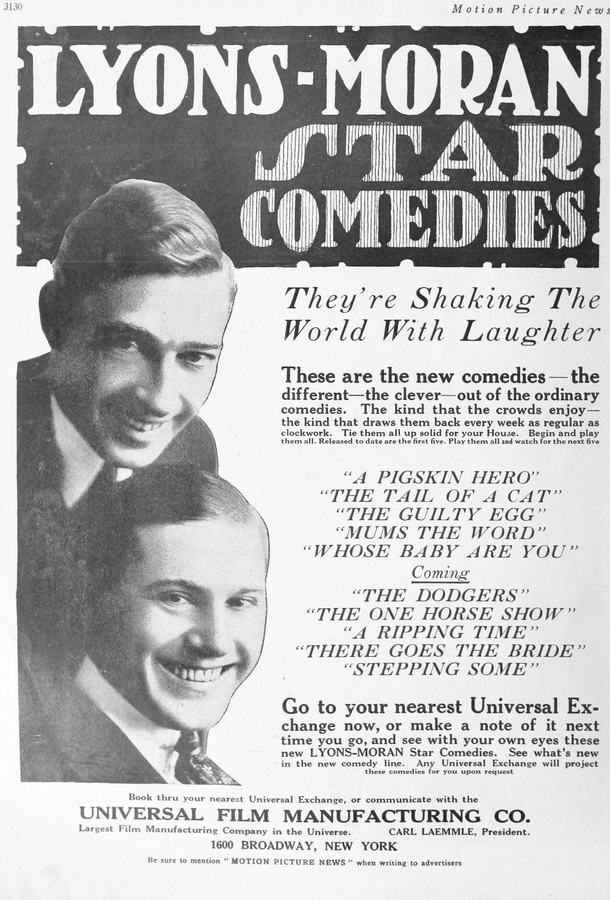
Stepping back into the nascent years of cinema, one encounters a fascinating tapestry of storytelling, often characterized by its directness, its reliance on visual narrative, and its surprising depth. Among these early gems, King Vidor's co-written 'There Goes the Bride' (1917), featuring the dynamic duo of Eddie Lyons and Lee Moran, emerges as a delightful, if somewhat understated, testament to the enduring appeal of the romantic comedy. It's a film that, despite its brevity and the simplicity of its premise, manages to capture a universal human experience: the often-awkward, sometimes painful, and always compelling dance of romantic rivalry.
The narrative, a seemingly straightforward love triangle, unfolds within the intimate confines of a boarding house, a setting that immediately imbues the story with a sense of domesticity and constrained social interaction. Here, two young men, Eddie Lyons and Lee Moran – their characters mirroring their real-life collaborative partnership – find themselves vying for the affections of the same young woman, portrayed with understated charm by Betty Brown. This isn't a grand, sweeping romance, nor is it a melodramatic clash of titans. Instead, it's a quiet, almost whimsical, battle of wits and charm, punctuated by a most peculiar wager: the loser of the girl's heart shall gain sole possession of their shared phonograph. It's a testament to the period's narrative ingenuity, where everyday objects could become symbols of deeper emotional stakes.
Eddie Lyons, a prolific actor and director of the era, brings to his character a certain roguish charm, an almost impish determination that makes his pursuit of the girl both endearing and slightly mischievous. His performance, typical of the period, relies heavily on exaggerated facial expressions and gestures, yet there's an underlying sincerity that prevents it from descending into mere caricature. He embodies the 'winner' with a youthful exuberance that is infectious, making his eventual triumph feel earned, if not entirely surprising.
Lee Moran, Lyons' frequent collaborator and co-writer here, offers a wonderfully contrasting performance. Moran often specialized in more comedic or slightly less dashing roles, and his portrayal of the 'loser' in this romantic contest is tinged with a subtle pathos. His resigned acceptance of the phonograph, rather than the girl, speaks volumes about the character's quiet dignity, or perhaps, his practical resignation. It's a nuanced performance for a silent short, demonstrating that even in these early films, actors were capable of conveying complex emotional states without a single spoken word. The interplay between Lyons and Moran is clearly the heart of the film, showcasing a comedic timing honed over many shared projects.
The female characters, Betty Brown and Beatrice Van, while perhaps less central to the film's core conflict, nonetheless contribute significantly to the overall charm. Brown's portrayal of the sought-after girl is a delicate balance of innocence and quiet agency. She isn't merely a prize to be won but an individual whose affections must be genuinely earned. Van, in a supporting role, adds another layer to the boarding house dynamic, hinting at the broader social fabric within which these romantic entanglements play out. Their presence, though brief, anchors the story in a relatable social reality.
It's particularly intriguing to note King Vidor's involvement as one of the writers. Vidor, who would go on to become one of Hollywood's most celebrated directors, helming classics like 'The Big Parade' and 'The Crowd,' was just beginning his illustrious career at this point. His contribution to 'There Goes the Bride' is a fascinating early indicator of his keen understanding of human nature and narrative economy. Even in this simple short, one can discern the seeds of a storyteller who valued character-driven plots and subtle emotional resonance. The clever premise of the phonograph wager, rather than a more conventional prize, showcases a nascent wit that would later define much of his work, even in more dramatic contexts.
The screenplay, co-written with Lyons and Moran, demonstrates a collaborative spirit that was common in early Hollywood. This creative synergy likely contributed to the film's cohesive tone and the naturalistic performances from the lead actors. It's a fine example of how a simple premise, when handled with care and a clear understanding of character, can yield a surprisingly engaging narrative, even without the technological sophistication or narrative complexity of later eras. One might compare its directness to other early silent shorts like Crooky or Rosie O'Grady, which also relied on simple, character-focused narratives to entertain.
While 'There Goes the Bride' is ostensibly a lighthearted romantic comedy, it subtly touches upon themes of aspiration, competition, and the bittersweet nature of life's compromises. The phonograph, in its era, was a relatively new and prized possession, a symbol of modernity and entertainment. For Lee to gain ownership of it, even at the cost of love, speaks to a certain pragmatic acceptance that resonates beyond the film's comedic facade. It's a quiet commentary on what people value and how they cope with disappointment, a theme that, in more dramatic forms, could be explored in films like The Enemy Within or The House of Bondage, albeit with vastly different emotional weight.
The film's setting in a boarding house is also significant. Boarding houses were common social spaces in the early 20th century, particularly in urban areas, acting as melting pots where individuals from various backgrounds would converge. These environments often fostered both camaraderie and rivalry, making them ideal backdrops for narratives exploring interpersonal relationships. This microcosm of society allowed for intimate storytelling, focusing on individual desires and conflicts without needing expansive sets or elaborate subplots. This approach to character interaction in confined spaces can be seen in other early films exploring social dynamics, though perhaps with more dramatic stakes, such as Toys of Fate or even the domestic struggles depicted in Baby Mine.
Technically, 'There Goes the Bride' is a product of its time. The cinematography is straightforward, relying on static shots and clear framing to convey the action. Editing is functional, serving the narrative without drawing undue attention to itself. Yet, within these constraints, the film achieves a remarkable clarity and efficiency in its storytelling. The performances, as mentioned, are the primary vehicle for emotional expression, and the actors deliver with an earnestness that transcends the limitations of silent film. The reliance on visual cues, body language, and expressive faces meant that silent actors had to master a unique craft, one that is often underappreciated today. In this sense, 'There Goes the Bride' offers a valuable lesson in the power of non-verbal communication in cinema.
While it may not possess the epic scope of a 'Birth of a Nation' or the social commentary of a 'Madame X' (1920, though that came later), 'There Goes the Bride' holds its own as a charming and historically significant piece of early American cinema. It represents a particular strain of filmmaking that prioritized accessible narratives and relatable characters, laying groundwork for the romantic comedies that would dominate Hollywood for decades to come. Its exploration of mild rivalry and the quirks of human affection makes it a delightful watch for anyone interested in the foundational elements of film storytelling.
The film's legacy, though perhaps not as widely celebrated as some of Vidor's later masterpieces, lies in its representation of a period where cinema was still finding its voice. It’s a snapshot of collaborative artistry, where actors, writers, and nascent directors worked in tandem to craft engaging stories for a rapidly growing audience. It reminds us that even the simplest narratives, when executed with genuine charm and a touch of wit, can leave a lasting impression. One could draw parallels to the unpretentious storytelling found in other early films of human interest, such as Our Mutual Girl or The Lily of Poverty Flat, which similarly captured slices of life for their contemporary audiences.
In conclusion, 'There Goes the Bride' stands as a testament to the fact that compelling cinema doesn't always require massive budgets or complex special effects. Sometimes, all it takes is a relatable human dilemma, a clever twist, and a cast capable of conveying a spectrum of emotions through silent performance. Eddie Lyons and Lee Moran, under the early influence of King Vidor's writing, deliver a film that is both a product of its time and timeless in its appeal. It’s a charming, unpretentious piece of cinematic history that offers a window into the romantic sensibilities and storytelling techniques of the early 20th century.
For those eager to delve into the foundational narratives of film, 'There Goes the Bride' is more than just a historical artifact; it's a delightful experience that demonstrates the power of simplicity and the enduring allure of a well-told love story, even one with a slightly unconventional resolution. It’s a reminder that even when the bride 'goes,' something valuable, be it a phonograph or a lesson in human nature, often remains. Its understated charm makes it a worthy subject for any film enthusiast's exploration, a small but significant piece in the grand mosaic of early cinema, much like the quiet yet impactful narratives of films such as Comin' Thro' the Rye or Shifting Sands, which similarly focused on personal dramas rather than epic spectacles. The film also provides a fascinating counterpoint to more adventure-driven narratives of the era, such as The Life and Adventures of John Vane, the Australian Bushranger or the exoticism of The Arab, highlighting the diverse range of stories being told in silent cinema. Even the introspective journey found in The Lost Paradise presents a different facet of early film's ability to explore human condition, a stark contrast to the lighthearted rivalry here. Each film, in its own way, contributes to the rich tapestry of silent film history, and 'There Goes the Bride' certainly earns its place within that collection.
IMDb —
1918
Community
Log in to comment.