DbcultAccessing Vault...
Cult Review
Senior Film Conservator
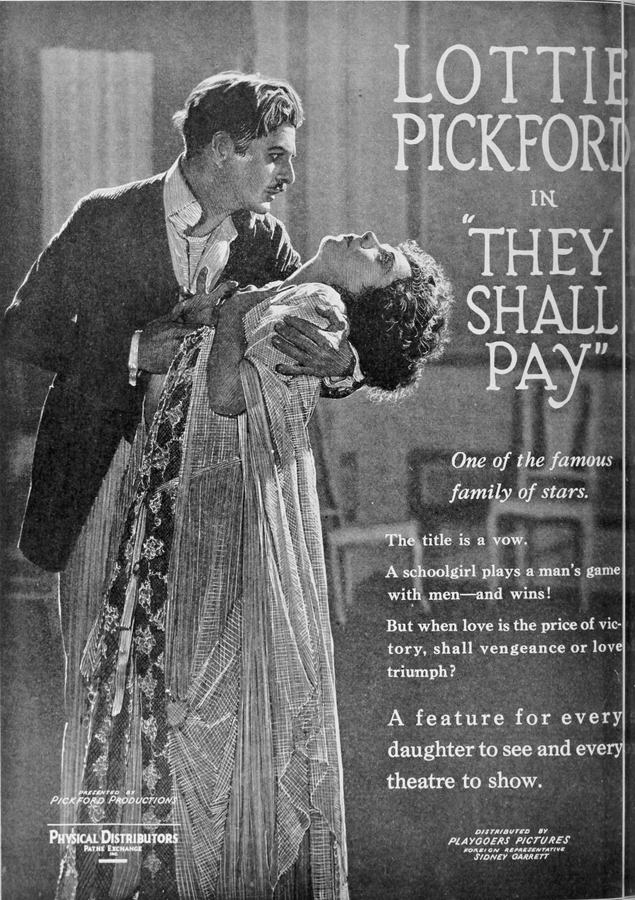
They Shall Pay is not merely a film of its era; it is a time capsule of cinematic audacity, where the chiaroscuro of emotion and intrigue is painted in broad strokes. Released in 1923, this silent drama, directed with a deft hand by Martin Justice, carves its identity in the marrow of its protagonist, Margaret Seldon, whose trajectory from vengeful daughter to conflicted lover is as gripping as it is timeless. The script, a labyrinth of moral quandaries, does not merely entertain—it interrogates the very nature of justice through the prism of a woman’s fury.
At its core, the film hinges on Margaret’s transformation, a metamorphosis that is as much internal as it is performative. George Periolat’s portrayal of her father, a man crushed by the weight of betrayal, sets the stage for a narrative steeped in pathos. His deathbed plea to his daughter is not a mere catalyst but a haunting specter that lingers in every calculated move she makes. Lottie Pickford, as Margaret, embodies this duality with a precision that is nothing short of mesmerizing. Her expressions, wide-eyed and resolute, speak of a woman unmoored by grief yet anchored by purpose—a duality that the camera lingers on with unsettling intimacy.
The film’s structure is a masterclass in tension-building. Margaret’s use of a detective agency to uncover the identities of her father’s betrayers is rendered with a clinical detachment that underscores her descent into manipulation. The scenes aboard Amos Colby’s yacht, where she infiltrates his world as a stewardess, are particularly striking. The camera glides over the opulent yet sterile interior, a visual metaphor for the hollow lives of the men she seeks to dismantle. Paul Weigel’s Colby is a study in smug villainy, his every gesture a reminder of the privilege that shielded him from accountability.
The most audacious sequence, however, is Margaret’s masquerade as a Spanish dancer at Courtland Wells’s engagement party. The production design here is a triumph—garish yet deliberate, the party’s decadence mirrors the moral rot of its host. Wells, played by Allan Forrest with a charm that borders on insincerity, is ensnared by Margaret’s performance, a seduction that is both literal and symbolic. The use of shadows in this scene is not just aesthetic but thematic; Margaret, cloaked in the guise of a temptress, becomes a puppeteer of Wells’s downfall. The exposure of his infidelity is not a victory but a necessary atonement, a ritual that blurs the line between justice and vengeance.
Yet, the film’s greatest strength lies in its exploration of emotional conflict. Margaret’s encounter with Allan Forbes, the Greenwich Village architect, is a quiet counterpoint to the operatic drama of her vendetta. Lloyd Whitlock’s performance as Forbes is understated, his warmth a balm to the fire of Margaret’s purpose. Their connection, fleeting and charged with unspoken tension, is the film’s most human element. When Margaret walks away, her heart heavy with indecision, the audience is left to ponder the cost of her mission. Is there room for redemption in a story so steeped in retribution?
Comparisons to other films of the silent era are inevitable. The Traitress and The Broken Coin share thematic ground in their exploration of betrayal and redemption, but They Shall Pay distinguishes itself through its psychological depth. Unlike the melodramatic excesses of Madero al sur del país, which leans heavily on exoticism, this film grounds its drama in the intimate and the personal. The emotional stakes are elevated by the restraint in its execution—dialogue is sparse, the narrative driven by glances and gestures that speak volumes.
The cinematography, a silent language in itself, amplifies the film’s emotional resonance. Long takes linger on Margaret’s face, capturing the flicker of doubt as she navigates her dual roles. The use of mirrors and reflective surfaces is particularly poignant, serving as a metaphor for her fractured identity. In one haunting scene, she gazes into a mirror while donning a disguise, her reflection a palimpsest of her former self and the persona she assumes. It is a visual echo of the film’s central tension: the struggle to reconcile the daughter she was with the avenger she has become.
The score, though minimal, is a character in its own right. Swells of melancholic strings accompany Margaret’s moments of vulnerability, while the abrupt silences in key scenes—her father’s death, Wells’s exposure—create an aural vacuum that heightens the drama. These moments are reminiscent of the tension in Bullets and Brown Eyes, where the absence of sound becomes a narrative device.
In its final act, the film refuses to offer easy resolutions. Margaret’s return to Allan Forbes is not a triumph but a reckoning. The ambiguity of their reunion—the lingering question of whether she has truly moved past her obsession—leaves the audience in a state of unresolved tension. This refusal to sanitize her journey is what elevates They Shall Pay from a standard revenge tale to a meditation on the cyclical nature of justice. The epilogue, a quiet moment of introspection, is a masterstroke: Margaret, alone in a dimly lit room, stares into the void, her reflection a mosaic of triumph and loss.
In the pantheon of early cinema, They Shall Pay stands as a testament to the power of storytelling to dissect the human condition. It is a film that demands to be seen not as a relic of its time but as a precursor to the psychological thrillers that would follow. Its exploration of vengeance, identity, and the moral ambiguity of justice remains as relevant today as it was nearly a century ago. For those seeking a film that is as intellectually stimulating as it is emotionally charged, this is an essential watch.
IMDb —
1916
Community
Log in to comment.