DbcultAccessing Vault...
Cult Review
Senior Film Conservator
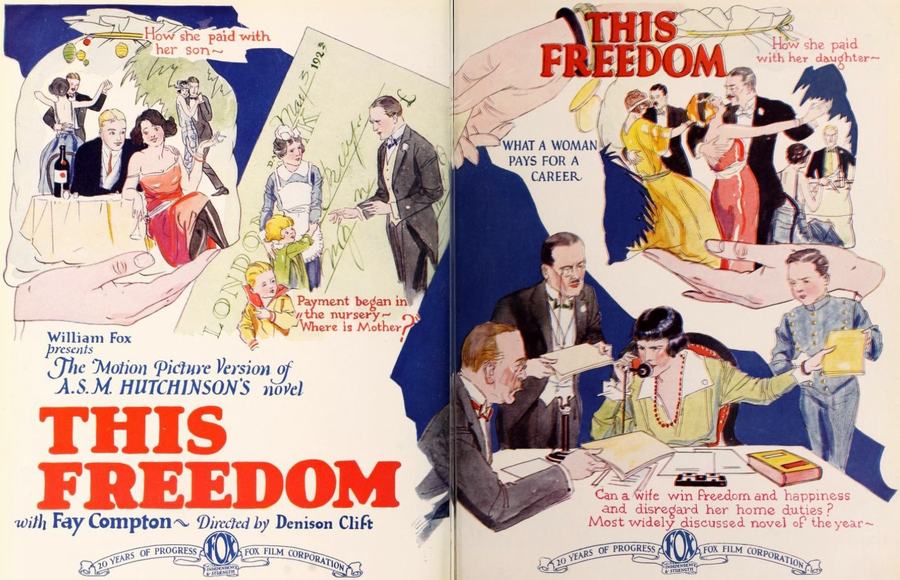
The 1920s were a period of seismic cultural shifts, a decade where the rigid moral scaffolding of the Victorian era began to splinter under the weight of modernism. At the heart of this cinematic exploration lies This Freedom, a 1923 silent drama directed by Denison Clift and based on the polarizing novel by A.S.M. Hutchinson. While many films of the era, such as the whimsical One Week, focused on the slapstick absurdities of domestic life, Clift’s work dives headlong into the murky waters of social responsibility and gendered expectations.
The narrative begins in the claustrophobic confines of a country rectory. Rosalie Aubyn, portrayed with a haunting intensity by Fay Compton, is raised under the watchful, judgmental eye of her father, a cleric whose worldview is as narrow as his vestments. This early environment is crucial; it establishes the atavistic pressure that Rosalie eventually explodes against. Unlike the characters in Bunty Pulls the Strings, who navigate social hierarchies with a certain level of comedic grace, Rosalie’s struggle is profoundly existential.
When Rosalie moves to London, the film’s visual language shifts. The pastoral stillness is replaced by the kinetic energy of the metropolis. Here, she finds her true calling—not in the nursery, but in the boardroom. The cinematography captures her ascent with a mixture of awe and apprehension. We see a woman who is intellectually superior to her male peers, yet constantly reminded of her 'natural' place. Her marriage to Harry, played by the suave Clive Brook, is presented not as a romantic culmination, but as a logistical challenge to her burgeoning career.
The crux of the film lies in its controversial depiction of Rosalie’s motherhood. Clift doesn't shy away from the friction between her professional success and her domestic duties. As Rosalie builds an empire, her children are left to the care of hired help—a decision that the film frames as a dereliction of duty. This is a far cry from the redemptive arcs seen in Her Better Self. Instead, This Freedom operates as a cautionary tale of the highest order.
The casting of Charles Hawtrey and John Stuart adds layers of nuance to the social milieu Rosalie inhabits. The film suggests that her absence at home creates a moral vacuum. Her children—Huggo, Dodo, and Benji—grow up without the guiding light of maternal influence, eventually spiraling into what the period termed 'perversion'—a catch-all for moral decay, criminal association, and social alienation. The tragedy is that Rosalie’s 'freedom' is built upon the ruins of her family’s stability.
Technically, This Freedom is a masterpiece of British silent cinema. Denison Clift’s direction is sophisticated, utilizing deep staging and expressive lighting to mirror Rosalie’s internal conflict. The shadows in the Aubyn household are long and oppressive, contrasting with the bright, almost clinical light of Rosalie’s office. This visual dichotomy reinforces the film’s central theme: the incompatibility of two worlds. The inclusion of Athene Seyler and Mickey Brantford provides a supporting cast that anchors the film in a believable, if heightened, reality.
In comparison to other films like A Square Deal, which often sought to resolve social conflicts through convenient plot devices, This Freedom is uncompromisingly grim. It refuses to offer the audience a neat resolution. The final acts are a relentless barrage of consequences, as Rosalie is forced to witness the literal and metaphorical death of her legacy. The film’s pacing is deliberate, allowing the sense of impending doom to simmer until it boils over in the final reels.
Watching This Freedom today is a complex experience. To a modern audience, the film’s message may feel reactionary, even misogynistic. It places the entirety of the family’s failure on the shoulders of the mother, exonerating the father and society at large. However, if we look past the didacticism, we find a fascinating character study of a woman who was truly ahead of her time. Fay Compton’s performance is nothing short of revolutionary; she captures the steely resolve of a pioneer and the crushing guilt of a mother who realizes her choices have come at a terrible price.
The film resonates with the same tension found in The Adopted Son, where the struggle for identity often leads to unintended destruction. Rosalie is not a villain; she is a victim of a society that refused to allow her to be both a professional and a parent. The 'perversion' of her children is as much a failure of the patriarchal structure as it is a result of her neglect. By refusing to provide a safety net for the working mother, the world of the film ensures her downfall.
It is essential to view This Freedom within the context of the post-war era. The 'surplus women' of the 1920s were entering the workforce in unprecedented numbers, and the film reflects the collective anxiety of a nation trying to reconcile this new reality with traditional values. While films like The Life and Passion of Jesus Christ dealt with eternal moralities, Clift was grappling with the immediate, messy realities of contemporary life.
The writers, A.S.M. Hutchinson and Denison Clift himself, crafted a screenplay that is heavy with symbolism. Every choice Rosalie makes is a brick in the wall that eventually separates her from her family. The film’s ending is a masterclass in silent pathos, as the silence of the medium amplifies the internal screams of a woman who has achieved everything she wanted, only to find she has lost everything that mattered. It is a haunting, beautiful, and deeply frustrating piece of cinema that demands to be seen and debated.
Ultimately, This Freedom stands as a landmark of 1920s British filmmaking. It is a work of significant lexical and emotional diversity, moving from the quiet desperation of a country home to the frantic energy of a London office. It challenges the viewer to question the true meaning of freedom and the inherent sacrifices required to achieve it. Whether one agrees with its moral conclusion or not, one cannot deny the power of its execution and the enduring brilliance of its lead performance.
For those interested in the evolution of gender roles on screen, this film is indispensable. It provides a bridge between the Victorian melodrama and the modern psychological thriller. It is a reminder that the struggle for balance in our lives is not a new phenomenon, but a battle that has been fought—and often lost—on the silver screen for over a century. Clift’s vision remains a stark reminder that every freedom comes with a price tag, and sometimes, that price is higher than we are willing to pay.
IMDb —
1916
Community
Log in to comment.