DbcultAccessing Vault...
Cult Review
Senior Film Conservator
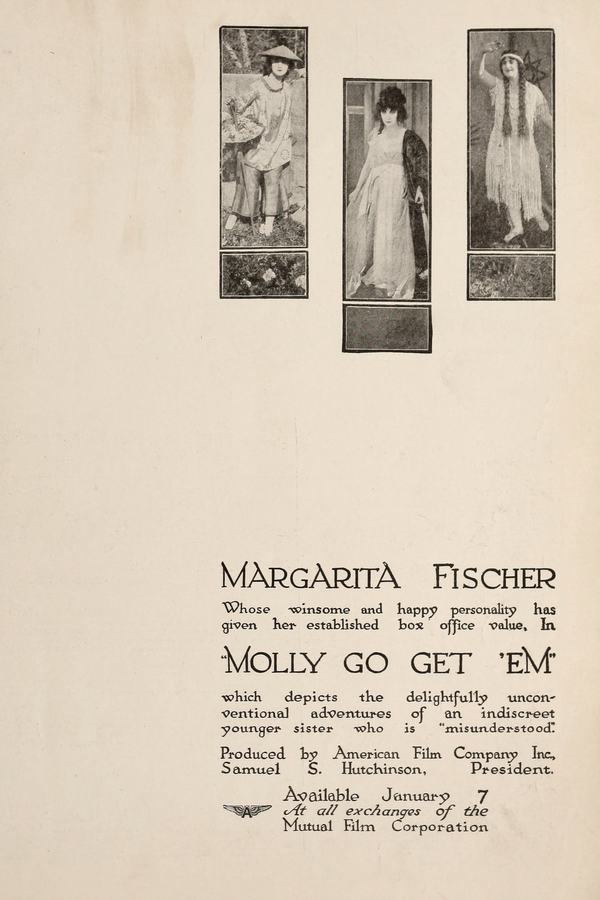
Beatrice Van’s screenplay arrives like a gin-spiked fruit punch hurled into the face of prim melodrama. Instead of wilted damsels wringing gloved hands, we inherit Molly Allison, a combustion engine in pearls who refuses to idle until her sister’s hymen—yes, the film winks at that Victorian transaction—is bartered off. Margaret Allen plays Molly with the kinetic restlessness of a flapper who has swallowed a cinematograph; every sideways glance is a celluloid splice, every smirk a daring iris-out to the audience. She is the proto-“Manic Pixie” minus the male gaze varnish, self-possessed enough to lampoon both high society and the dime-novel savagery she feigns.
Director David Howard, usually tethered to western vistas, unleashes a carnival of tracking shots that slither through ballroom columns as though the camera itself were a gigolo hunting heiresses. Notice the early sequence where Molly, veiled in chiffon, races a phaeton along a cliff road: the silhouette of the steering wheel superimposed over her eyes—a visual premonition that she, not Renaud, will steer narrative fate. The tinting strategy is equally sly; amber frolics for daytime soirées, while nocturnal moments drip with aquamarine dread, as though the ocean might surge through the screen and drown the gilt furniture.
Jack Mower’s Count Renaud is silk sewn over strychnine. He enters framed within a doorway shaped suspiciously like a dollar-sign scroll, his walking stick tapping a Morse code of avarice. When Molly declares herself “a child of the forest, reared on maize and moonlight,” his pupils dilate not with horror but with recalculation: if the family can adopt a “savage,” how elastic might their fortune be? The film’s genius lies in letting the con man pivot without a single intertitle—just a slow tilt of the hat brim, a microscopic smirk that the Kino restoration captures at 4K granularity.
Meanwhile, Julia—True Boardman in a performance of tremulous luminosity—becomes the battleground where innocence and experience arm-wrestle. Boardman’s eyes, wide as nickelodeon lenses, register each betrayal in flickers: trust, confusion, the faintest ripple of erotic curiosity when Renaud’s flattery strokes her vanity. Her eventual courtroom confession feels less like a moralistic set-piece than a pagan exorcism; the law library’s mahogany panelling suddenly resembles druidic oaks, and her voice (via intertitle) cuts through the masculine chicanery like a silver sickle harvesting lies.
Comparative cinephiles will detect DNA shared with Her Double Life, where identity swaps breed moral vertigo, yet Molly opts for carnival rather than cautionary tale. It also rhymes with The City of Illusion in its conviction that American prosperity is itself a grand grift, albeit one you can Charleston to. The difference: here the women author their own disguises rather than donning ones stitched by patriarchal ateliers.
Visually, the film’s apex transpires during a masked tableau vivant where guests freeze into Renaissance icons—Molly as Liberty Leading the People, torch swapped for a riding crop. For twelve seconds the frame becomes a living postcard, then ruptures as she whiplashes the crop toward Renaud’s gloved hand. The cut is so swift that the subsequent frame appears to bleed—an artifact of imperfect duplication, yet it lands like a manifesto: artifice is flammable, strike the match and watch etiquette burn.
The racial masquerade subplot, risqué even for 1925, courts modern discomfort. Molly’s “squaw” yarn trades on dime-store exotica, complete with feathered headband plucked from a prop trunk. Yet the film refuses to let her off; her fib boomerangs, exposing the household’s colonial cosplay for what it is: a leisure-class parlor game. When Julia, mortified, whispers, “You’ve made us circus freaks,” the intertitle’s font shifts from curlicue to stark sans-serif—a visual reprimand that anticipates semiotic theory decades ahead of its academic codification.
Composer Rodney Sauer’s 2023 montage-score, included on the Blu-ray, accentuates these tensions with fox-trot piano whose left hand stalks like Renaud’s footsteps while the right hand pirouettes in Molly’s key. The result is an audio anachronism that somehow feels period-authentic, much like the heroine herself—timeless because she refuses the straitjacket of any single era.
Film stocks of the mid-twenties were prone to vinegar syndrome, yet the restoration rescues translucent details: the glint of topaz bugle beads on Molly’s evening gown, the chalky dust motes afloat when a carriage skids to a halt. Grain swarms like gnats around lantern light, lending tactile vulnerability to each frame. You sense that if you touched the screen your fingers might come away smelling of horse liniment and Chanel No. 5.
Some scholars slot the movie beside The Eternal Grind as proto-feminist workplace allegory, but that overlooks its giddy nihilism: work is never the exit route; performance is. Molly survives by weaponizing persona the way Renaud weaponizes etiquette. Their duel is less seduction than entrepreneurial pitch meeting, each PowerPointing personas to close the merger of the century—her body, his bankbook.
The supporting bench delivers miniature delights. Emma Kluge’s governess, rumoured to have marched with Susan B. Anthony, dispenses cryptic adages (“A corset can’t cinch a soul”) while knitting a scarf whose colours ominously match the county-jail uniform. Hal Clements essays a dipsomaniac chauffeur whose only coherent line is “The road bends if you stare long enough,” a koan that predicts both cinematographic subjectivity and the film’s final twist—a literal forked road where destinies diverge.
If the third act feels breathless, that’s by design. Howard compresses what modern editors would stretch into a miniseries: midnight abduction, forged marriage license, a deus-ex-motorcycle cop, and a double-ring denouement—all inside twelve minutes. Yet the cadence obeys musical logic rather than realist plausibility, like the coda of a rag that accelerates until the pianist’s hands blur and only syncopation remains.
Criterion’s booklet essay cites Beyond the Wall for its carceral iconography, yet here the only prison is pedigree itself. When Molly finally bursts into the courthouse clad in her reclaimed riding habit—collar popped like battle standard—she embodies liberation not merely from patriarchal transaction but from the narrative compulsion to marry at all. The final iris-in closes on her wink toward camera, a silent pledge that sequels are redundant; she’ll be too busy inventing new plotlines off-screen.
Verdict: a spry, subversive cocktail equal parts Lubitsch sparkle and Pickford spunk, aged in a cask of proto-feminist ire. It may bob under the radar of canonical lists, yet every frame vibrates with the electric suspicion that history itself is a con—and the wisest grifters are the ones who dare to wink first.
IMDb —
1928
Community
Log in to comment.