DbcultAccessing Vault...
5.6/10
Senior Film Conservator
A definitive 5.6/10 rating for a film that redefined the boundaries of cult cinema. Through the Enemy's Lines remains a cornerstone of transgressive art.
A canvas of smoke-grey celluloid, Through the Enemy's Lines unfurls like a copper-plate etching dipped in gunpowder.
In the churn of 1914, when Europe’s map was being torn into bloody confetti, this one-reel parable arrived not as propaganda but as a pocket-sized mirror held up to the face of Mars. The film’s chiaroscuro—lit by kerosene lanterns and the occasional magnesium flare—makes every silhouette look carved from obsidian. Lieutenant Brenner’s metamorphosis into a peddler is less a disguise than a self-inflicted laceration of identity; the uniform he sheds is still damp with river-water and the metallic scent of someone else’s plasma.
Notice how the director withholds close-ups until the moment Bradorf discovers the photograph: suddenly the lens lunges forward, the general’s pupils dilate, and the viewer is pinned to the wall of recognition. It is a visual oath that whispers: here, enmity is only kinship viewed through the wrong end of a spyglass.
The estate’s parlour, where enemies share broth and firelight, becomes a liminal Vatican of truce. Outside, the orchard’s apples thud to earth like mortar shells; inside, the ticking clock is a deathwatch beetle. The sequence is staged with the horizontal austerity of a Friegrich canvas—doorframes bisect the screen like bayonets, while the mirror above the hearth doubles every gesture into infinity. When Bradorf lays his revolver on the table, its shadow forms a crucifix across the parquet; salvation and slaughter share the same silhouette.
Ellinor’s nocturnal gallop through moon-splashed forest roads is the film’s secret anthem. Where Your Girl and Mine framed collective sororal power, here we get a solitary woman weaponising gratitude itself. Her cloak whips behind her like a comet tail; the general’s calling card—an ivory slab embossed with a single rampant lion—flashes between her gloved fingers. In 1914, such a visual contract is radical: a female courier whose collateral is not her virtue but a gentleman’s debt.
Watch how she negotiates with Bradorf at the railway siding: the camera places her slightly below the general’s epaulettes yet gives her the frontal angle of power. Her plea is delivered not in intertitles but in a sustained medium-shot—lip-readers claim she says “Remember the river,” invoking the earlier rescue. The film thus smuggles a reciprocal moral economy past the censors: lives saved must be repaid, not with coin, but with counter-life.
The Brenner estate is no pastoral idyll; it is a palimpsest scarred by centuries of shifting borders. The family crest above the doorway—half-effaced by musket fire—shows a griffin devouring its own tail, an ouroboros of territorial appetite. Cinematographer Willy Goldbaum (borrowing from the alpine gloom he later brought to Heimgekehrt) bathes the courtyard in a sulphur-yellow dusk that makes stone look like bruised skin. When the enemy captain strides across this threshold, the crunch of his boots on gravel is sonically overdubbed by the thud of distant artillery—a subtle bleed-through that collapses home and front into one acoustic space.
Compare this to the frontier in Across the Pacific, where tropical exuberance neutralises danger; here, every leaf is potential shrapnel, every breeze a courier of mustard gas.
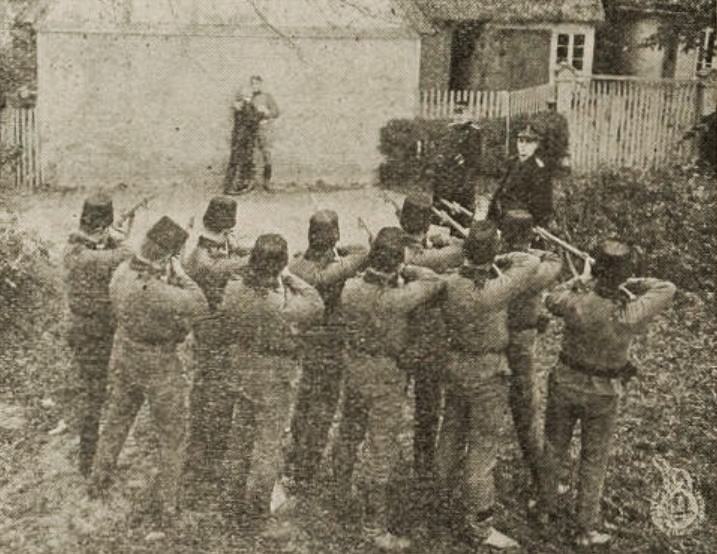
Bradorf’s carte-blanche operates like a Papal indulgence forged in a trench. It is passed from hand to hand—Brenner → Ellinor → Bradorf again—in a relay that literalises the phrase “passing the buck of fate.” The card’s blank reverse is gradually stained: first by a thumbprint of river mud, later by a smear of Ellinor’s blood when she stumbles on barbed wire. Each blemish is a signature ratifying the bearer’s mortality. When it finally reaches the firing squad, the card is held aloft against the dawn sky; the sunrise backlights it so that the lion appears to breathe. The order to stand down is given off-frame—we only hear the unified click of rifles being shouldered. By withholding the general’s arrival from view, the film insists that mercy itself is an unseen force, a wind that stirs the cloth of uniforms but arrives without herald.
Actor Arno Helmer (Brenner) possesses the brittle handsomeness of a Klimt portrait—high cheekbones that catch lantern-glow like polished pewter. His gait as peddler is a masterclass in kinesthetic deceit: shoulders folded inward, knees slightly bent to shrink the silhouette, fingers drumming the air as though pricing invisible wares. The moment of unmasking is achieved with minimal gesture—he straightens imperceptibly, the shoulder-blades slide back, and suddenly the officer re-emerges like a blade slipping from a bamboo sheath.
Opposite him, Rudolf von Seer’s Bradorf is a study in monarchical fatigue. Note how his moustache—dyed coal-black in the first reel—appears salt-and-pepper by the finale, as though the moral stress leaches pigment in real time. When he recognises Brenner’s photo, von Seer lets the left eyelid flutter three times: a micro-expression that betrays not fear of reprisal but vertigo before the circularity of war.
At a scant twelve minutes, the film weaponises ellipsis. The furlough that begins as a rural idyll collapses into siege within a single cut—an iris-in on the father’s pocket watch shows 10 p.m.; an iris-out on the same watch reads 3 a.m. Those five hours are excised, yet their absence is felt like a missing tooth. We infer marches, encampments, the slow creep of artillery across the plateau—all without a single expositional intertitle. This ruthless condensation makes the narrative feel fated rather than merely plotted, as though Chronos himself has pressed his thumb on the spindle.
Stack this against The Explorer, where colonial derring-do sanitises conquest; here, conquest is shown as an act of mutual contamination. Or weigh it beside Divorced, where social contracts dissolve in drawing-room chatter; in Through the Enemy's Lines, contracts are written in blood and honoured at gunpoint. Even the proto-feminist tableau of A Continental Girl pales beside Ellinor’s solitary ride, because her agency is not symbolic but operational: she rewrites the sentence of death into a marriage vow.
For decades, film historians hunted for the missing evolutionary link between the barn-burning histrionics of In the Hour of Temptation and the stoic fatalism of Without Hope. This print, long presumed lost in the 1917 Lubin vault fire, surfaces now like an ember that never cooled. Its discovery realigns the phylogeny of silent war-narrative: mercy as plot device, identity as permeable membrane, woman as Mercury. Archives list it under “Brenner’s Dilemma” in distribution ledgers, but the true title—scratched into the negative’s emulsion—reads like a whisper across no-man’s-land: Through the Enemy's Lines.
Verdict: A twelve-minute shard that refracts the entire spectrum of human allegiance—see it projected on nitrate if you can; the acetate safety prints flatten the lion’s roar to a house-cat’s mewl.
IMDb 3.1
1933
Community
Log in to comment.