DbcultAccessing Vault...
Cult Review
Senior Film Conservator
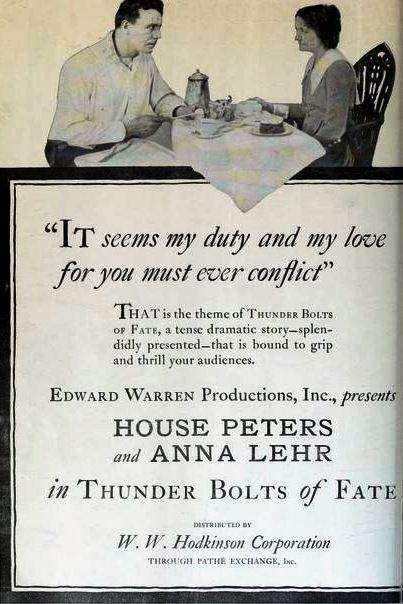
Stepping back into the annals of early cinema, one often encounters narratives that, despite their age, resonate with an astonishing contemporary relevance. Such is the case with the 1919 drama, Thunderbolts of Fate. This isn't merely a silent film; it's a pulsating tapestry woven with threads of political ambition, forbidden romance, and the devastating consequences of societal expectations. Directed with an acute understanding of human frailty and a flair for the dramatic, this picture, penned by the collaborative talents of H.S. Sheldon and Winifred Dunn, plunges its audience into a world where public image clashes violently with private desires, and the pursuit of power often demands the ultimate sacrifice of personal happiness.
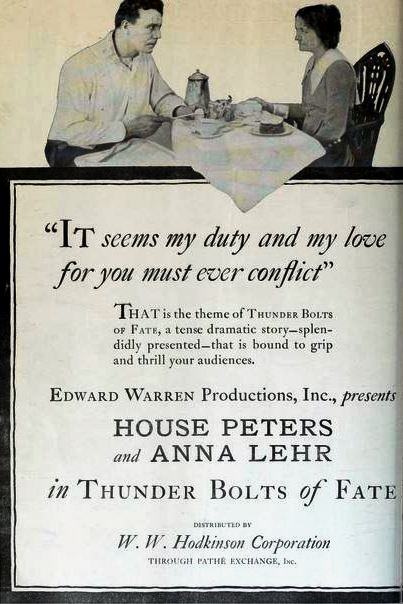
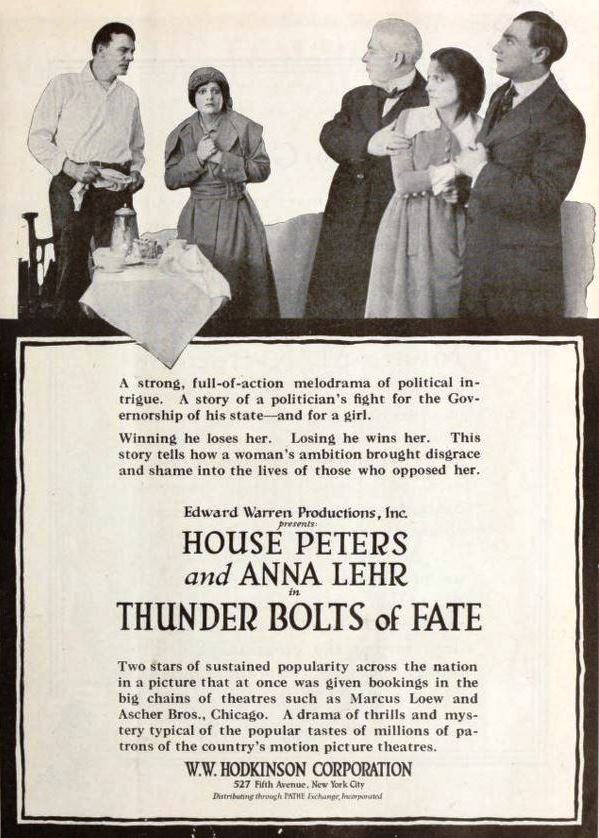
At its core, Thunderbolts of Fate meticulously dissects the perils of a life lived under the scrutinizing gaze of the public. Robert Wingate, portrayed with a compelling blend of idealism and vulnerability by House Peters, is a man on a mission: to cleanse the political landscape of graft and corruption. His gubernatorial campaign is a beacon of hope, yet his personal life is a tempest in waiting. He falls for Eleanor Brewster (Anna Lehr), a woman whose integrity mirrors his own, but who carries the unfortunate surname of his political adversary. This blossoming affection is complicated, indeed jeopardized, by his prior engagement to Adele Hampton (Corene Uzzell), a social climber par excellence, whose heart is far from Robert's, secretly entwined with the notorious "man-about-town," Howard Lennox (Henry Sedley).
The narrative’s initial conflict is a masterclass in moral dilemma. Robert and Eleanor, recognizing the catastrophic political fallout of breaking his engagement, make the agonizing decision to suppress their burgeoning love. This act of self-denial, however, only serves to lay the groundwork for a far more devastating chain of events. Robert marries Adele, who, predictably, continues her clandestine affair with Lennox. The film deftly portrays the suffocating hypocrisy of this arrangement, a stark contrast to the genuine, albeit unrequited, affection between Robert and Eleanor. Lennox, a character whose moral compass is perpetually adrift, soon tires of Adele and sets his sights on Eleanor, initiating a series of events that spiral into murder, false accusation, and a desperate race against time.
The strength of Thunderbolts of Fate lies not only in its intricate plot but also in the compelling performances that breathe life into its complex characters. Anna Lehr, as Eleanor Brewster, delivers a portrayal of quiet strength and profound suffering. Her expressive eyes convey the weight of her impossible situation, her unwavering virtue a stark counterpoint to the moral decay surrounding her. Lehr’s ability to communicate deep emotion without uttering a single word is a testament to the power of silent acting, making Eleanor a truly sympathetic figure whose plight resonates long after the credits roll.
House Peters, as Robert Wingate, navigates the treacherous waters of political ambition and personal anguish with remarkable conviction. We witness his transformation from an idealistic reformer to a man trapped by his own choices, his internal conflict palpable. Peters masterfully conveys the burden of his forced marriage and the torment of a love he cannot openly claim. His performance anchors the film, providing a relatable human core amidst the swirling drama.
Corene Uzzell’s Adele Hampton is a fascinating study in villainy, albeit one born of desperation and social ambition. Uzzell imbues Adele with a certain brittle charm that quickly gives way to a chilling ruthlessness. Her portrayal of a woman willing to destroy others to maintain her façade is both captivating and disturbing, culminating in a breakdown scene that is both tragic and deserved. Henry Sedley, as the nefarious Howard Lennox, perfectly embodies the archetype of the "man-about-town" – charmingly dangerous, utterly self-serving, and ultimately, a catalyst for destruction. His smirking villainy is expertly crafted, making his eventual demise a moment of grim satisfaction for the audience.
The supporting cast also deserves commendation. Ned Burton, Ben Lewin, and Wilfred Lytell contribute to the film’s rich tapestry, each adding depth to the socio-political landscape and personal dramas. Clifford Brewster, Eleanor's brother, played by an uncredited actor in some records but a pivotal role, embodies the protective sibling, whose rash actions, born of love, propel the plot into its most dangerous phase. The collective efforts of this ensemble elevate the film beyond mere melodrama, transforming it into a compelling character study.
The thematic richness of Thunderbolts of Fate is undeniable. It delves into the destructive power of ambition, particularly when untethered from moral principles. Adele's relentless pursuit of social standing at any cost serves as a cautionary tale, mirroring the corrupt political landscape Robert initially seeks to reform. The film also explores the profound sacrifices made for duty and reputation. Robert's decision to marry Adele, despite his love for Eleanor, is a poignant examination of how societal pressures can force individuals into agonizing choices, often with tragic repercussions.
Furthermore, the narrative touches upon the precarious nature of justice, especially when entangled with personal vendettas and circumstantial evidence. Clifford's unjust conviction for Lennox's murder highlights the fallibility of the legal system and the desperate fight for truth against overwhelming odds. This element of legal drama adds a thrilling layer of suspense, compelling the audience to root for Eleanor's desperate quest for exoneration. In this regard, one might draw parallels to other films of the era that explored similar themes of societal hypocrisy and the individual's struggle against an unforgiving system, such as The Ordeal of Rosetta, which also features a woman battling for her reputation and freedom amidst challenging circumstances.
While the directorial hand is not explicitly credited in the provided information, the film's execution speaks to a keen understanding of visual narrative. The use of dramatic close-ups to emphasize emotional turmoil, the staging of pivotal scenes to heighten tension, and the careful composition of shots all contribute to a compelling viewing experience. The storm sequence, which traps Eleanor and Robert at the hunting lodge, is particularly effective, serving not just as a plot device but as a potent metaphor for the tempestuous emotions raging between the characters and the impending disaster. The stark contrasts between opulent interiors and the rugged wilderness of the lodge further underscore the film's thematic dichotomies.
The film’s pacing, a crucial element in silent cinema, is expertly handled. It builds suspense incrementally, allowing the various subplots to intertwine organically before accelerating towards its dramatic climax. The intertitles, the textual inserts that convey dialogue and exposition, are succinct and impactful, never overstaying their welcome but providing just enough information to keep the narrative flowing. This judicious use of intertitles, combined with strong visual cues, ensures that the story remains clear and engaging without relying on excessive verbal explanation.
H.S. Sheldon and Winifred Dunn's screenplay is a marvel of intricate plotting. They weave together multiple narrative threads – political ambition, illicit romance, murder mystery, and legal drama – into a cohesive and gripping whole. The character motivations, though often morally ambiguous, are consistently drawn, making the actions of Robert, Eleanor, and Adele understandable within their dramatic context. The gradual escalation of conflict, from the initial political compromise to the harrowing murder trial and the final, shocking confession, is a testament to the writers' skill in building dramatic tension.
The narrative’s ultimate resolution, with Adele's confession and subsequent drowning, provides a cathartic, if tragic, conclusion. It offers a sense of justice, albeit one stained by further loss. The writers resist the urge for a simple happy ending, instead opting for a more complex, bittersweet resolution that reflects the harsh realities of the choices made throughout the film. This nuanced approach elevates Thunderbolts of Fate beyond a mere potboiler, imbuing it with a sense of gravitas and moral weight. The exploration of societal constraints and the lengths individuals go to preserve appearances, even at the cost of their soul, echoes the moral inquiries found in films like Love's Law, where the pressures of convention often dictate personal fates.
While Thunderbolts of Fate might not be as widely discussed as some of its more celebrated silent contemporaries, it stands as a powerful example of early American cinema's capacity for complex storytelling and profound emotional depth. Its exploration of themes like political corruption, the destructive nature of secrets, and the enduring power of love and sacrifice remains relevant even today. The film serves as a reminder that the struggles for integrity, justice, and personal happiness are timeless, transcending the technological limitations of the era in which it was made.
For enthusiasts of silent film and those interested in the evolution of dramatic narrative, Thunderbolts of Fate offers a rich and rewarding viewing experience. It's a testament to the artistry of its cast and crew, who, through gesture, expression, and masterful staging, crafted a story that continues to resonate with its emotional intensity and moral complexity. It compels viewers to consider the true cost of ambition and the devastating impact of choices made under duress. This film, with its intricate web of human drama, certainly earns its place as a compelling entry in the silent era's robust cinematic canon.
IMDb 5.2
1920
Community
Log in to comment.