DbcultAccessing Vault...
Cult Review
Senior Film Conservator
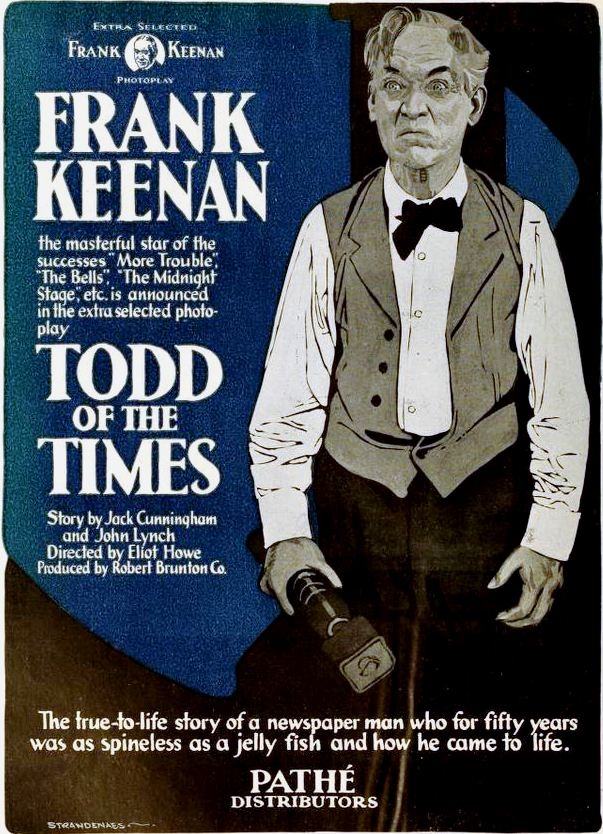
The year 1919 was a crucible of American identity, a moment caught between the lingering shadows of the Great War and the burgeoning roar of the twenties. In this cultural interregnum, Todd of the Times emerged not merely as a piece of celluloid entertainment, but as a sharp-edged scalpel performing an autopsy on the American middle-class psyche. Directed with a keen eye for the rhythmic pulse of the newsroom, the film offers a fascinating study of the dichotomy between professional brilliance and private subjugation.
Frank Keenan, an actor of immense gravitas, portrays Theobald Todd with a nuanced vulnerability that was rare for the silent screen. Todd is introduced as a man who possesses the "keenest nose for news," a metaphorical descriptor that the film treats with almost tactile reverence. In the hierarchy of the Springfield Evening Times, Todd is the indispensable engine, the man who can smell a scandal before the ink is even dry. This professional aptitude, however, serves as a painful contrast to his domestic life. Much like the protagonist in The Social Secretary, Todd must navigate a world where social expectations and personal identity are in constant friction.
The film excels in its depiction of the newsroom—a chaotic, kinetic environment where the clatter of typewriters and the smell of lead type create a symphony of industry. Here, Todd is a king in shirtsleeves. But the moment he steps across the threshold of his home, the cinematography shifts. The framing becomes tighter, more oppressive. His wife, played with a chilling, bureaucratic sternness by the cast, represents the stifling Victorian morality that still clung to the edges of the early 20th century. She is not merely a "shrew" in the Shakespearean sense; she is a systemic force of suppression.
The introduction of Roy, the overgrown and lethargic stepson, adds a layer of absurdist comedy that underscores the film's darker themes. Roy is the physical embodiment of unearned privilege and domestic decay. When Todd is coerced into giving Roy a job at the paper, the film transitions into a biting satire of nepotism. Unlike the earnest struggles found in A Jewel in Pawn, where the stakes are life and death, the conflict here is one of professional desecration. Roy’s presence in the newsroom is a pollutant, a disruption of the meritocratic ideal that Todd holds dear.
The narrative brilliance of Todd of the Times lies in how it weaves these domestic frustrations into a larger tapestry of civic corruption. The gambling ring, operating under the guise of stockbrokers, is a masterstroke of screenwriting. It mirrors Todd’s own life: a respectable facade hiding a reality of exploitation. The fact that the ringleader is the town’s self-appointed anti-vice crusader provides a cynical commentary on the hypocrisy of the era’s moral guardians—a theme echoed in the more somber The Toll of Mammon.
When the owner of the Times departs, he leaves Todd with a temporary mandate of power. This is the film’s inciting incident, the spark that ignites Todd’s latent assertiveness. The sequence involving the exposure of the gambling ring is a tour de force of silent era editing. We see Todd and his star reporter working in tandem, a frantic race against time that is hampered at every turn by Roy’s inadvertent (and occasionally deliberate) interference. The tension is palpable, the stakes high—not just for the city of Springfield, but for Todd’s very soul.
The production of the "extra" edition is filmed with a documentary-like precision. We see the frantic typesetting, the rolling of the presses, and the eventual explosion of newsboys onto the streets. This is the moment of Todd’s apotheosis. He has used his "nose for news" to dismantle a structure of corruption that mirrors his own domestic bondage. The success of the paper is the external validation he needs to finally confront the internal demons that have kept him subservient.
The film’s climax is perhaps one of the most jarring and satisfying resolutions in silent cinema. Having been appointed managing editor, Todd returns home. But he does not return as the henpecked husband. The scene where he smashes the parlor furniture is a radical act of iconoclasm. In the early 1900s, the parlor was the sacred heart of the middle-class home, a space of curated respectability and feminine control. By physically destroying this space, Todd is not merely throwing a tantrum; he is performing a ritualistic destruction of the old order.
This sequence may strike modern viewers as aggressive, but within the context of 1919, it was a profound statement on the reclamation of agency. It stands in stark contrast to the more passive resolutions seen in films like Danger, Go Slow. Todd’s declaration that he is now the "managing editor of his own establishment" serves as a linguistic bridge between his professional success and his personal liberation. The "reign of terror" ends not with a whimper, but with the splintering of wood and the shattering of glass.
Visually, the film utilizes a palette of deep shadows and sharp highlights, particularly in the newsroom scenes, which suggests a proto-noir sensibility. The use of title cards is sparse but effective, allowing the physicality of the actors—particularly Keenan’s expressive face—to carry the emotional weight. The contrast between the sprawling, messy world of the newspaper and the sterile, rigid environment of the boardinghouse is achieved through meticulous set design and blocking.
While some might compare the film’s moral arc to Pilgrim's Progress, Todd of the Times is far more grounded in the muck and mire of modern life. It eschews allegory for the visceral reality of ink-stained fingers and domestic strife. The writers, John Lynch and Jack Cunningham, have crafted a script that avoids the mawkish sentimentality often found in contemporary features like A Child of Mystery.
In the grand pantheon of silent cinema, Todd of the Times deserves a prominent place for its sophisticated blend of social critique and character study. It captures a specific American anxiety—the fear of being emasculated by the very structures of respectability one works so hard to maintain. Todd is a hero for the everyman, a man whose extraordinary talent is nearly extinguished by the mundane cruelty of his domestic situation.
The film also serves as a fascinating precursor to the great newspaper films of the 1930s and 40s. It understands that the press is not just a conveyor of information, but a weapon that can be used to level the playing field. When Todd exposes the gambling ring, he isn't just doing his job; he is asserting his right to exist in a world that is honest and transparent. This pursuit of truth, both in the public square and the private home, is what gives the film its enduring power.
In conclusion, Todd of the Times is a masterwork of tonal balance. It manages to be funny, tense, and profoundly moving all at once. For those interested in the evolution of the American narrative, it is an essential viewing experience. It reminds us that sometimes, to find our voice, we must first be willing to break the furniture.
IMDb 5.1
1936
Community
Log in to comment.