DbcultAccessing Vault...
7.4/10
Senior Film Conservator
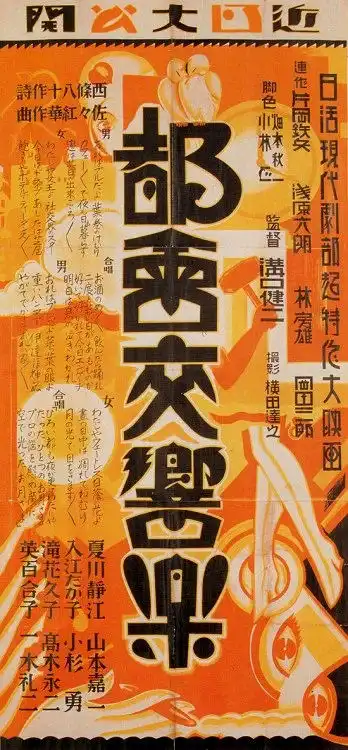
A definitive 7.4/10 rating for a film that redefined the boundaries of cult cinema. Tokai kokyogaku remains a cornerstone of transgressive art.
"Tokai kokyogaku," or "Urban Symphony," is one of those films that pops up and makes you think about early Japanese cinema. Is it worth tracking down today? Well, if you're into films that really lean into their social message, and don't mind a bit of melodrama from the era, then yes, absolutely. If you're hoping for something fast-paced or subtle, though, this one might feel a bit like a history lesson you didn't sign up for. It’s for folks who appreciate the raw, urgent storytelling of its time, especially silent film buffs or anyone curious about how class struggle played out on screen way back then.
The story itself is pretty stark: a young woman, taken advantage of by a rich dude, finds help from a working-class guy to get things right. It’s a setup we've seen a million times, sure, but here it feels really direct, almost like a parable.
There's a scene, I'm thinking of it now, where Takako Irie's character just has this look of utter defeat that really sticks with you. It’s not overacted, not like some of the more theatrical performances from that period. It’s a quiet despair, a heavy burden carried visibly. Then, the camera holds on her for just a beat too long, and you start to feel it with her, almost uncomfortably so.
And the rich guy, played by Eiji Takagi, he's not just a bad guy; he's got this smugness that radiates from the screen. It's almost cartoonish at times, but it works for the story they're telling, making him a clear villain without much nuance. You want to see him get his comeuppance, really.
Isamu Kosugi, as the working-class youth, brings a different energy. He's got a certain grit to him. You can see the determination, even when he’s just walking; his posture speaks volumes. There's a moment where he just stands there, watching the wealthy district, and you can practically hear the thoughts about injustice brewing in his head. No dialogue needed, just that gaze. 🧐
The film’s message about class feels really upfront. It's not trying to hide it, not even a little bit. The contrasts between the opulent settings of the rich — all grand stairs and empty spaces — and the stark, almost bare surroundings of the working class are really highlighted. Sometimes, it almost feels like the sets themselves are shouting the message, leaving little to the imagination.
Pacing wise, it's not a sprint. It takes its time, building up the emotional weight of each revelation and setback. Some modern viewers might find parts a bit slow, especially the transitions between scenes. But I found myself appreciating the chance to just sit with the characters' situations, letting the atmosphere soak in. It’s deliberate, a slow burn of indignation.
The cinematography, while simple for its time, still manages to convey a sense of scale. There's this one shot of the city, almost like a character itself, a bustling, indifferent backdrop to all this personal struggle. "Urban Symphony" is a fitting title; you see the movement, the constant flow, but underneath it all are these very human, very raw stories, often lost in the shuffle.
I remember thinking about the small gestures, too. A hand reaching out, or a subtle nod between characters. Those tiny things carry so much weight when the dialogue is minimal, or perhaps feels a bit dated now. It makes you lean in closer.
The ending, without giving too much away, feels earned. It's not a tidy, everything-is-perfect kind of resolution, which is refreshing. It’s more like a sigh of relief, a small victory in a world that’s still pretty unfair, leaving you with a lingering sense of justice, but also the scale of what's left to fight. It's not a feel-good wrap-up, but a thoughtful pause.
It's a film that definitely shows its age in some ways, maybe in the starkness of its good-vs-evil portrayals, but the raw emotion and clear intent still shine through. You feel the writers, Masashi Kobayashi and Shūichi Hatamoto, had something they really wanted to say, something urgent about their society. And they said it, loud and clear.

IMDb —
1925
Community
Log in to comment.