DbcultAccessing Vault...
Cult Review
Senior Film Conservator
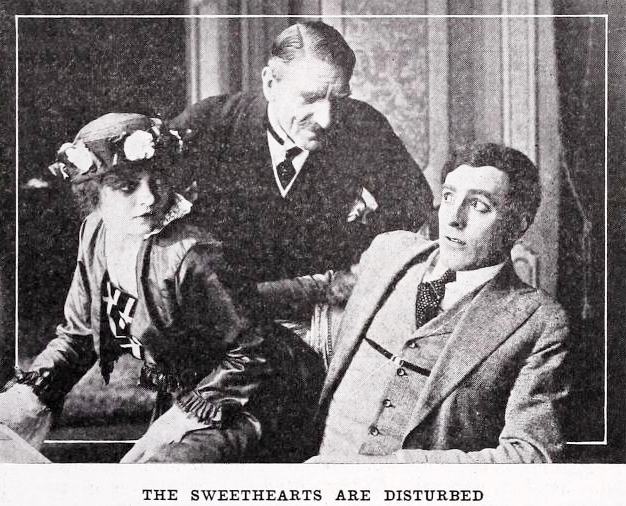
Money clangs louder than wedding bells in John Glayde's Honor, a brittle 1915 morality tale that feels like stepping on a marble floor iced over with regret.
Director Edwin L. Hollywood—working from Alfred Sutro's West-End melodrama—frames every scene like a balance sheet: assets on the left, liabilities on the right, humanity wedged somewhere in the cramped middle column. The film arrives during the same year that gave us The Island of Regeneration’s utopian glow and Colonel Carter of Cartersville’s genteel swagger, yet its chill is closer to The Bells’ guilt-ridden hallucinations. Instead of open prairies or Salvationist sermons, we get drawing-room crucifixions conducted with chequebooks.
The narrative is a palimpsest: you see the rubbed-out affection between John and his wife Margaret (a luminous Etta De Groff) more clearly in the things they no longer do—no shared breakfasts, no casual touches, no laughter echoing off the walnut wainscoting. Glayde’s obsession with a mythical “family fortune” metastasizes into a second marriage: one between a man and his ledger. When Margaret seeks solace in the quiet attentions of Sidney Mason’s character—an architect who sketches arches instead of adding columns of numbers—the scandal detonates not with shouted epithets but with the soft click of a door closing on an empty house.
What follows is a gauntlet of social whispers, creditors pounding at the gate, and a final reckoning shot in high-contrast chiaroscuro that predates The Fugitive’s noir shadows by decades. The climax arrives in a candle-lit study where Glayde burns his stock certificates one by one, each flame reflecting in his eye like miniature hells forfeit. The ashes drift upward, recalling the incense of The Life of Our Saviour; or, The Passion Play, only this time the martyr is a marriage, and the resurrection uncertain.
C. Aubrey Smith—still years away from becoming Hollywood’s go-to British colonel—plays Glayde’s counsel with the flinty rectitude of a Roman senator. Opposite him, Mary Lawton simmers as the family friend who sees the crash coming yet can’t wrest the wheel from a man steering by profit alone. Charley Butler supplies the comic foil, a bumbling secretary whose pratfalls momentarily aerate the film’s stifled parlors; his antics echo the suffragette zest of Your Girl and Mine: A Woman Suffrage Play, hinting that social change is rattling every windowpane, even those barricaded by patriarchal pride.
Yet the picture belongs to Etta De Groff. She wields silence like a rapier: a lifted eyebrow when John signs yet another promissory note, a half-turn of the shoulder that closes more doors than any deadbolt. Her final exit—captured in a lingering close-up that the camera almost never granted women in 1915—feels less like abandonment than liberation. The iris-in circles on her tear-streaked smile, and for a second the frame itself seems to breathe.
Cinematographer Louis Ostland (unjustly obscure) cranks contrast until the Glayde mansion becomes a mausoleum of highlights. Brass candelabras flare like solar eruptions; black velvet jackets absorb light so greedily they resemble portable voids. Note the motif of mirrors: each reflection shows characters doubled, suggesting the split between public virtue and private rapacity. When Margaret’s silhouette slips past one such pane, her image fractures—an early, wordless announcement that the marriage is already a cracked plate waiting for the final tap.
Exterior shots—rare but pivotal—were filmed in the frost-bitten Hudson Valley. Leafless trees scratch at a pewter sky, recalling the bruised romanticism of The Beloved Vagabond, yet stripped of bohemian color. The palette is slate, rust, and the bone-white of frozen grass. Nature here isn’t solace; it’s a grand jury of indifferent elements.
Sutro’s penknife-sharp dialogue survives in intertitles that eschew the usual expository blandness for aphoristic stings: “A heart that keeps accounts finds love forever in arrears.” Typography geeks will swoon over the drop-cap "H" in Honor, flanked by tiny lithographed coins—visual echo of the narrative equation between wealth and worth. Compare this linguistic swagger to the plain-spoken cards of My Old Dutch, where working-class sincerity trumps ornamental wit. Here ornament is the wit, and the result is a film that feels carved rather than merely shot.
Though originally accompanied by a live trio, surviving cue sheets suggest a Wagner-heavy playlist—Tristan’s yearning chromatics underscoring Margaret’s restlessness, the Ride of the Valkyries ironically heralding John’s business coups. Modern restorations often substitute chamber reductions, but if you’re lucky enough to catch a 35 mm print at an archive (MoMA possessed one, last I checked), insist on a pianist who understands that bass tremolos should mimic the heartbeat of a man counting coins at 3 a.m.—syncopated, anxious, ultimately arrhythmic.
Some scholars lump the film with anti-suffragist cautionary tales: woman abandons home, chaos blooms. But the camera’s sympathy is unmistakably with Margaret. Her flight is framed not as fall but as ascent; the rival lover is never demonized. In an era when Anna Held musicals peddled coquettish escapism, this drama dares to propose that a wife’s most radical act is to refuse creditor status in a matrimonial transaction. The final shot—a reverse tracking shot showing her silhouette boarding a dawn-lit ferry—anticipates the liberatory iconography of The Nightingale (albeit sans sound, sans color, sans nets).
Place John Glayde's Honor beside The Long Chance and you witness two divergent moral algorithms. The latter wagers that risk can be redemptive; the former insists that obsession with safety—fiscal, reputational—breeds the gravest jeopardy of all. Both share a penchant for last-minute reversals, yet Glayde’s downfall feels predestined, Calvinist, whereas Long Chance thrums with the contingent universe of a gambler who still believes in odds.
Stack it against Ruslan i Lyudmila and the contrasts sharpen: Russian fantasy versus Edwardian realism; folkloric macrocosm versus parlor microcosm. Yet both probe the moment when possession—of wife, of kingdom—slips into obsession. The films are distant cousins, separated by language, latitude, and the gulf between sword and chequebook, but united in their diagnosis of masculine hubris.
No complete negative is known to survive. What circulates among archivists is a 1923 re-release print—German subtitles, Czech intertitles, American censor scuffs—like a passport overstamped by history. The Museum of Modern Music (yes, the typo is on the print’s leader) retains a 9.5 mm Pathescope condensation, but key scenes—especially the burning of certificates—exist only in production stills. The hunt resembles the quest for Salainen perintömääräys: rumored to exist in a Helsinki basement, yet no one has smelt the vinegar syndrome to prove it.
Rewatch the film after a crypto-crash and its prescience rattles your ribs. Glayde’s speculative fever—buying land on paper credits, leveraging future harvests that never arrive—mirrors the leveraged longing of digital wallets. The moment he learns his “sure thing” is underwater, his face flickers with the same millisecond of incredulity you see on Reddit threads when a coin plummets 90 % overnight. History doesn’t repeat; it rhymes in intertitles.
Your best bet is an archival screening. Keep an eye on the Pordenone Silent Film Festival; they’ve teased a “Glayde surprise” for their next edition. Failing that, a low-resolution rip floats on the Internet Archive, but the black crush obliterates those luscious mid-tones. If you crave a 4K hallucination, petition Kino Lorber or Carlotta Films—they’ve resurrected obscurities like The Moth and the Flame; perhaps a De Groff restoration could be next.
Seek this film if you crave post-financial-crash catharsis without CGI explosions. Seek it if you believe silent cinema can slice as cleanly as any talkie. Beware: its austerity may leave you frost-lipped, its gender politics both progressive and period-strapped. Yet in the current age of algorithmic trading and influence-led divorces, John Glayde's Honor plays less like an artifact and more like tomorrow’s headlines etched onto yesterday’s nitrate.
Score: 8.7/10—A tarnished coin that still rings true.
IMDb —
1920
Community
Log in to comment.