DbcultAccessing Vault...
Cult Review
Senior Film Conservator
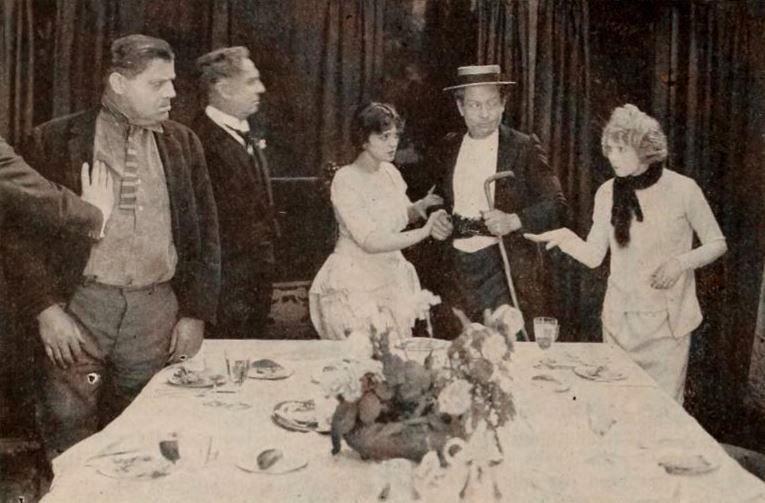
In the annals of silent cinema, where grand gestures and exaggerated expressions often spoke louder than any dialogue, certain films stand out for their audacious premises and surprisingly astute social commentary. One such forgotten gem is the 1919 comedy, Too Many Crooks. Far from a mere slapstick romp, this picture, penned by Edith Rathbone Brainerd and J. Chauncey Brainerd and directed by Edward J. Montague, offers a fascinating glimpse into the era's fascination with crime, class, and the often-blurred lines between artistic endeavor and real-world consequences. It’s a narrative that, even a century later, retains a delightful piquancy, prompting us to consider the perennial human impulse to understand, and perhaps even romanticize, the darker corners of society.
At its heart, Too Many Crooks is a story of intellectual hubris colliding with the messy, unpredictable currents of reality. Our protagonist, Charlotte Browning, portrayed with a spirited vivacity by Jean Paige, is no ordinary socialite. She is a playwright, brimming with the kind of artistic conviction that often leads to grand, if misguided, experiments. Her initial grievance, sparked after attending a crime play, is deeply resonant for any creative soul: the characters, she laments, are not authentic. They lack the genuine grit, the unpredictable charm, and the inherent danger that she believes defines true criminality. This isn't just a critique; it's a challenge, a gauntlet thrown down to the very notion of fictionalized crime.
Charlotte’s solution to this artistic dilemma is nothing short of audacious. She decides to conduct a real-life character study, transforming her opulent home into a living laboratory for criminal observation. With the assistance of Bidwell Wright (Cecil Chichester), whose true nature remains tantalizingly ambiguous for much of the film, she extends invitations to a veritable rogues' gallery of notorious criminals. The premise she feeds them is brilliant in its absurdity: they are to form an international 'family of thieves,' with Charlotte and her unsuspecting millionaire father, Erastus Browning (Thomas J. McGrane), at its helm. This setup immediately imbues the film with a rich vein of dramatic irony, as the audience is privy to the true intentions, while the characters, both the naive socialites and the deluded criminals, operate under a delightful misconception.
The casting choices, while perhaps not household names today, would have been familiar to audiences of the era. Jean Paige, known for her expressive eyes and graceful demeanor, embodies Charlotte's blend of intellectual curiosity and upper-class naiveté with aplomb. Thomas J. McGrane, as the bewildered father, provides much of the film's grounding humor, his patrician world view slowly crumbling under the weight of genuine criminal chaos. The ensemble of 'crooks' is where the film truly shines, each actor bringing a distinct, often exaggerated, persona to their role, a hallmark of silent film acting where physical comedy and clear character archetypes were paramount.
What ensues is a masterclass in comedic escalation. Charlotte’s attempts at detached observation are repeatedly, and hilariously, derailed by the very 'character studies' she invited. The film's pacing, crucial in silent comedies, builds tension and humor through a series of increasingly brazen criminal acts. The garden party, intended as a genteel backdrop for observation, quickly becomes a stage for authentic larceny. Benny the Chipmunk, a character whose name alone suggests a penchant for swift, surreptitious movements, lives up to his moniker by deftly picking the pockets of every male guest. This scene, undoubtedly a highlight, would have relied heavily on precise physical comedy and visual gags, demanding a high level of coordination from the cast and director.
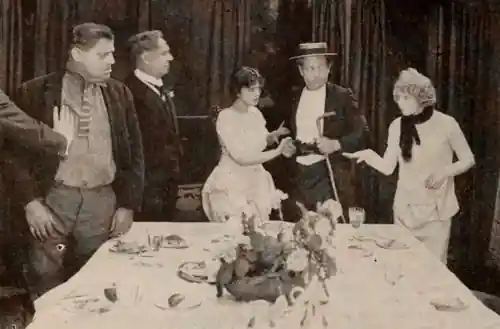
Then there's Boston Fanny, played by the captivating Gladys Leslie. Her character is a delightful subversion of the femme fatale archetype, a vamp not just for money but for hearts. She doesn't merely steal Erastus Browning’s cash and jewelry; she steals his affections, adding a layer of romantic comedy and moral ambiguity to the proceedings. This particular incident highlights the film's nuanced approach to 'crooks' – they aren't just one-dimensional villains; they possess charm, cunning, and a surprising ability to manipulate. This echoes a similar thematic thread found in other contemporary films like Untamed Ladies, which also explored the complexities of female agency and societal expectations, albeit perhaps with a different genre lens.
The turning point arrives with the revelation of Bidwell Wright's true identity. Far from being a criminal himself, Wright is a noted criminologist, an expert whose understanding of the underworld transcends Charlotte's academic curiosity. This twist is both satisfying and ironic, highlighting the chasm between intellectual pursuit and practical knowledge. Wright’s ability to quell the escalating chaos and successfully disperse the criminals underscores his genuine expertise, offering a stark contrast to Charlotte’s ill-fated experiment. It's a classic narrative device, seen in many mystery and crime films, where the true authority figure is hidden in plain sight, much like in Mistinguett détective, where appearances are often deceiving.
His agreement to help Charlotte complete her play is the film's ultimate resolution, suggesting a path towards genuine understanding born from the crucible of experience. It’s a subtle nod to the idea that true art must be informed by life, even if that life is messy, dangerous, and utterly unpredictable. The film, in this sense, becomes a meta-commentary on the creative process itself, arguing that authentic storytelling requires more than just theoretical knowledge; it demands immersion, even if that immersion comes at a significant social and material cost.
Watching Too Many Crooks today offers more than just a peek at a bygone era's comedic sensibilities. It provides a valuable lesson in silent film techniques. The reliance on visual storytelling, the exaggerated gestures, the interplay between actors without the benefit of spoken dialogue – these elements are masterfully employed here. The use of intertitles would have been crucial, not just for dialogue but for conveying Charlotte's internal thoughts and the narrative's ironic twists. The film’s ability to evoke laughter and maintain narrative momentum without sound is a testament to the skill of its creators.
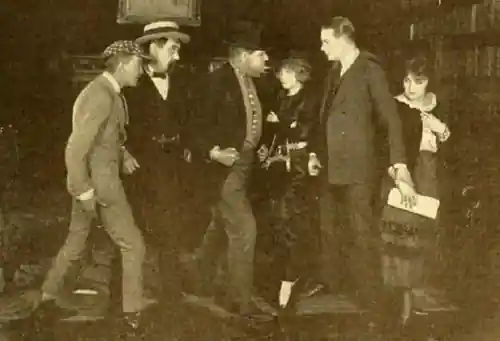
Furthermore, the film's thematic depth extends beyond simple comedy. It deftly satirizes the upper class's often-condescending view of the lower strata of society, particularly those engaged in illicit activities. Charlotte's initial belief that she can simply 'study' criminals, much like one might study insects, is a clear critique of bourgeois detachment. The film suggests that genuine understanding requires engagement, not just observation. This social commentary places Too Many Crooks alongside other films of its time that subtly, or not so subtly, explored class distinctions and societal norms, such as The Education of Mr. Pipp, which similarly explores an upper-class character's journey of discovery.
The film also touches upon the concept of identity and performance. The crooks themselves are performing for Charlotte, believing they are being 'recruited' rather than 'studied.' Charlotte, in turn, is performing the role of the detached artist. Bidwell Wright is performing the role of a criminal accomplice. This layering of performances adds a sophisticated meta-narrative to the film, questioning the authenticity of all involved parties. It’s a playful exploration of how we construct and perceive identities, both our own and others'. This thematic complexity elevates it beyond a simple farce, giving it an intellectual heft that might surprise modern viewers accustomed to more straightforward silent comedies. Even in its lightheartedness, it prompts reflection on the nature of truth and deception, themes that are perennially fascinating in cinema, from early works to contemporary blockbusters.
In an era marked by rapid social change and the burgeoning popularity of cinema, Too Many Crooks stands as a testament to the versatility of early filmmaking. It blends elements of comedy, crime, and social satire into a cohesive and entertaining whole. The film's relatively compact runtime, typical of features from the late 1910s, belies its narrative ambition and thematic richness. It’s a film that demands a certain appreciation for the unique aesthetics of silent cinema – the reliance on expressive acting, the kinetic energy of physical gags, and the subtle art of visual storytelling. For those willing to immerse themselves in this unique cinematic language, the rewards are substantial.
The film’s enduring relevance lies in its exploration of universal themes: the clash between idealism and reality, the allure of the forbidden, and the sometimes-humorous consequences of human folly. It reminds us that even a century ago, filmmakers were grappling with complex ideas, using the nascent medium to reflect on society, human nature, and the very act of creation. While not as overtly dramatic as Her Beloved Enemy or as starkly impactful as Race Suicide, Too Many Crooks carves its own niche with its lighthearted yet insightful approach to social critique.
Ultimately, Too Many Crooks is more than just a historical curiosity; it is a vibrant, engaging piece of cinema that continues to amuse and provoke thought. It's a delightful reminder that sometimes, the most profound lessons are learned not in the sterile confines of a study, but in the glorious, unpredictable chaos of real life, especially when that life is populated by a charming array of 'too many crooks.' It’s a film that, much like a well-executed heist, leaves you feeling both entertained and slightly richer for the experience, a true testament to the inventive spirit of its time. Its legacy, though perhaps not as widely celebrated as some of its contemporaries, is a valuable piece in the mosaic of early cinematic achievement, showcasing a blend of wit, social observation, and pure entertainment that remains potent and enjoyable today. It serves as a compelling argument for the continued preservation and appreciation of these silent treasures, which offer a unique window into the past while still speaking to the present.
IMDb —
1919
Community
Log in to comment.