DbcultAccessing Vault...
7.6/10
Senior Film Conservator
A definitive 7.6/10 rating for a film that redefined the boundaries of cult cinema. Toot Toot remains a cornerstone of transgressive art.
Short answer: yes, but only if you appreciate the raw, jagged edges of early cinematic experimentation. Is this film worth watching today? If you are a student of animation or a fan of surrealist comedy, it is an essential artifact. If you require high-definition polish and linear storytelling, you will likely find it jarring and abrasive.
This film is for the cinephile who wants to see the exact moment animation learned to talk back to its creator. It is NOT for viewers who find silent-era slapstick repetitive or those who prefer the sanitized perfection of modern CGI.
This film works because it refuses to respect the boundaries of the frame, creating a genuine sense of unpredictability that many modern films lack.
This film fails because the middle act drags with repetitive gag structures that feel like filler even in a short runtime.
You should watch it if you want to see the grandfather of 'Who Framed Roger Rabbit' and 'Duck Amuck' in its most primal form.
Yes, 'Toot Toot' is worth watching because it represents a pivotal leap in rotoscoping technology. It offers a rare glimpse into the playful, often adversarial relationship between Max Fleischer and his most famous creation, Koko the Clown. The film is a brief but potent reminder that early cinema was often more experimental than the blockbusters of today.
Max Fleischer wasn't just making cartoons; he was playing God. In 'Toot Toot,' the interaction between the live-action Max and the animated Koko isn't just a gimmick. It is a philosophical statement. When Koko steps out of the inkwell and begins to manipulate the 'real' world, the film challenges our perception of what is tangible.
Consider the scene where Koko takes over the train controls. The transition isn't seamless, and that’s why it works. There is a flickering, ghostly quality to Koko’s presence in the real world. It feels like a haunting. Unlike the grounded realism of The Master Key, 'Toot Toot' embraces the impossible.
The acting by Max Fleischer himself is surprisingly understated. He plays the 'straight man' to a drawing. This requires a level of imagination that many actors of the period struggled with. While films like Together relied on interpersonal chemistry, Fleischer relies on his ability to react to nothingness. It is a lonely, impressive performance.
The fluid movement of Koko is the result of the rotoscope, a device Fleischer patented. By tracing over live-action footage of his brother, Dave Fleischer, Max achieved a level of realism that was unheard of in 1923. In 'Toot Toot,' this fluidity is put to the test during the train sequence.
The train itself becomes a character. Its movements are rubbery and organic. It doesn't follow the laws of physics found in The Pitfall. Instead, it stretches and compresses like an accordion. This 'squash and stretch' technique, which would later become a staple of Disney and Warner Bros, is seen here in its infancy.
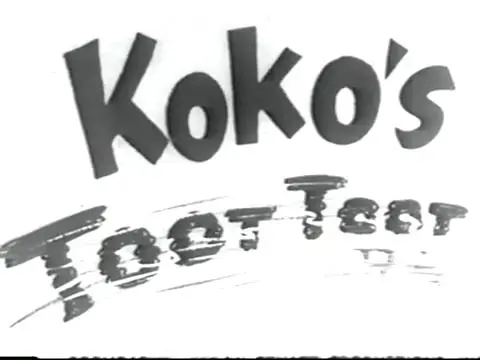
The cinematography by Archie Stout (uncredited but influential) captures the grittiness of the real-world train station. This contrast between the grainy, industrial reality and the clean, white-void of the animation is striking. It creates a visual tension that keeps the viewer engaged even when the plot thins out.
The tone of 'Toot Toot' is deceptively dark. While it is marketed as a comedy, there is a manic, almost desperate energy to Koko’s actions. He isn't just playing; he is disrupting. This isn't the heroic struggle seen in Fighting Blood. This is chaos for the sake of chaos.
The pacing is relentless. Once the train starts moving, the film doesn't breathe. This works to its advantage, masking the lack of a traditional narrative arc. However, some of the gags involving Fitz the dog feel recycled from earlier 'Out of the Inkwell' shorts. It’s a minor gripe, but it prevents the film from being perfect.
Compare this to the methodical build-up in Sherlock's Home. 'Toot Toot' has no interest in deduction or logic. It wants to grab you by the collar and shake you. It succeeds. But it’s flawed. The ending feels abrupt, as if the ink literally ran out before the story could reach a satisfying conclusion.
One thing most critics miss is the sound—or the lack thereof. Even in a silent format, 'Toot Toot' feels loud. The visual representation of the train whistle is so evocative that you can almost hear the steam. This is a testament to Fleischer's ability to use visual shorthand to trigger sensory responses.
Furthermore, Koko is more of a chaotic god than a clown. He doesn't just perform; he re-authors the world. This is a level of agency rarely given to animated characters of this era. In The Agent, characters are bound by their circumstances. Koko simply redraws the circumstances.
When you look at other films from the same period, such as The Virgin of Stamboul, you see a cinema obsessed with grand scale and exoticism. 'Toot Toot' is the opposite. It is claustrophobic and intimate. It takes place on a desk and in a train car.
Yet, it feels more modern than many of its peers. The self-awareness found in Fleischer’s work prefigures the post-modernism of the late 20th century. While Enemies of Women deals with traditional melodrama, 'Toot Toot' deals with the medium itself. It is a film about filmmaking.
Even compared to something like Sic 'Em Brownie, which uses animals for comedy, Koko feels more 'real' because his movements are based on human anatomy. This is the irony of rotoscoping: the more 'fake' the character looks, the more 'real' he feels to the subconscious mind.
'Toot Toot' is a fascinating relic that still possesses the power to surprise. It is not a masterpiece of storytelling, but it is a masterclass in technical imagination. Max Fleischer’s willingness to put himself in the line of fire of his own creations is a bold creative choice that pays off.
The film lacks the narrative depth of Daring Love or the psychological complexity of Munkens fristelser, but it doesn't need them. It is a pure expression of joy and technical bravado. It works because it is honest about its own absurdity.
"Toot Toot is a chaotic, ink-stained joyride that proves the 1920s were far more experimental than we give them credit for."
If you have ten minutes, spend them with Koko. You might find that the boundary between your world and his is thinner than you think. It’s a wild ride. Just don't expect a smooth landing.
IMDb 4.6
1934
Community
Log in to comment.