DbcultAccessing Vault...
Cult Review
Senior Film Conservator
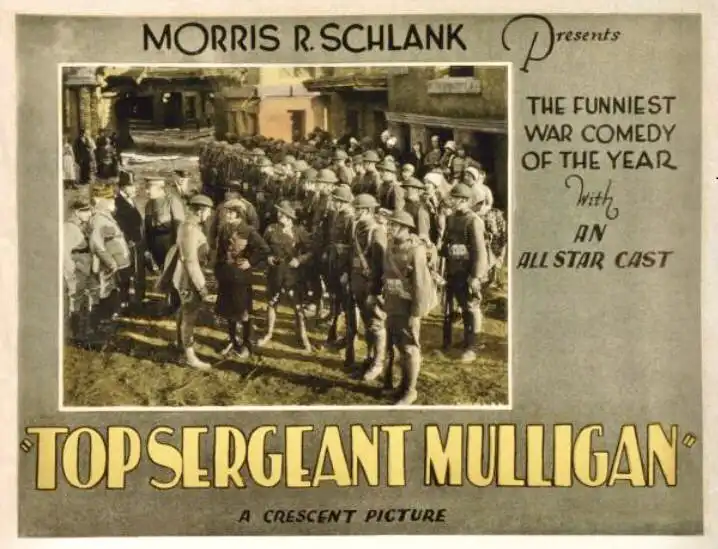
If you're the kind of person who spends their Saturday nights digging through the bottom of the silent era barrel, Top Sergeant Mulligan is a decent find. It’s not a masterpiece, and it’s certainly not going to change your life, but it’s got that specific 1928 energy where everyone seems to be moving about 15% faster than humanly possible. If you want a tight, dramatic war story, stay away. If you want to see a bunch of guys in oversized uniforms making bug-eyes at each other, you’re in the right place.
The movie starts with Mickey (Donald Keith) doing a vaudeville act. It’s one of those scenes where the movie is clearly trying to convince you he’s a comedic genius, but the actual routine involves a lot of frantic arm-waving. What’s actually interesting is the background. The extras playing the theater audience look like they were pulled off the street five minutes before the camera rolled. Some of them are staring directly into the lens with this 'when do I get paid?' expression that I found way more entertaining than the actual act.
Mickey ends up in the Army, and of course, his girlfriend (Lila Lee) ends up there too, working for the YMCA. The logic is thin, but it sets up the central conflict: basically every man in a five-mile radius is trying to hit on her. This includes the titular Sergeant Mulligan, played by Wheeler Oakman. Oakman has this incredible way of glaring that makes his eyebrows look like two caterpillars trying to merge into one. He’s supposed to be the antagonist, but honestly, Mickey is so annoying for the first half-hour that you kind of root for the Sergeant to give him extra latrine duty.
There’s a specific shot about halfway through where they’re in the training camp, and the framing is just slightly off. You can see the edge of a tent that looks like it’s about to fall over, and there’s a dog wandering in the distance that clearly wasn't supposed to be there. It’s these little technical imperfections that make these late silents feel so much more alive than the polished studio stuff that came later. It feels like they were just making it up as they went along.
The pacing is a bit of a mess. It’ll spend ten minutes on a single joke about a pair of boots that don't fit, and then rush through an entire plot point about a secret mission in about thirty seconds. It reminds me a bit of the frantic energy in A Girl in Every Port, though without the Howard Hawks touch that makes that one a classic. Here, the director just seems to be hoping the physical comedy carries the day.
Lila Lee is the real standout. While the men are all doing 'Big Acting'—lots of chest-puffing and dramatic pointing—she’s actually quite subtle. There’s a moment where she’s being cornered by three different guys at once, and she does this tiny eye-roll that felt completely modern. It’s the most relatable thing in the whole movie.
I did find myself checking the runtime during the middle section. There’s a lot of 'training' footage that feels like it was borrowed from a government documentary and then spliced in to pad the length. It gets repetitive. You see one guy trip over a hurdle, you’ve seen them all. And the YMCA worker character—his mustache is so distracting it deserves its own credit. It’s perfectly groomed in a way that makes no sense for a muddy camp environment.
Is it a 'good' movie? Not really. But it’s a fascinating look at what passed for mainstream entertainment right before the world changed. It’s got that weird, transitional feel, much like The Master Mystery, where the storytelling techniques are still catching up to the technology. The ending is predictable, the jokes are broad, and the sentimentality is laid on thick, but there’s a charm to its clumsiness. It’s the kind of movie you watch because you want to see the texture of the 1920s, not because you care if Mickey and his girl live happily ever after.
IMDb 6.1
1936
Community
Log in to comment.