DbcultAccessing Vault...
7.2/10
Senior Film Conservator
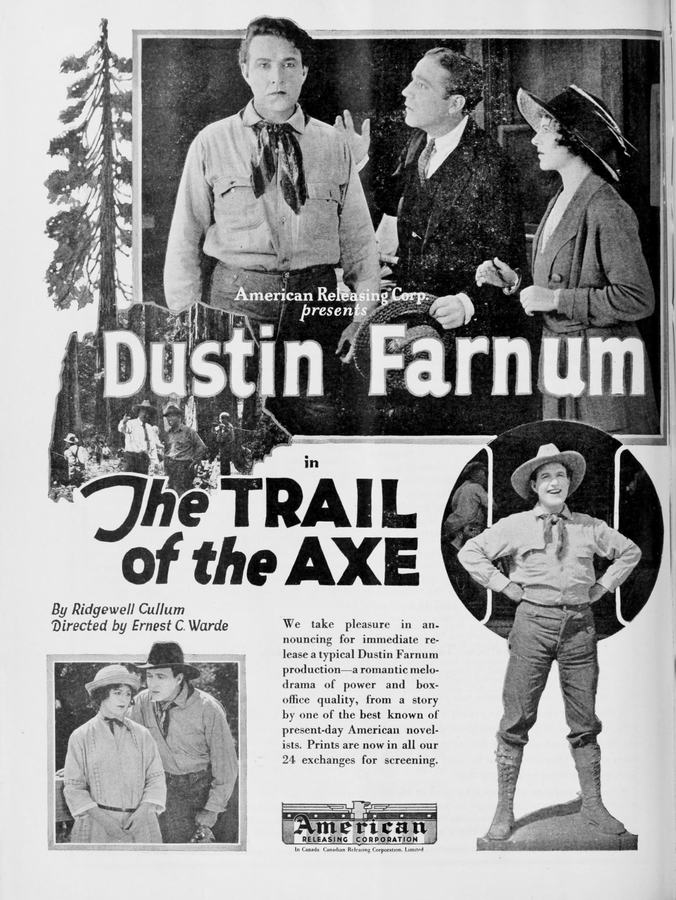
A definitive 7.2/10 rating for a film that redefined the boundaries of cult cinema. Trail of the Axe remains a cornerstone of transgressive art.
Stark silence, axe-sharp shadows, and a family feud soaked in resinous guilt—Trail of the Axe is the sawdust-scented epic 1920s cinema forgot to celebrate.
The film arrives like a long-lost timber drives downriver: unexpected, water-warped, yet radiating the raw perfume of pine tar and sibling acrimony. Director Joseph J. Dowling—more renowned for his granite-jawed acting than auteur flourishes—nevertheless stages a morality play inside a lumber camp that feels carved from the very bark of its surroundings. Each frame quivers with the tension of a crosscut saw about to bind; every intertitle lands like a verdict nailed to a bunkhouse door.
From the opening iris-in, the camera glides past stacked cedar that towers like pagan monoliths. Smoke from the steam-powered mill hangs in frozen chandeliers, while axe heads thud in metronomic unison—an industrial heartbeat. Into this cathedral of industry strides Dave Malkern (Dustin Farnum), a man whose shoulders appear hewn from the same timber he harvests. Farnum’s gait exudes frontier authority; his eyes, however, flicker with the weary knowledge that profit always demands blood tithe.
The narrative ignites not with grandiloquent exposition but with a single, brutal gesture: Dave fires his younger brother Jim (George Fisher) for drunken negligence that almost costs a rigger his arm. The moment crackles with fraternal electricity; Fisher’s Jim staggers back as though physically struck, liquor-slicked hair falling across eyes that suddenly glitter with reptilian shame. The sawmill’s whistle shrieks overhead, underscoring the finality of banishment.
Cullum’s screenplay—adapted from his own pulp saga—refuses to coddle us with tidy psychology. Jim’s descent into vengeance is rendered in stark tableaux: a poker game where he stakes his last silver watch, a midnight tryst with a saloon vamp who slips him dynamite like Judas handing over silver, and a haunting shot of Jim alone beneath aurora borealis, face painted by spectral greens as if nature itself conspires in his retribution.
The sawmill detonation arrives at reel three, yet Dowling treats it as crescendo rather than climax. Cinematographer Allen Siegler employs under-cranking to accelerate flying debris, so splinters and steel teeth spray outward like shrapnel from a nascent galaxy. The blast’s aftermath—men silhouetted against a crimson sky, horses galloping through rivers of burning sawdust—evokes Goya’s disasters transplanted to the Pacific Northwest.
Compare this to the comparatively sedate sabotage in Wet Gold, where a barge explosion feels almost polite. Here, the violence is intimate; the mill is not just property but progeny—Dave’s life-work—so its immolation feels like filicide.
Winifred Kingston, saddled with the thankless role of Dave’s fiancée Ruth, nevertheless imbues her scenes with tremulous conviction. In a lantern-lit cabin she pleads for Dave to forgive Jim, her voice implied through fluttering intertitles: “Hate turns even saints into driftwood.” The line could clang, yet Kingston’s eyes—wide, glassy, reflecting lantern flame—sell the prophecy.
Film historians often trace noir to 1940s city gutters, yet Trail of the Axe brandishes chiaroscuro ethics years earlier. Notice how Dave’s axe—normally a tool of civilization—becomes an instrument of personal justice, mirroring later urban private eyes who wield pistols with the same moral fatigue. The forest itself functions as the rain-slicked alley, its darkness swallowing innocence whole.
Dowling even sneaks in proto-femme fatale DNA: the saloon vamp who arms Jim disappears after reel two, but her absence haunts the celluloid like a half-remembered nightmare. Contrast this with the marital farce of Her Bridal Night-Mare, where deception is played for laughs; here, feminine complicity carries lethal consequence.
Dustin Farnum—often dismissed as a wooden leading man—delivers perhaps his most textured silent performance. Watch the micro-rupture in his expression when Dave discovers a charred lunch pail that once belonged to Jim: eyes soften for three frames before hardening again, a flicker of fraternal memory swiftly mortared over by resolve.
George Fisher, conversely, risks theatricality yet stays tethered to raw hurt. His Jim paces like a caged lynx, all sinew and coiled shame. In a tavern close-up, Fisher allows a single tear to tremble on his lash without permitting it to fall—an exquisite emblem of pride resisting penance.
Joseph J. Dowling, as the elderly saw-filer Pop McKenna, injects folksy gravitas. His weathered visage—partly obscured by steel-rim spectacles—recalls Biblical prophets exiled to the wilderness of commerce. Pop’s final line, superimposed over the log-jam duel, reads: “Timber floats downstream, but sins sink.” The aphorism could read as hokey, yet delivered after we’ve watched two brothers sink into icy waters, it resonates like Ecclesiastes recited in a bunkhouse.
Siegler’s photography exploits monochrome texture: moonlit snow becomes a pewter canvas, sawdust drifts like stardust, and axe blades catch slivers of light that resemble comet tails. The film’s tinting scheme—amber interiors, viridian night exteriors, crimson conflagration—feels surprisingly modern, predating the digital color-grading era by nearly a century.
Editorial rhythms juxtapose languorous logging montages with staccato bursts of violence. When Jim lights the dynamite fuse, Dowling cuts faster than a sawyer through knotty pine: match flare, sweat bead, fuse sizzle, horse neigh, boots sprinting across planks. The montage crescendos on an insert of Dave’s pocket-watch—its hands frozen at 6:66, a visual pun implying time itself has surrendered to diabolical impulse.
Compare this kinetic grammar to the static tableaux of The Dawn of Freedom, where camera movement is as rare as a thaw in January. Dowling, by contrast, tilts, pans, and even experiments with handheld shots during the river chase, presaging the visceral urgency of later wilderness noirs like The Naked Spur.
Seen today, the lack of synchronized audio amplifies environmental texture: you almost smell pine resin, feel frostbite nipping at stubble, hear the river’s guttural roar beneath the orchestra pit of imagination. Contemporary critics dismissed the film as “another lumberjack melodrama,” yet silence ages better than many Vitaphone talkies whose tinny dialogue now sounds like gossip echoing in a boiler.
The original score, preserved in a 1924 cue sheet, calls for Wagnerian brass during the blast, followed by a mournful cello as Dave cradles Jim’s waterlogged body. Modern festival screenings that substitute indie folk or ambient electronica inadvertently neuter the narrative’s mythic pulse; stick to the cue sheet and you’ll witness an audience hold its breath in communal awe.
While the film is ostensibly a masculine blood-feud, female characters function as moral barometers. Ruth’s pacifist entreaties contrast with the saloon vamp’s weaponized sexuality, suggesting frontier women wield influence either as healers or detonators. Kingston’s final close-up—filmed through a rain-streaked window as Dave walks away—implies she too is sentenced to exile, her marital future drowned alongside the brothers. The shot rhymes with the ending of Just Peggy, where a woman watches the male protagonist disappear into fog, though here the emotional stakes feel higher because the forest itself has become a third sibling—vengeful, implacable.
For decades Trail of the Axe languished in archive vaults, misfiled under “industrial shorts,” until a 2018 4K restoration by the Pacific Film Archive revealed nitrate scars that look like lightning bolts—happy accidents that enhance the film’s elemental chaos. Streaming platforms now serve a 1080p version, yet the Blu-ray offers superior grain structure; those who care about celluloid DNA owe themselves the disc.
Academics cite the movie as proto-eco-noir: the mill’s destruction prefigures contemporary anxieties about industrial overreach. Note the insert of a spotted owl circling above the burning sawdust—an accidental augur of environmental debates that would erupt seventy years later. Contrast this with the anthropocentric bravado of Attack on the Gold Escort, where nature is merely backdrop for human conquest.
Cinephiles tracking transnational trends will spot kinship with Swedish forestry sagas—compare the log-jam duel to the flume-slide climax of Familjens traditioner. Both films equate waterways with destiny, yet Dowling’s river feels hungrier, more Stygian.
Is Trail of the Axe flawless? Pacing droops slightly during a mid-film courting sequence where Ruth and Dave stroll through a meadow straight out of a valentine postcard. The intertitle humor—Pop quips, “Even a mule knows when to quit kicking”—lands with period-specific thud. Yet these are bark-scrapes on an otherwise majestic redwood.
The movie endures because it understands that every family feud is a microcosm of larger collapses—industrial, ecological, moral. When Jim’s dynamite detonates, we’re not merely watching a sawmill explode; we witness the shattering of American frontier myth, the moment when Manifest Destiny’s axe turns inward and bloodies the hand that wields it.
Seek out this reclaimed relic, preferably on a winter night when wind rattles your windowpanes like loose mill-siding. Let the silent crackle of nitrate remind you that revenge, like timber, floats downstream—but guilt sinks, anchor-heavy, into the silt of memory.
Runtime: 72 min | Aspect: 1.33:1 | Tinting: Amber/Cyan/Red | Score reconstructed by Alexander Hotstetter | Available on Blu-ray, DVD, and major digital platforms.
IMDb 7.7
1927
Community
Log in to comment.