DbcultAccessing Vault...
Cult Review
Senior Film Conservator
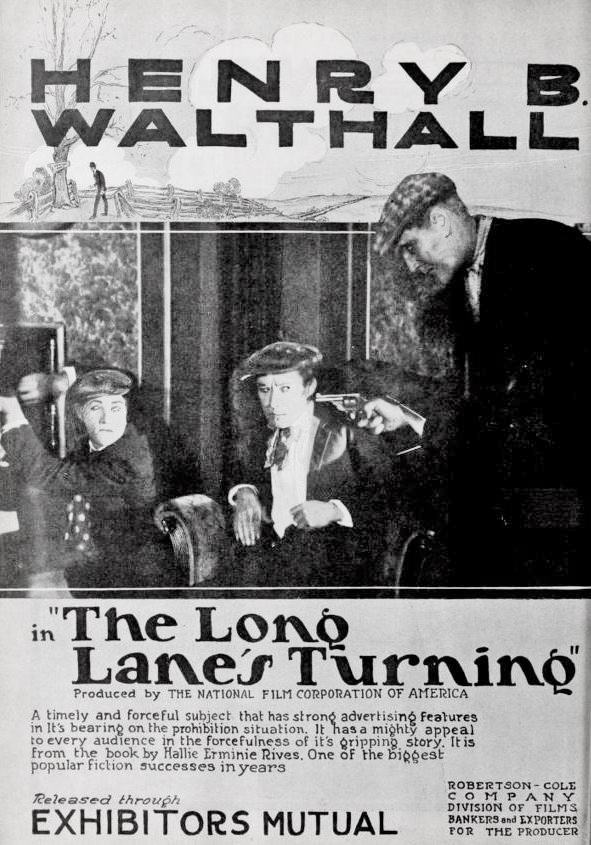
There is a specific, haunting quality to the cinema of 1919—a world teetering between the Victorian moralities of the past and the burgeoning, often cynical complexities of the modern era. The Long Lane's Turning, directed with a keen eye for melodrama and social commentary, stands as a quintessential artifact of this transition. At its center is Henry B. Walthall, an actor whose face was the very canvas of silent-era pathos. Known to many as the 'Little Colonel' from Birth of a Nation, Walthall here occupies a role that demands a more nuanced, internal struggle: the transformation of Harry Sevier from a broken alcoholic into a political beacon of temperance.
The film opens with a visceral depiction of Sevier’s fall. Unlike the more sanitized versions of addiction seen in later decades, the 1919 lens treats his inebriation as a totalizing failure of the soul. When he fails Paddy the Brick (played with a rugged sincerity by Bert Lindley), the stakes are not merely professional; they are existential. The legal battle, while structurally similar to the tensions found in My First Jury, serves as the catalyst for a much broader odyssey of the self. This is not just a courtroom drama; it is a pilgrimage through the dark night of the American spirit.
One cannot discuss The Long Lane's Turning without acknowledging its proximity to the ratification of the 18th Amendment. The film is steeped in the 'dry' politics of its time, presenting the temperance movement not merely as a policy choice, but as a moral imperative for national survival. Harry Sevier’s eventual run for governor on the 'dry' ticket is a narrative masterstroke that mirrors the zeitgeist of 1919 America. This political dimension elevates the film above standard melodrama, aligning it with works like The Ring and the Man, which also explored the intersection of personal virtue and public office.
The villainy of Cameron Craig (Jack Richardson) is inextricably linked to his interests in a distilling corporation. By making the antagonist a liquor tycoon, the film frames the struggle as a battle between corporate greed and individual sobriety. Craig’s use of incriminating love letters to blackmail Judge Allen (Melbourne MacDowell) adds a layer of soap-operatic intrigue that was a hallmark of Hallie Erminie Rives’ writing. This blackmail subplot provides the necessary friction to propel Echo Allen (Mary Charleson) into action, transforming her from a passive object of affection into a proactive, if somewhat misguided, agent of her father’s salvation.
The middle act of the film, set predominantly on a train and within the shadows of Craig’s estate, utilizes the visual language of the proto-noir. When Sevier removes his beard—a symbol of his derelict past—he undergoes a visual metamorphosis that echoes the thematic transformations in The Way Back. This 'new' Sevier is a ghost haunting his own life, unrecognized by the woman he loves, yet driven by a singular purpose. The train sequence is particularly effective, using the claustrophobic confines of the carriage to heighten the tension between Echo’s desperation and Sevier’s silent observation.
"The cinema of the late 1910s often relied on physical transformation to signal moral clarity. In Sevier’s clean-shaven face, we see the erasure of the bottle’s stain, a tabula rasa upon which a new political destiny can be written."
The cinematography during the burglary at Craig’s home is surprisingly sophisticated for its time. The use of low-key lighting and deep shadows creates an atmosphere of dread that predates the expressionist influence of the 1920s. When Craig is shot, the narrative takes a sharp turn into the territory of the fugitive thriller, a trope explored with similar vigor in The Silent Mystery. The fact that Sevier is sent to prison alongside Paddy—the very man he failed at the start of the film—is a poetic irony that underscores the cyclical nature of justice in the narrative.
Walthall’s performance is the gravity well around which the entire film orbits. Unlike the broader, more gesticular acting styles of some of his contemporaries in films like Vivo ou Morto, Walthall utilizes his eyes to convey a profound sense of internal wreckage. His portrayal of the 'dry' candidate is not one of bombastic zealotry, but of quiet, reasoned conviction. He plays Sevier as a man who has seen the bottom of the glass and found only darkness there, making his political platform feel like a personal testimony rather than a campaign stunt.
Mary Charleson provides a solid counterpoint as Echo Allen. While the script occasionally confines her to the 'sacrificial daughter' archetype, Charleson imbues the role with a sense of agency. Her decision to marry Craig to save her father is portrayed not as a weak submission, but as a calculated, albeit painful, tactical move. This complexity of character is reminiscent of the female leads in Blackbirds or Her New York, where women navigate the treacherous waters of societal expectation and personal honor.
When placed alongside other films of the era, The Long Lane's Turning reveals its unique blend of social realism and escapist melodrama. For instance, while East Is East deals with cultural clashes, this film focuses on the internal American clash between vice and virtue. The rugged settings and the theme of the 'outcast' returning to society also draw parallels to The Girl from Outback and The Cave Man, though Sevier’s return is through the ballot box rather than physical conquest.
The film’s reliance on a 'wrongly accused' plot point is a staple of the genre, seen in everything from The Scarlet Pimpernel to Spöket på Junkershus. However, the specific intersection of alcoholism, legal malpractice, and political redemption gives it a distinct flavor. It is less a 'whodunit' and more a 'how-will-he-rise.' The tension is not in the mystery of who killed Craig, but in whether the system Sevier once served—and was then crushed by—will ultimately recognize his worth.
The direction by the uncredited (though often attributed to the studio's house style) hands remains remarkably consistent. The pacing is deliberate, allowing the psychological weight of Sevier’s addiction to land before launching into the more kinetic burglary and escape sequences. The film’s use of locations, particularly the rural landscapes where Sevier seeks his 'cure,' provides a stark contrast to the opulent, corrupt interiors of Craig’s mansion. This binary between the purity of nature and the decadence of the city is a classic trope, but here it is effectively tethered to the 'dry' vs. 'wet' political debate.
The script by E. Magnus Ingleton, based on Hallie Erminie Rives’ novel, is dense with dialogue cards that attempt to capture the literary flourish of the source material. While some might find the intertitles verbose, they provide a window into the rhetorical style of the 1910s. The dialogue between Sevier and Paddy in the prison cell is particularly poignant, serving as the emotional anchor of the film’s final act. It is a moment of mutual recognition between two men discarded by society, both seeking a way back to the light.
In the final analysis, The Long Lane's Turning is more than just a piece of Prohibition-era propaganda. It is a deeply human story about the fragility of reputation and the arduous path to redemption. While its plot hinges on the kind of coincidences that modern audiences might find strained—the train encounter, the shared prison cell, the perfectly timed political nomination—these elements are handled with such earnestness that they become part of the film’s operatic charm. It shares a certain stylistic DNA with Bawbs O' Blue Ridge in its portrayal of rural integrity versus external corruption.
For the modern viewer, the film offers a fascinating glimpse into a moment when cinema was beginning to realize its power as a tool for social change. Henry B. Walthall’s performance remains a masterclass in silent acting, proving that even without a voice, an actor can convey the entire arc of a man’s soul. Whether you are a student of silent film history or a fan of classic redemptive dramas, this film deserves a place in the pantheon of early American cinema. It is a long lane indeed, but the turning, when it finally comes, is nothing short of transcendent.
IMDb 7
1923
Community
Log in to comment.