DbcultAccessing Vault...
Cult Review
Senior Film Conservator
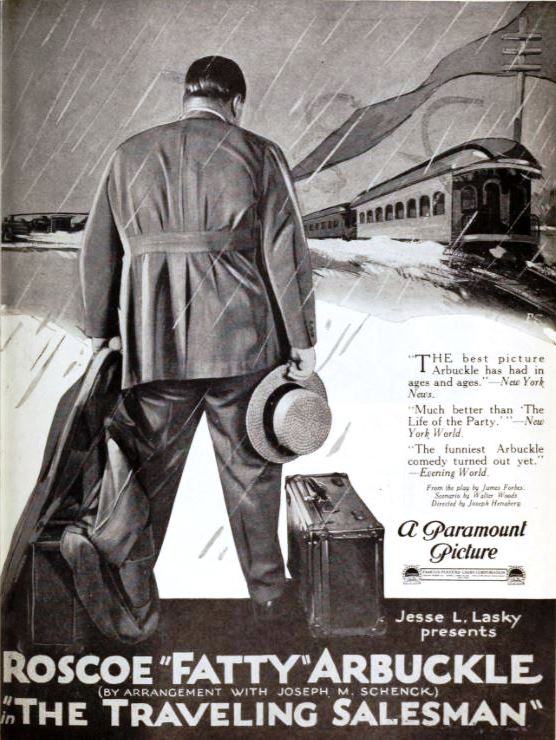
Bob Blake’s valise hits the platform with the hollow thunk of a magician’s hat about to yield doves. What escapes instead is a town-sized confidence game masquerading as Main-Street wholesomeness.
There is a special ache in silent cinema for spaces that speak louder than intertitles, and Traveling Salesman luxuriates in that ache. Directors James Forbes and Walter Woods treat the Grand River house like a porcelain echo: every mantel clock tick lands as a reminder that property—like affection—accrues value only when someone is willing to fight for it. The film’s visual grammar is a ledger of angles: low, oblique shots make the ceilings loom like verdicts, while horizon-level exteriors flatten politicians and drummers into the same cardboard silhouette. The result is a moral neutrality rare for 1921, a year still drunk on post-war uplift.
Richard Wayne’s Bob suggests Buster Keaton’s stoicism filtered through Arthur Miller’s Willy Loman—a salesman whose smile is a reflex, not a promise. Notice the micro-gesture after he outbids the cabal: he pockets the receipt with two fingers, the other three splayed as though testing wind direction. It is the tiniest of ballets, announcing that the deal is both triumph and tether.
Lucille Ward’s Beth, meanwhile, carries herself like a woman who has read every clause except the one governing her own pulse. In the tax-office scene she never looks at Bob; she looks past him, toward a painted mural of steaming locomotives—an unsubtle but effective forecast that her fate will be decided by timetables rather than tenderness. Ward’s performance is a masterclass in withheld blink rate; the stiller her eyes, the louder the internal machinery.
And then there is Roscoe ‘Fatty’ Arbuckle, wedged into a subplot as a hayseed conductor whose punchline is a sneeze that derails a handcar. Historians often treat his cameo as footnote, yet it serves as pressure-valve: the audience exhales, remembering that graft and heartbreak are still digestible as slapstick. Arbuckle’s physical linguistics—hips swaying like sacks of flour—counterbalance the film’s more Darwinian undertones.
The script’s fulcrum is a legislative footnote: a wife’s signature void without husbandly assent. Today such a statute reeks of patriarchal fossil, yet here it becomes a narrative trampoline. By weaponizing matrimony, the film flips the virgin/whore dichotomy into contract law. Beth’s ‘I do’ is less vow than veto, a reminder that in silent-era storytelling, marriage often functioned the way deus ex machina does in Greek drama—except with rice instead of gods.
Cinematographer Gordon Rogers shoots the climactic wedding inside the same parlor where Bob first trespassed. Match cuts juxtapose the earlier darkness—moonlight striping floorboards like prison bars—with confetti snowing from a busted pillow. Same space, altered moral valence. The visual symmetry implies that ownership is less about deeds than about who gets to switch on the lights.
Compared to contemporaneous rural comedies like Flying Pat or The Remittance Man, Traveling Salesman lacks flapper fizz; its tempo is deliberate, almost agrarian. Yet that stateliness ages well. While Daredevil Kate ricochets via cliffhanger clichés, this film trusts the simmer, believing that anticipation can be a character.
Listen to the orchestra of objects: a screen door spring twanging like a bassoon, coins clacking onto county-office marble, the hush of a railroad switchyard at dusk. These Foley-born textures, recreated by modern restorers, remind us that silent cinema was never truly mute—merely eloquent in dialects we’ve forgotten how to hear.
Some viewers fault the third act for folding too neatly: marriage as solvent, villains foiled by their own parchment. Yet tidy resolutions were the era’s commercial grammar; audiences paid nickels to see entropy reversed before their popcorn cooled. What lingers is the afterimage—Beth’s hand resting on Bob’s sleeve, not in surrender but in joint custody of a future neither had mapped the night before.
Modern analogues? Think of Blue Jeans where courthouse paperwork determines dynasties, or The Brand whose branding iron scars both hide and title. Each inherits the DNA on display here: the American obsession with dirt you can deed, and the romance of finding someone willing to stand on that dirt with you when the railroad bulls come knocking.
Arrow Academy’s 2K restoration lavishes attention on tinting: amber for interiors, cerulean for night exteriors, rose for the wedding. The tonal palette amplifies emotional subtext without drowning it—an achievement, given that over-saturated tints can turn melodrama into marzipan. The disc also gifts us an audio essay by historian Dr. Maya Caldwell, who argues the film is a covert allegory on post-war labor mobility; the salesman’s territory becomes a movable Midwest where rootlessness is both wound and wings.
Is Traveling Salesman a rediscovered masterpiece? Not quite. Its gender politics remain welded to the era, and the comic brio of Arbuckle’s cameo only underscores how somber the rest feels. Yet it is an exemplar of second-tier silents that thrum with pragmatic philosophy: love is a negotiation, property a promise, and every contract hides a loophole big enough for a heartbeat to slip through.
Watch it late, with the lights off and the radiator clanking like a distant steam engine. You may find yourself surveying your own four walls, wondering what deeds—emotional or otherwise—bind you to the place where your shoes land each night. And if a train whistle moans somewhere in the dark, do not be surprised if you smile at the thought that every junction, like every heart, is up for sale to the highest bidder—be they politician, pal, or penniless passer-through with a grin sharp enough to sign a marriage license and a mortgage in the same breath.

IMDb —
1925
Community
Log in to comment.