DbcultAccessing Vault...
Cult Review
Senior Film Conservator
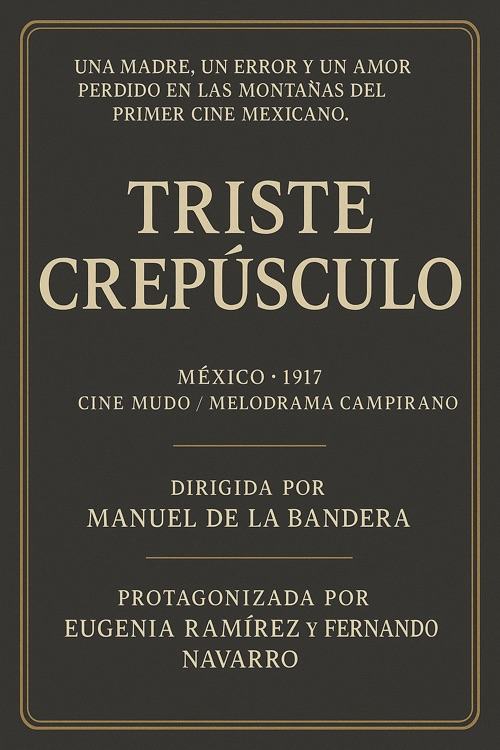
There are films that merely tell a story, and then there are those that breathe, that ache, that leave an indelible mark upon the viewer's soul long after the final frame has faded. 'Triste crepúsculo' (Sad Twilight), a masterwork of human drama penned with exquisite sensitivity by Maria Luisa Ross and Manuel de la Bandera, belongs unequivocally to the latter category. It is a cinematic experience less about plot mechanics and more about the inexorable erosion of the human spirit, the slow, agonizing decay of a once-proud lineage, and the suffocating weight of secrets buried beneath generations of polished facades. From its opening shot, a lingering gaze over the crumbling façade of Hacienda de la Sombra, the film immerses us in an atmosphere so thick with regret and faded glory that one can almost taste the dust of forgotten dreams.
The very title, 'Triste crepúsculo', serves as a prescient harbinger of the emotional landscape we are about to traverse. It is a twilight not just of the day, but of an entire epoch, a family's prestige, and indeed, the very essence of its inhabitants' joy. The hacienda itself, more than a mere setting, emerges as a central character: a vast, decaying organism that mirrors the internal desolation of the Alcocer family. Its peeling paint, overgrown gardens, and echoing, empty rooms are not just visual details; they are allegories for the psychological deterioration plaguing those who inhabit its once-majestic halls. Salvador Alcocer, as Don Ricardo, embodies this fading aristocracy with a performance of staggering pathos. His Don Ricardo is a man trapped in a self-constructed labyrinth of denial, his mind a fractured mirror reflecting only the glories of a past that has long since ceased to exist. Alcocer's portrayal is not merely an act; it is a profound excavation of a soul teetering on the precipice of madness, clinging desperately to the illusion of control while his world crumbles around him. His every gesture, every vacant stare, speaks volumes about the futility of resisting an inevitable decline, much like the characters grappling with existential dread in Raskolnikov, though here the decay is societal as much as individual.
At the emotional epicenter of this desolation stands Elara, magnificently rendered by Eugenia Ramirez. Ramirez delivers a performance of such nuanced restraint and profound sorrow that it becomes almost unbearable to witness. Elara is not overtly dramatic; her tragedy is etched into her very being, a quiet, persistent ache that permeates every scene she inhabits. Her eyes, often downcast or gazing into some unseen distance, convey a universe of unspoken grief, a past trauma that has calcified her spirit. It is a performance that speaks to the power of internal struggle, where the most devastating battles are fought in the silent chambers of the heart. Her plight, a woman burdened by a past that dictates her present, echoes the tragic resignation seen in characters from films like Destiny: or, the Soul of a Woman, where fate seems to conspire against individual happiness. Ramirez's Elara is not a victim in the conventional sense, but a survivor whose survival has come at an unbearable cost, a living testament to the destructive force of unresolved history.
The dynamic between Elara and her younger sister, Sofia (Guadalupe Vela), forms another crucial layer of the film's intricate tapestry. Sofia, in her youthful vivacity and nascent romance with Dr. Mateo (Fernando Navarro), represents a fragile hope for escape, a potential rupture in the cycle of despair. Vela imbues Sofia with a touching innocence, a burgeoning desire for a life beyond the hacienda's shadowed walls. Her optimism, however, feels almost sacrilegious in the context of her surroundings, a fleeting ray of sunlight desperately trying to penetrate a perpetual gloom. Fernando Navarro's Dr. Mateo, initially appearing as a beacon of modernity and progress, soon reveals layers of ambition and perhaps, a willingness to overlook the moral complexities of his chosen path. His character introduces a pragmatic, albeit sometimes morally ambiguous, external force into the insular world of the hacienda, a stark contrast to the emotional idealism often portrayed in early romantic dramas like Youth's Endearing Charm.
The catalyst for the film's gradual unraveling of truth comes in the form of Aunt Consuelo, played with captivating subtlety and piercing insight by Carmen Patino. Consuelo is not merely a relative; she is the embodiment of memory, a sharp-eyed observer who, having been distant from the immediate tragedy, possesses the clarity to see the fissures beneath the family's carefully constructed façade. Patino's performance is a masterclass in understated tension; her presence alone is enough to stir the stagnant waters of the hacienda, her quiet probing a far more potent force than any dramatic outburst. She represents the unwelcome return of accountability, the past demanding its due. Her role is akin to a detective of the soul, slowly piecing together a puzzle that the others have desperately tried to bury. This narrative device, where an outsider gradually uncovers long-held secrets, resonates with the intricate plot twists found in films like The Secret Seven, though 'Triste crepúsculo' grounds its mystery in raw human emotion rather than pure suspense.
The heart of the film's tragic revelation lies in the surfacing of the hidden affair between Elara and Mateo's brother, Miguel (Leonor Davila), long presumed lost. Davila's brief but impactful portrayal of Miguel, largely through flashbacks and the lingering weight of his memory, is crucial. He is the ghost that haunts Elara, the tangible manifestation of her sorrow. The discovery of old letters, whispered rumors, and fragmented recollections slowly stitches together a narrative of forbidden love, sacrifice, and betrayal that explains Elara's profound desolation. This revelation is not a sudden explosion but a slow, agonizing bleed, each drop of truth further staining the already tarnished reputation of the Alcocer family. The film handles this delicate unveiling with remarkable grace, allowing the audience to piece together the tragedy alongside the characters, experiencing their dawning horror and understanding. The forbidden nature of their love and the societal pressures that led to its concealment draw parallels to the grand, tragic romances explored in Wenn das Herz in Haß erglüht, albeit with a distinct cultural and emotional resonance.
Visually, 'Triste crepúsculo' is a triumph of atmospheric storytelling. The cinematography, though perhaps constrained by the technological limitations of its era, manages to capture the oppressive beauty of the hacienda. Shadows play a vital role, often engulfing characters, symbolizing the secrets that consume them. The use of natural light, filtering through grimy windows or dappling across decaying frescoes, evokes a sense of time passing, of glory fading. The framing often isolates characters within vast, empty spaces, emphasizing their loneliness and the psychological distance between them. This visual language is deeply evocative, creating a world where every object, every architectural detail, seems to whisper tales of past splendor and present ruin. It’s a masterclass in using the environment as an extension of character psychology, much like the meticulous set designs in films such as The Barrier, which also leverage setting to amplify narrative themes.
The direction, subtle yet firm, ensures that the film never descends into melodrama, despite its inherently dramatic subject matter. Instead, it maintains a delicate balance, allowing the emotional weight to build organically, through lingering gazes, pregnant silences, and the understated performances of its superb cast. The pacing is deliberate, almost languid, reflecting the slow passage of time in a world where change is resisted at all costs. This unhurried rhythm allows the audience to fully absorb the film's pervasive mood, to truly feel the suffocating atmosphere of the hacienda and the despair of its inhabitants. It's a testament to the filmmakers' confidence in their story and their actors, knowing that the power lies not in frenetic action but in profound introspection.
At its core, 'Triste crepúsculo' is a profound meditation on the themes of societal decay, the corrosive nature of family honor, and the inescapable weight of the past. The Alcocer family, once a pillar of their community, now represents a dying breed, their adherence to rigid social codes and the preservation of a tarnished reputation leading to their ultimate downfall. The film meticulously dissects how the pursuit of an abstract 'honor' can lead to unimaginable personal suffering and the systemic destruction of familial bonds. It questions the very notion of legacy when that legacy is built upon lies and repression. This exploration of a crumbling social order and the personal sacrifices demanded by tradition finds echoes in the grand historical dramas like Pyotr Velikiy, where individuals often find themselves crushed by the machinery of state or societal expectations, though 'Triste crepúsculo' keeps its focus intimately domestic.
The film's denouement is not one of catharsis but of a quiet, devastating resignation. The truth, once revealed, does not bring liberation but rather a deeper understanding of the irreversible damage inflicted. The final scenes are imbued with a sense of tragic inevitability, a poignant acknowledgment that some wounds are too deep to heal, some losses too profound to ever truly recover from. It leaves the viewer with a profound sense of melancholy, a lingering echo of Elara's sorrow, and a contemplation of the choices we make in the name of love, duty, and self-preservation. This lingering sadness, devoid of easy answers, is what elevates 'Triste crepúsculo' beyond mere entertainment; it transforms it into a profound piece of art that challenges and haunts.
The performances across the board are uniformly strong, with each actor contributing to the film's rich emotional tapestry. Guadalupe Vela brings a fragile hope to Sofia, a character on the cusp of understanding the dark realities of her family. Carmen Patino's Aunt Consuelo is a quiet force, her wisdom and subtle prodding essential to the narrative's progression. Fernando Navarro, as Dr. Mateo, embodies the complex morality of an outsider drawn into a web of deceit. Even Leonor Davila, in his spectral presence as Miguel, leaves an indelible impression, his memory a potent force throughout the film. The collaborative effort of these actors, under the astute guidance of the director, creates a believable and deeply affecting ensemble.
In an era that sometimes favored overt theatrics, 'Triste crepúsculo' stands out for its commitment to psychological realism and emotional depth. It eschews simplistic resolutions, instead embracing the complexities and ambiguities inherent in human relationships and the burdens of history. Its influence can be seen in later films that explore similar themes of aristocratic decay and hidden family secrets, such as Five Nights, which also delves into the claustrophobic atmosphere of a confined space harboring dark truths. The film's enduring power lies in its ability to resonate across generations, speaking to universal experiences of love, loss, and the poignant struggle to reconcile with one's past. It is a work that demands patience and introspection from its audience, rewarding those who engage with its profound emotional landscape with a deeply moving and unforgettable experience.
Ultimately, 'Triste crepúsculo' is not just a film; it is a meticulously crafted elegy, a lament for a world in transition, for lives irrevocably altered by circumstance and choice. It reminds us that the most profound tragedies often unfold not in grand gestures, but in the quiet, agonizing moments of realization, in the silent acceptance of a fate that has long been set in motion. It is a testament to the power of cinema to explore the darkest corners of the human heart with empathy and artistry, leaving us with a lingering sense of beauty interwoven with an almost unbearable sadness. For those who appreciate cinema that delves deep into the human condition, that prioritizes emotional truth over superficial spectacle, 'Triste crepúsculo' remains an essential, haunting masterpiece, a sad twilight that continues to cast its long, beautiful shadow.
The film’s examination of moral compromise and the difficulty of escaping one’s inherited circumstances also brings to mind the struggles depicted in The Bargain, where characters are forced to confront their ethical boundaries in the face of adversity. However, 'Triste crepúsculo' elevates this conflict by embedding it within a rich tapestry of historical decline and familial obligation, making the personal stakes feel intrinsically tied to a larger cultural shift. It’s a powerful narrative that argues for the inescapable influence of our lineage, even as we strive to forge our own paths. The tension between tradition and individual desire, between societal expectation and personal yearning, is palpable throughout, making for a truly compelling watch. It is a film that doesn't just show you a story; it invites you to inhabit its world, to feel the weight of its sorrows, and to ponder the enduring questions it raises about fate, choice, and the bittersweet nature of existence.
IMDb 6.1
1935
Community
Log in to comment.