DbcultAccessing Vault...
Cult Review
Senior Film Conservator
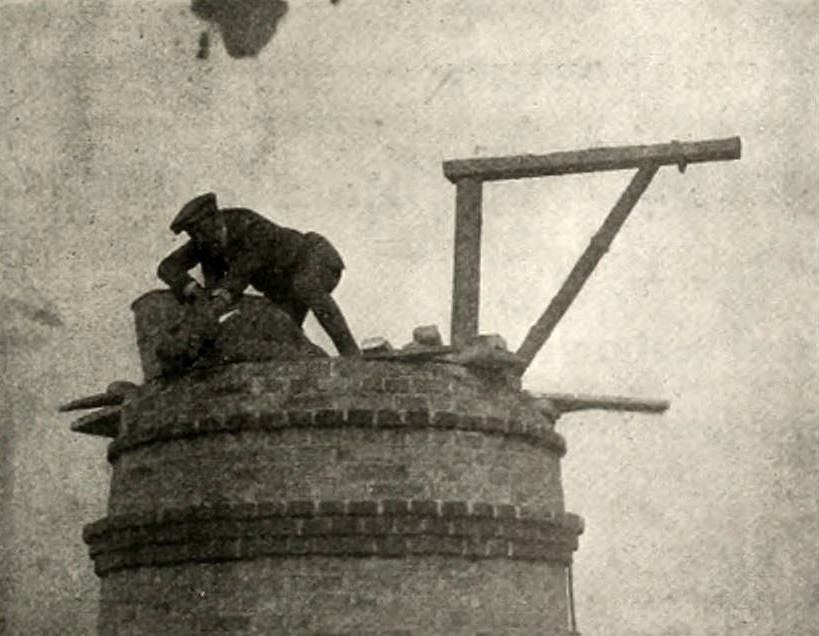
There is a moment—somewhere between the 200-foot mark and the vanishing point—when the chimney in Tween Heaven and Earth stops being brick and becomes theology. The camera, craning upward from the factory yard, turns the smokestack into a Gothic spire, its crown lost in photochemical haze; down below, the world is all iron, steam, and the rhythmic clang of capital. Up top, two men cling like damned souls to the lip of a bell-tower that tolls only doom. In 1913, German cinema had not yet acquired the vocabulary of vertigo Hitchcock would patent two decades later, yet this long-lost melodrama anticipates every rung of that anxiety ladder, rung by rung, until the viewer’s palms bleed on the armrest.
Heinrich Lautensack’s screenplay—adapted from a pulp novella that circulated in Berlin tram cars—takes the hoariest of triangles (father, daughter, suitor) and suspends it, literally, in thin air. The factory owner’s insomnia is no incidental malady; it is the industrial revolution dreaming its own nightmare, soot for pillow, chlorofom for lullaby. His daughter Eva, played by Eva Speyer with the lunar pallor of a Pre-Raphaelite postcard, drifts through frames like sleep-walking Ophelia, her costuming shifting from white muslin to soot-smudged overalls as the narrative descends from drawing-room flirtation to brick-lined abyss. Ernst Rückert, the real-life industrialist turned actor, embodies her father with the haggard gravitas of a man who has sold his circadian rhythm for quarterly dividends.
Enter Ralph Dennison—engineer, idealist, bearer of the kind of jawline that inspires lithographs in labor newspapers. The film’s central tension is less a love story than a contest of verticalities: who will ascend the social/professional chimney fastest? Briggs, the manager whose moustache curls like a satyr’s smile, has mastered the lateral politics of the yard; Ralph, the dreamer, aims for the sky. When Eva resists Briggs’s riverbank assault—one of the most startlingly frank sequences in pre-WWI European cinema—she triggers a vengeance that is part sexual reprisal, part class warfare. The ladder he sabotages is not merely scaffolding; it is the Enlightenment narrative itself, kicked out from under the meritocrat.
Visually, the picture is a study in gradients: the lower third bathes in umber shadows shot through with sodium flare from the furnaces; the middle registers dissolve into slate gray; the upper reaches bleach to a spectral white that feels positively antimatter. The restoration team at Deutsches Filminstitut scanned the 35mm nitrate at 4K, and the tonal separation now recalls the finest Stummfilm charcoal drawings—think The Student of Prague crossed with the sooty realism of Strike. Intertitles, once lost, have been reconstructed using the censor’s archive in Düsseldorf; they arrive in Gothic type that hammers like cold type on hot steel.
Yet the film’s masterstroke is its temporal tension. Time dilates once Ralph begins his ascent; intercut shots of Eva racing across the yard on foot, of workers frantically welding an interior stair that no longer exists, of the kid brother launching a kite whose string will become literal lifeline, create a fugue structure that makes the 78-minute runtime feel both endless and breathlessly compact. The Danish cinematographer Louis Larsen, fresh from Nordisk’s Vampyrdanserinden, mounts the camera on a purpose-built elevator inside the chimney, yielding a 360-degree pan that predates La Roue’s famous locomotive-wheel POV by eight years. When the pulley block plunges, we drop with it, the image spinning like Eadweard Muybridge’s most sadistic experiment.
Performances oscillate between operatic and proto-method. Speyer’s Eva never once looks at the lens, a rarity in 1913; her panic is registered in the tremor of a gloved finger on a boat oar, the sudden intake of breath when she spots the sabotaged ladder. Rückert père, meanwhile, delivers a monologue on insomnia that feels lifted from Nietzsche’s notebooks: “Sleep is the last commodity I cannot manufacture.” The line, delivered in a single close-up—unusual for an era that preferred mid-shots—becomes the film’s thesis: capitalism will commodify rest, then sell you the chloroform to endure its absence.
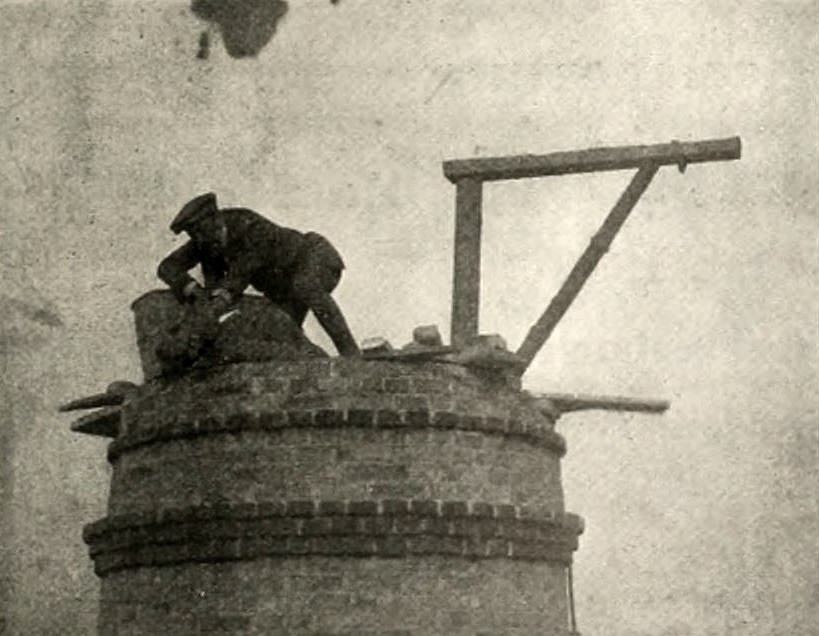
The finale, once dismissed as moralistic contrivance, now reads as proto-surrealist. Ralph’s use of the kite string transmutes the urban pastoral into absurdist rescue; the boy below, unaware that the toy now dangles a man’s life, could wander into any Magritte canvas. When Ralph empties Briggs’s revolver into the dawn sky, the muzzle flashes strobe against the smoke like a primitive stroboscope, a visual drumbeat that summons the fire brigade who haul him back to terra firma. Briggs, dead from chloroform overdose, swings upside-down in a composition that prefigures the hanged partisans in Ingeborg Holm—a grisly pendant to the film’s earlier class critique.
Historians will place Tween Heaven and Earth within the “chimney cycle” that includes The Great Circus Catastrophe and Saved in Mid-Air, yet its DNA splices something older—Victorian stage melodrama—with something embryonically modern: the vertical thriller, the architectural action film. Every skyscraper sequence in Lang’s Spione, every climax of Hitchcock’s Vertigo, every IMAX ascent owes a debt to this German smokestack.
Contemporary critics, when the picture premiered at the Marmorhaus in September 1913, praised its “nerve-shattering altitude” but sniffed at the love triangle as “kintopp kitsch.” Yet today the romantic through-line feels surprisingly progressive: Eva is no passive prize; her warning letter, smuggled past Briggs, engineers the narrative pivot. The final courtroom acquittal—rendered in a brisk montage of witness faces, gavel strikes, and celebratory confetti—lasts barely forty seconds, as if the film itself is impatient to return to the chimney, the true crucible of judgment.
Arrow Academy’s 2024 Blu-ray offers two scores: a percussive industrial suite by Ensemble Musikfabrik that clangs like anvils, and a more traditional piano accompaniment by Gabriel Thibaudeau that leans into late-Romantic chromaticism. I recommend alternating between them on repeat viewings; the clash of metallurgic rhythm and Lisztian lament replicates the film’s own dialectic between machinery and soul. The booklet essay by Stefan Drössler excavates production stills showing a stuntman dangling from a wire above the rooftops of Tempelhof—proof that the heights were no miniature.
Ultimately, Tween Heaven and Earth survives as both artifact and experience: a cracked window onto an era when cinema still tested the laws of gravity and morality in the same breath. Watch it at 2 a.m., windows open, city sirens weaving through the track score; you may find yourself counting rungs on every fire escape you pass, wondering which ones have been loosened by hands more malicious than fate.
“Between heaven and earth,” the German proverb goes, “hangs the heart.” This film knots that heart to a kite string, lets it ride the smoke, then reels it back—forever singed, forever soaring.
IMDb —
1919
Community
Log in to comment.