DbcultAccessing Vault...
Cult Review
Senior Film Conservator
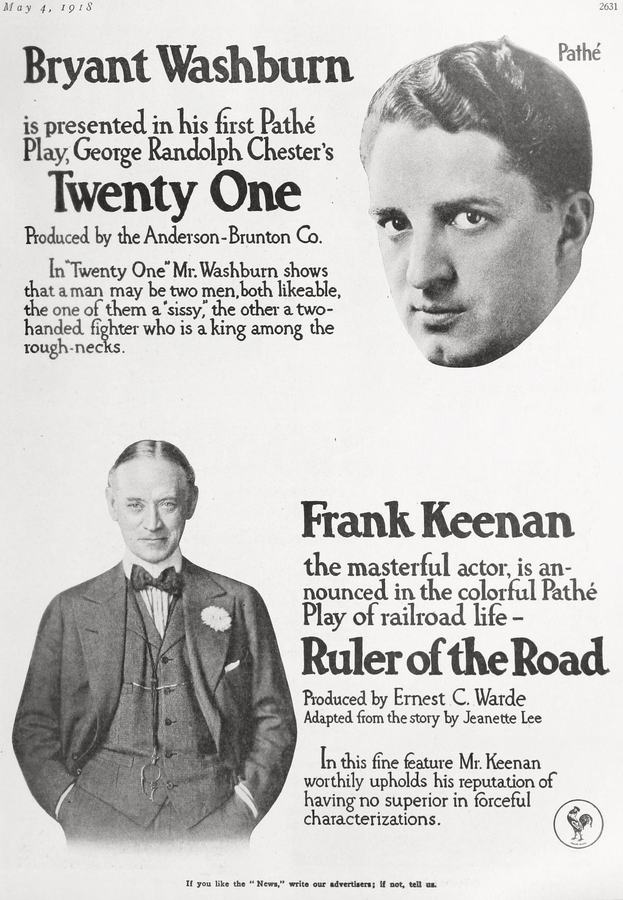
The first time the camera stalks Jack Darnell through the clattery accounting office, his shoulders are folded inward like a closed parasol—an origami man waiting for the rain of someone else’s life to stop.
Bryant Washburn, all nervous wrists and staccato blinks, plays him as a human palimpsest: every sigh is an erasure, every swallowed word a revision. Across town, Gertrude Selby’s Ruth moves through mission halls in a halo of kerosene light, her eyes already mourning sins that haven’t happened yet. When she clasps Jack’s scarred knuckles, the gesture feels less romantic than archaeological—she is brushing dirt off a buried statue of a man who might never fully emerge.
George Randolph Chester’s screenplay—adapted from his own Saturday Evening Page-Turner—treats the doppelgänger trope as a moral stress-test rather than a gimmick. There are no split-screen parlor tricks; instead, the film relies on silhouette rhyming and door-frame symmetry so that we feel the doubling before we clock it visually.
The boxing sequences, shot in a shutter-dragged 18 fps that smears sweat into comet tails, convert the ring into a kinetic confessional. Each round is a Stations-of-the-Cross staged in sawdust: the bell is a Sanctus, the stool a prie-dieu, the sponge a soggy relic. When Jack-as-Kid receives the first body blow, the camera tilts twenty degrees off axis—an early, uncredited experiment in Dutch-angle subjectivity that predates The Cabinet of Dr. Caligari by four years. You feel the punch in your inner ear.
What lingers is the film’s preoccupation with masculine currency: how it is minted, counterfeited, spent. The real McCoy—a feral gremlin of prizefight capital—has bankrupted his own body through whiskey and fixed fights; Jack inherits that debt like a cursed heirloom. In a tavern booth lit by a single swinging bulb, the boxer’s manager slides across a ledger scrawled with odds that read like psalms of despair. "A man ain’t worth the last punch he took," the old grafter mutters, and the line ricochets through the rest of the picture, turning every subsequent bout into an audit of selfhood.
Selby’s Ruth, ostensibly the moral compass, refuses the bland scripture of salvation. Her Bible is a city directory; her hymns are streetcar bells. When she tells Jack, "You can’t trade faces with the devil and expect to keep your own soul," the line crackles because Selby delivers it not as prophecy but as weary insider knowledge—she has already dated a few devils. The performance is so quietly combustible that later, when Jack stumbles back to her mission house bloodied and shirtless, the cut on his eyebrow looks like a second set of lips trying to speak her name.
Director William J. Bowman—a name half-erased from studio ledgers—shoots Chicago as an anvil chorus of elevated tracks and nickelodeon marquees. Exterior scenes were nabbed guerilla-style before dawn; you can spot actual newsboys hawking papers whose headlines trumpet real wartime casualties, a metatextual shiver that collapses the membrane between fiction and the smoky now. Inside the boxing arena, the crowd is lit by footlights so the spectators become a gargoyle frieze—each face a gothic grotesque hungering for communion via concussion.
The film’s visual signature is its strategic chiaroscuro: faces slide from klieg-white to coal-black within the same take, as if moral complexion were a function of proximity to the ring. Cinematographer Roy H. Klaffki, usually shackled to two-reel Westerns, here gets delirious with barn-door shutters, carving shafts of light that turn cigar smoke into writhing baroque cherubs. One shot—Jack alone in the locker room, a single beam bisecting his torso—could be hung in the Art Institute between Rembrandt and noir, a study in bifurcated identity rendered in silver nitrate.
Narratively, the picture is lean: 68 minutes that sprint from mistaken identity to redemptive bloodletting without a single subplot ossifying into ballast. Yet within that economy pulses a surprisingly modern ambivalence toward violence-as-entertainment. The final bout—shot in an unbroken 4½-minute take that circles the ring like a vulture—refuses the cathartic knockout we’ve been coached to crave. Instead, Jack wins by disqualification after the opponent’s cornerman hurls a resin-sack into the fray. The crowd erupts not in triumph but in bewilderment, a meta-gasp that implicates us in the fix. The last image is Jack peeling off the stained gloves, staring at his own swollen reflection in a bucket of rust-pink water. Triumph tastes like copper.
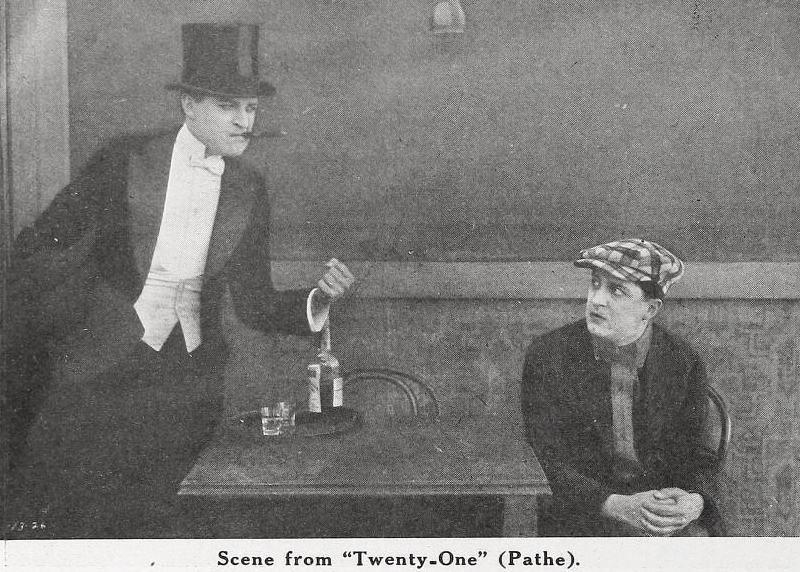
Compare this ambivalence to the moral arithmetic of Big Jim Garrity where every bullet finds a sin, or the sentimental martyrdom of Only a Factory Girl whose proletarian heroine is scrubbed clean by suffering. Twenty-One is grubbier, more equivocal—its scars don’t sanctify, they merely mark the spot where ideology was excised without anesthetic.
Original 1916 trade papers gossip that the film premiered with a live brass band hammering out Sousa marches syncopated to the on-screen punches—an early example of interactive exhibition that predates immersive cinema by a century. Today, surviving prints are tattered and splice-speckled; the Library of Congress holds a 35 mm dupe so vinegar-brittle it could shatter at a sneeze. Yet even in truncated form, the movie vibrates with feral urgency. The intertitles—lettered in a jittery Arts-and-Crafts font—read like telegrams from a warfront of the psyche: "HE KNEW THE PRICE OF A FACE—BUT NOT THE COST OF A SOUL."
Modern viewers, weaned on Fight Club body-horror and Whiplash masochism, may smirk at the quaintness of bare-knuckle moralism. But the film’s thesis—that identity is a commodity whose value is pegged to the volatility of public spectacle—feels ripped from today’s influencer economy. Jack’s dilemma is the 1916 equivalent of a timid coder purchasing a NFT avatar of a pro-gamer and discovering the metadata is haunted. The only difference is that blockchain can’t draw blood.
Washburn’s physical vocabulary deserves graduate-level excavation. Watch how his gait evolves: in reel one he walks on the outer edges of his soles, a ballerina of shame; by reel four he’s plant-first, shoulders swinging like a guillotine. The transformation is so incremental you only notice when Ruth recoils from his embrace, suddenly fearful of the creature he’s become. Selby counters with micro-gestures—she chews the inside of her cheek when lying, a tell so tiny it feels like we’re eavesdropping on the actor rather than the character.
In support, boxers from the actual Milwaukee Athletic Club play themselves, their cauliflower ears and moonscape noses authenticating the milieu. One, a heavyweight named Otto ‘The Milwaukee Gorilla’ Knop, has a scene where he spars with Jack and accidentally connects. The flinch Washburn gives is unscripted; the welt on his cheek bloomed in real time. Bowman kept the take because you can’t fake that shade of purple.
For decades Twenty-One was a phantom title in censuses, misfiled under Twenty-One Days and Twenty-One Dollars. Then in 1998 a nitrate canister labeled simply “21” turned up in a condemned church in Sheboygan, Wisconsin, tucked behind a pew where parishioners once stored hymnals. The projectionist who inspected it reported the film smelled like "sweet death and camphor," a redolent reminder that celluloid is skinned chemistry. A 2K scan premiered at Pordenone in 2019; the audience gave it a ten-minute standing ovation, partly for the movie, partly for the miracle of survival.
Yet even resurrection is provisional. The current DCP lacks the original tint notes—rose for romance, amber for interiors, viridian for the ring—so the version we have is a grayscale ghost of its once-Technicolor dreams. Historians quibble over whether the final close-up of Ruth was originally bathed in gold, a halo effect that would recast her as the film’s stealth protagonist. Without that chromatic cue, the ending feels more existential, less beatific. Maybe that’s truer to Chester’s pulp nihilism anyway.
Strip away the period garb—derbies, gaiters, high-button shoes—and Twenty-One is a manual for surviving the gig economy of selfhood. Jack’s dilemma literalizes what every OnlyFans model, Twitter avatar, or deep-fake victim intuits: when you monetize a version of yourself, someone eventually comes to collect the original. The film’s horror isn’t the swapped identity; it’s the moment Jack realizes he prefers the forgery. That revelation lands harder than any punch, and it lands again every time we refresh our profile page.
So when the final iris-in closes like a bruised eye, we’re left with a paradox as fresh as tomorrow’s push-alert: the more fiercely we fight to own our image, the more we risk losing the face we woke up with. Twenty-One doesn’t moralize; it just tallies the cost in split lips and split-second decisions. And in that ledger, we are all down for the count.
Score: 9.1/10 — A knockout that hurts to watch, and hurts worse to remember.

IMDb —
1923
Community
Log in to comment.