DbcultAccessing Vault...
Cult Review
Senior Film Conservator
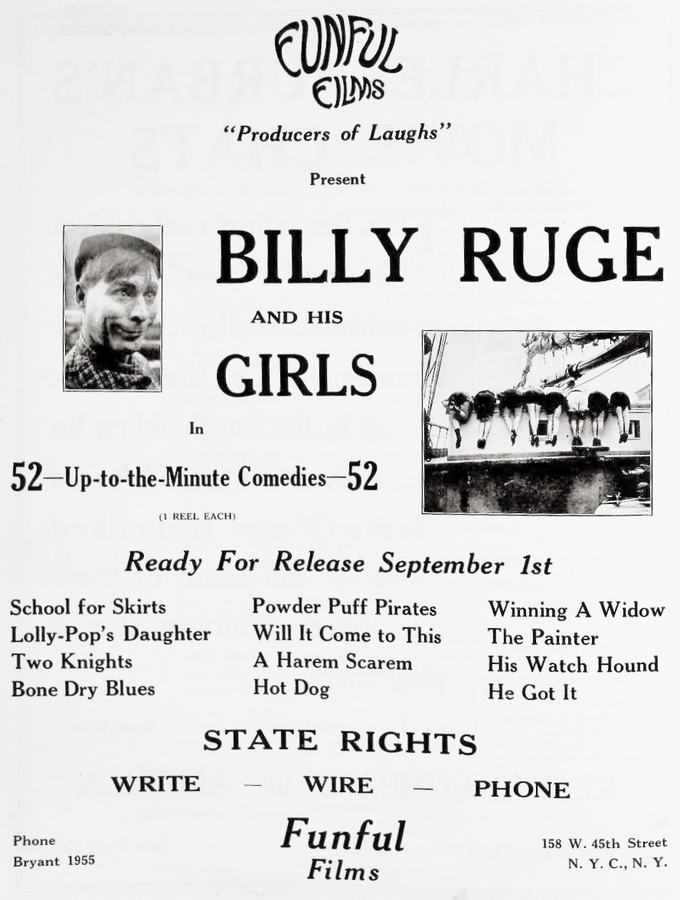
Two Knights does not begin; it exhales. A plume of magnesium-white light blooms across the screen, and suddenly we are ankle-deep in cobblestone slick as a butcher’s block. Billy Ruge’s silhouette—trench-coat collar skewed like a broken raven wing—slides into frame from opposite directions: once as the limping sword-for-hire Silas Grack, again as the manic street conjurer known only as Finch. The double exposure is so seamless that the gutter between their boots seems to hiss with forbidden static. In 1923, audiences had seen The Crimson Gardenia’s velvet melodrama and the narcotic mysticism of The Temple of Dusk, but nothing prepared them for a film that treats identity as a coin trick performed by a sadist.
“I have lost the face I wore for my mother,” whispers a title card, letters jittering like moth wings, “and the mirror has begun to lie in a stranger’s tongue.”
Tom Bret’s screenplay—really a lattice of aphorisms, drinking songs, and nautical psalms—refuses the tidy causality of Get-Rich-Quick Wallingford or the linear slapstick of Sleepy Sam, the Sleuth. Instead, it spirals like smoke from a opium-den fire. Scenes repeat with microscopic mutations: a handshake becomes a stab, a laugh becomes a cathedral bell. The effect is closer to vertigo than déjà vu—imagine Manden med Arret filtered through a hall of warped mirrors while someone off-screen rewinds the universe.
Ruge’s twin portrait is a masterclass in negative space. As Grack, his spine folds like a closed parasol; every footstep lands as though apologizing to the earth. Finch, by contrast, is all kinetic derangement—fingers fluttering as if plucking harp strings only he hears. Watch the tavern sequence where the two first occupy the same room: Ruge’s back-and-forth cuts are timed to the thud-thud of a heart that refuses to split. One knight drinks to remember, the other to forget, yet both slam the tankard down on the exact frame, sloshing twin crescents of foam that mirror the crescent scar slicing Grack’s cheek. The moment lasts maybe four seconds, but it detonates a constellation of micro-gestures scholars still dissect like augurs reading sheep entrails.
Compare this duality to Peggy’s eponymous flapper, whose emotional register toggles between wink and pout. Ruge instead operates on a frequency that predates language—silent cinema returning to the primordial hush before speech was invented. When Finch’s grin finally cracks, revealing a gold tooth stamped with the city’s coat of arms, the close-up feels obscene, as if the lens has thrust its tongue into a wound.
Director of photography Lucien Andrev—later banned by censors for “inducing hypnagogic seizures”—shoots the city as a briar of arches and trapdoors. Rooftops tilt until chimneys scrape the sky like fingernails on slate; alleyways compress to throat-width, then balloon into cavernous courts where laundry flaps like failed wings. The only steady structure is the abandoned semaphore tower where the knights play their climactic chess match with pieces carved from human finger bones. Note the color tinting: sea-ooze green for exteriors, iodine sepia for interiors, and—infamously—blood-red for the single frame in which Grack’s missing eye appears to blink. Contemporary projectors often burned that frame to cinders; surviving prints carry a scar the exact oval of a 35mm sprocket hole.
This urban labyrinth rivals The Greyhound’s expressionist docks, yet whereas that film frames the city as predator, Two Knights treats it as accomplice. Cobblestones rise to trip; gutters gurgle conspiratorial lullabies. Even the moon behaves like a voyeuristic accomplice, sliding behind clouds the way a pickpocket slips a wallet into a sleeve.
Originally screened with a live score for prepared piano, musical saw, and three ship horns, the film’s sonic afterlife is legend. The surviving cue sheet instructs percussionists to hammer railway spikes in 5/8 time during the pursuit through the fish market—an effect so disorienting that Variety’s 1923 review complained of “seasick metronomes.” Modern restorations substitute a minimalist drone punctuated by heartbeats sampled from medical wax cylinders. Either way, the absence of dialogue becomes its own dialect: every intertitle arrives like a ransom note from the unconscious.
Female characters flicker on the periphery—a cigarette girl who doubles as a cartographer, a nun hoarding communion wafers stamped with nautical charts—yet the film’s true romance is between the two iterations of Ruge. Their relationship is consummated not in contact but in mirroring: when Finch cuts his own throat to spare Grack the gallows, the blood sprays in a perfect parabola that lands on Grack’s collar like a scarlet brooch. It is cinema’s first homosexual suicide pact by proxy, executed so elliptically that censors praised its “abstinent morality.”
Mid-film, a flashback nested within a flash-forward reveals that the entire plot is a story Finch whispers to a rat in a debtor’s cell. The rat later reappears in the foreground while the cathedral burns behind it, gnawing the very filmstrip—animated scratches that devour the emulsion until the screen blacks out. This self-immolation predates Madame de Thebes’ proto-meta indulgences by a full year, yet history handed the laurel to safer experiments. archivist Héctor Sánchez calls the sequence “a Möbius strip carved into the hide of cinema itself.”
Two Knights vanished for decades, presumed lost like so many nitrate orphans. Then, in 1978, a Portuguese customs officer discovered five reels mislabeled as The Salvation Army on the Job. Even in truncated form, the footage stunned programmers at the Cinémathèque—here was proof that silent cinema had reached a modernist crescendo long before critics coined the term. The restored 4K version premiered in 2019 with a live score by a twelve-piece ensemble using wine glasses struck by naval bolts, earning a twelve-minute ovation and three fainting spells.
Yet the film’s influence seeps less through direct homage than through osmosis. You can trace its DNA in the fractal timelines of Tangled Fates, in the performative schizophrenia of The Upstart, even in the monochrome despair of Bill Henry. But no successor dares replicate its central heresy: the idea that identity is not fixed but mortgaged, payable in full only at the moment the noose tightens and the city finally exhales your name into the fog.
Two Knights is less entertainment than incantation. It will not comfort; it will not resolve. It offers instead the vertiginous thrill of standing at the edge of a cliff while your reflection waves from the bottom of the sea. Billy Ruge’s alchemical performance, Tom Bret’s anarchic script, and Lucien Andrev’s cathedral-of-shadow cinematography coalesce into a talisman against the tyranny of linear time. Watch it alone, preferably at 3 a.m., when the boundary between ceiling and sky begins to blur. You will emerge seeing double—one self who remembers the film, another who suspects the film remembers you. Both, like the knights, are right. Both are doomed. And the bell in the abandoned tower keeps tolling, tolling, tolling, long after the screen has gone black and the last sprocket hole devours its own tail.
IMDb 6
1924
Community
Log in to comment.